

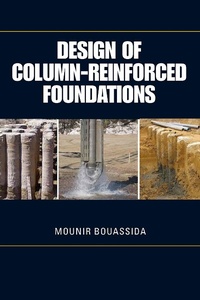
Design of Column-Reinforced Foundations
Published on 1. August 2016
229 pages
978-1-60427-772-2 (ISBN)
Description

The design of foundations on reinforced soil by columns is discussed within a general framework where several aspects are taken into consideration: modeling of reinforced soil, bearing capacity, settlement, acceleration of consolidation, and improvement of soil characteristics with selected case histories. Unlike existing books on unique improvement techniques (deep soil mixing, stone columns, sand compaction piles) that focus on installation and equipment issues, this one-of-a-kind, full-color guide details the design. It is an important work for all in the geotechnical field, including practitioners, academics, and students.
More details
Other editions
Additional editions
Mounir Bouassida
Design of Column-Reinforced Foundations
Book
08/2016
J Ross Publishing
€120.50
Shipment within 10-20 days
Person
Mounir Bouassida is a professor of civil engineering at the Ecole Nationale d'Ingénieurs de Tunis (ENIT) of the Université de Tunis¿El Manar where he earned his B.S., M.S., Ph.D., and doctorate of sciences diplomas, all in civil engineering. He currently teaches soil mechanics and limit analysis courses at ENIT and the Polytechnic School of Tunisia. He is the director of the Research Laboratory in Geotechnical Engineering and has supervised 13 Ph.D. and 29 master of science graduates. His research focuses on soil improvement techniques and behaviour of soft clays.Dr. Bouassida is the co-author of 42 papers in refereed international journals; 126 papers, including 17 keynote lectures from international conferences; and a book related to testing in soil mechanics. He is a member of the editorial committees of the journal Ground Improvement (ICE), the Journal of Geotechnical and Geological Engineering, Infrastructure Innovative Solutions (Springer), and International Journal of Geomechanics (ASCE). He is also an active reviewer in several international journals, including the Journal of Geotechnical and Geoenvironmental Engineering and the Canadian Geotechnical Journal.As a 2006 Fulbright scholar, Professor Bouassida created a novel methodology for the design of foundations on reinforced soil by columns. He was awarded the 2006 S. Prakash Prize for Excellence in the practice of geotechnical engineering. In 2008, Bouassida launched a Tunisian consulting office in geotechnical engineering, SIMPRO. He is a co-developer of the software Columns 1.01 used for designing column-reinforced foundations. Prof. Bouassida held the office of the vice president of ISSMGE for Africa (2005-2009). He benefited from several grants as a visiting professor in the USA (CSUS and MIT), France (ENPC, Paris, Ecole Centrale de Lille, and Ecole des Mines Douai), Belgium (Catholic University of Louvain-La Neuve), and Australia (University of Newcastle).
Content
- Front Cover
- Title Page
- Copyright
- Contents
- Foreword
- Preface
- Dedication
- About the Author
- Chapter 1: An Introduction to Column-reinforced Foundations
- Abstract
- 1.1 Ground Improvement Techniques
- 1.2 Reinforcement by Columns
- 1.3 Modeling of Column-reinforced Foundations
- 1.3.1 Isolated Column and Trench Models
- 1.3.2 Unit Cell Model
- 1.3.3 Group of Columns Model
- 1.4 Installation of Columns
- 1.4.1 Sand Compaction Piles
- 1.4.2 Stone Columns and Vibro-compaction
- 1.4.3 Deep Mixing Method for Lime-Cement Columns
- 1.5 Conclusion
- References
- Chapter 2: Predicting the Ultimate Bearing Capacity of Column-reinforced Foundations
- Abstract
- 2.1 Introduction
- 2.2 Design Methods for Isolated Column and Trench Models
- 2.2.1 Prior Contributions
- 2.2.1.1 Use of the States of Stresses
- 2.2.1.2 Approaches Based on Failure Mechanisms and States of Stresses
- 2.2.1.3 Approaches Based on Failure Mechanisms
- 2.2.1.4 Floating Columns
- 2.2.2 Bearing Capacity of an Isolated Column and Soil Reinforced by a Trench in Limit Analysis Framework
- 2.2.2.1 Identification of Minimum Characteristics of Reinforcing Material
- 2.2.2.2 Quasi-Exact Bearing Capacity of Soil Reinforced by a Trench
- 2.2.2.3 Loading Tests: Validation and Calibration of Models
- 2.3 Ultimate Bearing Capacity of Column-reinforced Foundation by the Unit Cell Model
- 2.3.1 Previous Contributions-In Brief
- 2.3.2 Equivalent and Homogenized Characteristics of Reinforced Soil
- 2.3.3 Assessment of Predicted Characteristics with Experimental Data
- 2.4 Ultimate Bearing Capacity of Column-reinforced Foundation by the Group of Columns Model
- 2.4.1 Direct Approaches of Limit Analysis
- 2.4.2 Floating Columns
- 2.4.3 Homogenization Method
- 2.5 Conclusion
- References
- Chapter 3: Settlement Predictions of Foundations on Reinforced Soil by Columns
- Abstract
- 3.1 Introduction
- 3.2 Classification of Methods for the Prediction of Settlement of Reinforced Soil by Columns
- 3.3 Empirical and Semi-empirical Methods
- 3.3.1 Greenwood's Chart
- 3.3.2 Priebe's Method
- 3.4 Settlement Prediction by the Unit Cell Model
- 3.4.1 Methods Adopting Linear Elastic Behavior
- 3.4.2 Methods Adopting Elastoplastic Behavior
- 3.5 Settlement Predictions by the Group of Columns Model
- 3.5.1 Variational Stress Approach in Linear Elasticity
- 3.5.2 Rectangular Raft on Column Reinforced Foundation
- 3.5.3 Some Comments
- 3.5.4 Homogenization Approach
- 3.6 Assessment of Settlement Predictions by Scaled and Full-scale Models
- 3.6.1 Oil Storage Tank
- 3.6.2 Storage Facility of Protected Bullets in Mounded Banks in Tunisia
- 3.7 Conclusions
- Appendix 3.1 Variational Approach in Linear Elasticity
- References
- Chapter 4: Novel Methodology for Design of Column-reinforced Foundations
- Abstract
- 4.1 Introduction
- 4.2 Problem Statement
- 4.3 Bearing Capacity of CRF
- 4.3.1 Case of Stone Columns
- 4.3.2 Case of Deep Mixing Columns
- 4.4 Settlement of Column-reinforced Foundations
- 4.4.1 Settlement of End-Bearing Columns
- 4.4.2 Settlement of Floating Columns
- 4.4.3 Acceleration of Consolidation
- 4.5 Illustrative Case Histories
- 4.5.1 Oil Tank on End-Bearing Sand Compaction Column Foundation (Tunisia)
- 4.5.2 Embankment on Soft Clay Reinforced by Floating Columns
- 4.5.3 Trial Embankment in Saga, Japan
- 4.6 Conclusions
- Appendix 4.1
- References
- Chapter 5: The Behavior of Improved Soft Clay by Stone Column Installation
- Abstract
- 5.1 Introduction
- 5.2 Stone Column Installation in Soft Clay
- 5.3 Simulation of Stone Column Installation in Soft Soils
- 5.3.1 Numerical Simulations Using the Unit Cell Model
- 5.3.1.1 Numerical Predictions by the Mohr Coulomb Model
- 5.3.1.2 Numerical Predictions by the Hardening Soil Model
- 5.3.2 Numerical Simulations Using the Group of Columns Model
- 5.3.2.1 Processed Numerical Predictions
- 5.3.2.2 Parametric Study for Varied Spacing Between Columns
- 5.3.3 Experimental Simulation of Stone Column Installation in Soft Clay
- 5.3.3.1 Preparation of Clay Specimen
- 5.3.3.2 Expansion of Cylindrical Cavity
- 5.3.3.3 Triaxial Tests
- 5.3.3.4 Influence of Cavity Expansion Ratio
- 5.4 Acceleration of Settlement in Post-final Loading
- 5.4.1 Equations of Linear Poroelastic Behavior
- 5.4.2 Statement of the Auxiliary Problem
- 5.4.3 Solution of the Poroelastic Problem
- 5.4.4 Settlement Prediction for a Given Loading History
- 5.5 Conclusions
- Appendix 5.1 Behavior of Normally Consolidated Soft Clays
- Appendix 5.2 Details of the Poroelastic Model
- References
- Chapter 6: Behavior of Foundations on Soils Reinforced by Columns
- Abstract
- 6.1 Introduction
- 6.2 Study of Reinforced Soil Behavior: Selected Case Histories
- 6.2.1 Foundations on Compressible Clays Reinforced by End-bearing Columns
- 6.2.1.1 Oil Storage Tank at Zarzis (Tunisia)
- 6.2.1.2 Oil Storage Tank at La Goulette (Tunisia)
- 6.2.2 Comparison Between Numerical Predictions in Plane Strain and Axisymmetric Analyses
- 6.2.2.1 Predictions by the HSM (Plane Strain Condition)
- 6.2.2.2 Predictions by the HSM (Axisymmetric Condition)
- 6.2.3 Embankment on Compressible Soil Reinforced by Floating Stone Columns: Ghannouche Case History (Tunisia)
- 6.2.3.1 Prediction of the Settlement of Unreinforced Soil (Plaxis Code)
- 6.2.3.2 Numerical Simulation of the Behavior of a Storage Facility on Reinforced Soil
- 6.2.3.3 Numerical Predictions Using the Group of Trenches Model
- 6.2.4 Comparison Between Predictions by the Plane Strain and Axisymmetric Model of Reinforced Soil
- 6.3 Conclusions
- Forthcoming Developments
- References
