

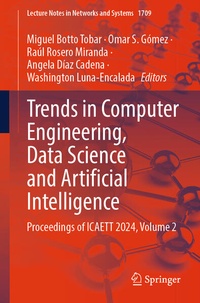
Trends in Computer Engineering, Data Science and Artificial Intelligence
Description

This book constitutes the proceedings of the 6th International Conference on Advances in Emerging Trends and Technologies (ICAETT 2024), held in Riobamba, Ecuador, on 17-18 October 2024, proudly organized by Facultad de Informática y Electrónica (FIE) at Escuela Superior Politécnica de Chimborazo and supported by GDEON. ICAETT 2024 brings together top researchers and practitioners working in different domains of computer science to share their expertise and to discuss future developments and potential collaborations. Presenting high-quality, peer-reviewed papers, the book discusses the following topics:
Artificial Intelligence
Business Intelligence
Cloud Computing
Computer Vision
e-Learning
Internet of Things
Security
Software Engineering and Quality
More details
Other editions
Additional editions
Persons
Miguel Botto-Tobar is a Professor at the University of Guayaquil, Ecuador, and Ph.D. in Computer Science at Eindhoven University of Technology (TU/e), The Netherlands. He serves as Editor-in-Chief of the University's scientific journals. He has authored over 30 indexed publications and edited several Springer volumes. His research interests include Software Engineering, Empirical Software Engineering, and the social aspects of software development.
Omar S. Gómez is a lecturer and researcher at the Escuela Superior Politécnica de Chimborazo (ESPOCH), where he leads the GRIISOFT research group. His work focuses on software engineering, experimental methods, and computing education, with multiple international publications.
Raúl Hernán Rosero Miranda (Raúl H. Rosero) is a computer scientist and educator with experience in software engineering and informatics, dedicated to advancing computing education and research in Ecuador. He is currently Emeritus Lecturer at the Escuela Superior Politécnica de Chimborazo (ESPOCH).
Angela Díaz-Cadena holds a Master's degree in Creation and Management of Innovative Enterprises from the University of Guayaquil and is currently pursuing a Ph.D. in Business Administration at Universidad Católica Argentina (UCA). Her research focuses on innovative enterprises, particularly their management models, growth strategies, and market impact.
Washington Luna Encalada, PhD, is a professor and researcher with more than 25 years of experience in higher education. He holds a PhD in Systems and Computer Engineering and has led international accreditation processes and digital transformation projects at ESPOCH, where he currently serves as Dean of the Faculty of Computer Science and Electronics. Author of books and scientific articles, he combines academic management with technological innovation. He is registered as an Education Researcher - Engineering Educator, strengthening his contribution to academic quality and university excellence.
Content
1. Artificial Intelligence.- 2. Business Intelligence.- 3. Cloud Computing.- 4. Computer Vision.- 5. e-Learning.- 6. Internet of Things.- 7. Security.- 8. Software Engineering and Quality.
