

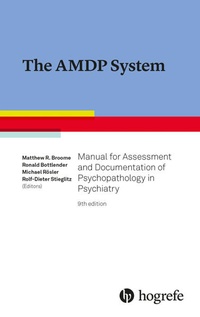
The AMDP System
Manual for Assessment and Documentation of Psychopathology in Psychiatry
9th Edition
Published on 9. October 2017
IV, 204 pages
978-1-61676-542-2 (ISBN)
Description

The 9th edition of this valuable tool for assessing and documenting psychopathology, now in English!
Now in its 9th edition, the AMDP System is a widely used tool for documenting psychiatric symptoms in clinical and research projects. It is not only an essential part of many internal clinical documentation systems, but it is also a valuable instrument for training the identification of psychopathological symptoms.
This new edition, now in English, involved the complete revision of the psychopathological and somatic symptoms, with particular attention to the elimination of ambiguities and inconsistencies, to the precision of definitions, to the exact differentiation of the self and other ratings, as well as to the user friendliness of the system. Taking account of developments in recent years in the description and rating of psychopathological symptoms, this latest edition of the AMDP System has been extended by an additional eleven psychopathological and three somatic symptoms and a new section on syndrome formation in the appendix.
This clearly structured manual enables the standardized application of the system, making it an invaluable tool in the training of medicine and psychology students and an essential reference volume in the psychiatric field.
More details
Edition
9th edition 2018
Language
English
Place of publication
Cambridge
United States
Target group
Professional and scholarly
For psychiatrists, clinical psychologists, other mental health professionals.
Edition type
Revised edition
File size
2,01 MB
ISBN-13
978-1-61676-542-2 (9781616765422)
DOI
10.1027/00542-000
Schweitzer Classification
Other editions
Additional editions
Ronald Bottlender | Michael Rösler | Rolf-Dieter Stieglitz
The AMDP System
Manual for Assessment and Documentation of Psychopathology in Psychiatry
Book
10/2017
9th Edition
Hogrefe Publishing
€27.95
Available immediately
Matthew R. Broome | Ronald Bottlender | Michael Rösler
The AMDP System
Manual for Assessment and Documentation of Psychopathology in Psychiatry
E-Book
10/2017
9th Edition
Hogrefe Publishing
€24.99
Available for download
Persons
Matthew R. Broome, PhD, MRCPsych, is Professor of Psychiatry and Youth Mental Health and Director at the Institute for Mental Health, University of Birmingham, UK; Senior Clinical Research Fellow, Department of Psychiatry and Faculty of Philosophy, University of Oxford, UK. Matthew is a founding member of the Maudsley Philosophy Group.
Ronald Bottlender, MD, PhD, is the Clinical Director, Department of Psychiatry and Psychotherapy, Maerkische Kliniken, Luedenscheid, Germany, assistant professor, University of Bochum and lecturer, University of Bonn, Germany. He has published more than 100 peer reviewed articles on psychosis, affective disorders, amongst others.
Michael Roesler, MD, PhD, is the Head of the Institute of forensic Psychiatry, Homburg/Saarland, Germany, and Emeritus Professor at the University of the Saarland, Germany. During the last decades he has been engaged in adult ADHD research.
He is the current Chair of the Association of Methodology and Documentation in Psychiatry (AMDP).
Rolf-Dieter Stieglitz, PhD, is Professor of Clinical Psychology and Psychiatry and the Head of the Department of Clinical Psychology and Psychiatry, University of Basel, Switzerland. He has published more than 600 papers and books, especially in the field of psychopathology and clinical assessment. He was previously the Chair of the AMDP 2006-2012.
Ronald Bottlender, MD, PhD, is the Clinical Director, Department of Psychiatry and Psychotherapy, Maerkische Kliniken, Luedenscheid, Germany, assistant professor, University of Bochum and lecturer, University of Bonn, Germany. He has published more than 100 peer reviewed articles on psychosis, affective disorders, amongst others.
Michael Roesler, MD, PhD, is the Head of the Institute of forensic Psychiatry, Homburg/Saarland, Germany, and Emeritus Professor at the University of the Saarland, Germany. During the last decades he has been engaged in adult ADHD research.
He is the current Chair of the Association of Methodology and Documentation in Psychiatry (AMDP).
Rolf-Dieter Stieglitz, PhD, is Professor of Clinical Psychology and Psychiatry and the Head of the Department of Clinical Psychology and Psychiatry, University of Basel, Switzerland. He has published more than 600 papers and books, especially in the field of psychopathology and clinical assessment. He was previously the Chair of the AMDP 2006-2012.
Content
Preface
Preface to the Ninth German Edition
Introduction
AMP Founding Members
AMP/AMDP System Chair
AMDP Registered Association Chair
AMDP Revision Group (9th edition)
1 Introduction
1.1 Overall Structure of the AMDP System
1.2 Representation of Individual Symptoms in the Manual
1.3 Requirements for Use
1.3.1 General Requirements for Use
1.3.2 AMDP Training Seminars
1.4 Recording Basics
1.4.1 General Considerations
1.4.2 Assessment Basics
1.4.3 Time Frame of Assessment Period
1.4.4 Documentation
1.5 The Formal Logic of the Decision-Making Process
1.5.1 Evaluation Level 1: Accessibility and Nonaccessibility
1.5.2 Evaluation Level 2: Degree of Certainty Over Presence or
Absence of a Symptom
1.5.3 Evaluation Level 3: Presence
1.5.4 Evaluation Level 4: Degree of Severity
1.6 Data Processing
1.7 The AMDP Personal History
2. Psychopathological Findings
2.1 Preliminary Notes
2.2 Disorders of Consciousness
2.3 Disturbances of Orientation
2.4 Disturbances of Attention and Memory
2.5 Formal Thought Disorder
2.6 Worries and Compulsions
2.7 Delusions
2.8 Disorders of Perception
2.9 Ego (Boundary) Disturbances
2.10 Disturbances of Affect
2.11 Disturbances of Drive and Psychomotor Activity
2.12 Circadian Disturbances
2.13 Other Disturbances
2.14 Additional Psychopathological Items (ZP1-ZP11)
3 Somatic Findings
3.1 Disturbances of Sleep and Vigilance
3.2 Appetitive Disturbances
3.3 Gastrointestinal Disturbances
3.4 Cardiac-Respiratory Disturbances
3.5 Other Autonomic Disturbances
3.6 Other Somatic Disturbances
3.7 Neurological Disturbances
3.8 Additional Somatic Items (ZS1-ZS3)
Literature
Appendices
Appendix A: Documentation Form
Appendix B: English, German, and French Labels of the AMDP
Symptoms
Appendix C: AMDP Syndromes
Index
Preface to the Ninth German Edition
Introduction
AMP Founding Members
AMP/AMDP System Chair
AMDP Registered Association Chair
AMDP Revision Group (9th edition)
1 Introduction
1.1 Overall Structure of the AMDP System
1.2 Representation of Individual Symptoms in the Manual
1.3 Requirements for Use
1.3.1 General Requirements for Use
1.3.2 AMDP Training Seminars
1.4 Recording Basics
1.4.1 General Considerations
1.4.2 Assessment Basics
1.4.3 Time Frame of Assessment Period
1.4.4 Documentation
1.5 The Formal Logic of the Decision-Making Process
1.5.1 Evaluation Level 1: Accessibility and Nonaccessibility
1.5.2 Evaluation Level 2: Degree of Certainty Over Presence or
Absence of a Symptom
1.5.3 Evaluation Level 3: Presence
1.5.4 Evaluation Level 4: Degree of Severity
1.6 Data Processing
1.7 The AMDP Personal History
2. Psychopathological Findings
2.1 Preliminary Notes
2.2 Disorders of Consciousness
2.3 Disturbances of Orientation
2.4 Disturbances of Attention and Memory
2.5 Formal Thought Disorder
2.6 Worries and Compulsions
2.7 Delusions
2.8 Disorders of Perception
2.9 Ego (Boundary) Disturbances
2.10 Disturbances of Affect
2.11 Disturbances of Drive and Psychomotor Activity
2.12 Circadian Disturbances
2.13 Other Disturbances
2.14 Additional Psychopathological Items (ZP1-ZP11)
3 Somatic Findings
3.1 Disturbances of Sleep and Vigilance
3.2 Appetitive Disturbances
3.3 Gastrointestinal Disturbances
3.4 Cardiac-Respiratory Disturbances
3.5 Other Autonomic Disturbances
3.6 Other Somatic Disturbances
3.7 Neurological Disturbances
3.8 Additional Somatic Items (ZS1-ZS3)
Literature
Appendices
Appendix A: Documentation Form
Appendix B: English, German, and French Labels of the AMDP
Symptoms
Appendix C: AMDP Syndromes
Index
