

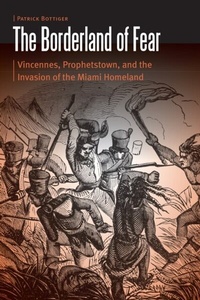
The Borderland of Fear
Vincennes, Prophetstown, and the Invasion of the Miami Homeland
1st Edition
Published on 1. November 2016
328 pages
978-0-8032-9092-1 (ISBN)
Description

Published through the Early American Places initiative, supported by the Andrew W. Mellon Foundation.
The Ohio River Valley was a place of violence in the nineteenth century, something witnessed on multiple stages ranging from local conflicts between indigenous and Euro-American communities to the Battle of Tippecanoe and the War of 1812. To describe these events as simply the result of American expansion versus Indigenous nativism disregards the complexities of the people and their motivations. Patrick Bottiger explores the diversity between and among the communities that were the source of this violence.
As new settlers invaded their land, the Shawnee brothers Tenskwatawa and Tecumseh pushed for a unified Indigenous front. However, the multiethnic Miamis, Kickapoos, Potawatomis, and Delawares, who also lived in the region, favored local interests over a single tribal entity. The Miami-French trade and political network was extensive, and the Miamis staunchly defended their hegemony in the region from challenges by other Native groups. Additionally, William Henry Harrison, governor of the Indiana Territory, lobbied for the introduction of slavery in the territory. In its own turn, this move sparked heated arguments in newspapers and on the street. Harrisonians deflected criticism by blaming tensions on indigenous groups and then claiming that antislavery settlers were Indian allies.
Bottiger demonstrates that violence, rather than being imposed on the region's inhabitants by outside forces, instead stemmed from the factionalism that was already present. The Borderland of Fear explores how these conflicts were not between nations and races but rather between cultures and factions.
The Ohio River Valley was a place of violence in the nineteenth century, something witnessed on multiple stages ranging from local conflicts between indigenous and Euro-American communities to the Battle of Tippecanoe and the War of 1812. To describe these events as simply the result of American expansion versus Indigenous nativism disregards the complexities of the people and their motivations. Patrick Bottiger explores the diversity between and among the communities that were the source of this violence.
As new settlers invaded their land, the Shawnee brothers Tenskwatawa and Tecumseh pushed for a unified Indigenous front. However, the multiethnic Miamis, Kickapoos, Potawatomis, and Delawares, who also lived in the region, favored local interests over a single tribal entity. The Miami-French trade and political network was extensive, and the Miamis staunchly defended their hegemony in the region from challenges by other Native groups. Additionally, William Henry Harrison, governor of the Indiana Territory, lobbied for the introduction of slavery in the territory. In its own turn, this move sparked heated arguments in newspapers and on the street. Harrisonians deflected criticism by blaming tensions on indigenous groups and then claiming that antislavery settlers were Indian allies.
Bottiger demonstrates that violence, rather than being imposed on the region's inhabitants by outside forces, instead stemmed from the factionalism that was already present. The Borderland of Fear explores how these conflicts were not between nations and races but rather between cultures and factions.
Reviews / Votes
"Bottiger has produced a deeply researched and careful volume, one that represents the best job yet of examining the sources for Tippecanoe."-American Historical Review "This book is a welcome addition to the historiography and contributes a valuable analysis to what some might see as familiar territory."-John P. Bowes, Journal of American History "The Borderland of Fear offers a well-written, thought-provoking meditation on the complexity of Indian-White relations on the early frontier."-Robert M. Owens, Tribal College Journal of American Indian Higher Education "Much of what we know about Prophetstown, Patrick Bottiger tells us in this provocative and fascinating new book, is a lie. But lies reveal as well as conceal, and in his hands the world of the Miami borderlands, which the lies both divulge and helped create, is far more compelling than the clashing Indian and American nationalisms that the older stories tell about Tippecanoe."-Richard White, Margaret Byrne Professor of American History at Stanford University and past president of the Organization of American HistoriansMore details
Series
Language
English
Place of publication
Lincoln
United States
Target group
Professional and scholarly
Illustrations
3 figures, 3 maps, 2 tables
File size
6,17 MB
ISBN-13
978-0-8032-9092-1 (9780803290921)
Copyright in bibliographic data and cover images is held by Nielsen Book Services Limited or by the publishers or by their respective licensors: all rights reserved.
Schweitzer Classification
Other editions
Additional editions
Patrick Bottiger
The Borderland of Fear
Vincennes, Prophetstown, and the Invasion of the Miami Homeland
Book
11/2016
University of Nebraska Press
€48.50
Shipment within 10-20 days
Person
Patrick Bottiger is an assistant professor of history at Kenyon College.
Content
List of IllustrationsPrefaceIntroduction1. Facing East from Miami Country2. The National Trinity3. Prophetstown for Their Own Purposes4. Vincennes, the Politics of Slavery, and the Indian "Threat"5. The Battles of TippecanoeConclusionNotesBibliographyIndex
