

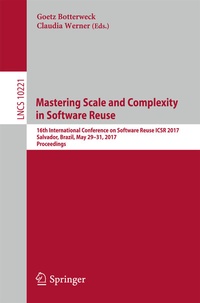
Mastering Scale and Complexity in Software Reuse
16th International Conference on Software Reuse, ICSR 2017, Salvador, Brazil, May 29-31, 2017, Proceedings
Published on 8. May 2017
XV, 225 pages
978-3-319-56856-0 (ISBN)
Description

This book constitutes the refereed proceedings of the 16th International Conference on Software Reuse, ICSR 2017, held in Salvador, Brazil, in May 2017.
The 8 revised full papers presented together with 3 short papers and 2 keynote presentations were carefully reviewed and selected from 34 submissions. The papers are grouped in topical sections on documentation reuse and repositories; software product lines; variability management and model variants; verification and refactoring for reuse; tools demonstrations; doctorial symposium; tutorials; and workshop.
More details
Series
Edition
1st ed. 2017
Language
English
Place of publication
Cham
Switzerland
Publishing group
Springer International Publishing
Product notice
Reflowable
Illustrations
XV, 225 p. 67 illus.
File size
24,78 MB
ISBN-13
978-3-319-56856-0 (9783319568560)
DOI
10.1007/978-3-319-56856-0
Schweitzer Classification
Other editions
Additional editions
Goetz Botterweck | Claudia Werner
Mastering Scale and Complexity in Software Reuse
16th International Conference on Software Reuse, ICSR 2017, Salvador, Brazil, May 29-31, 2017, Proceedings
Book
04/2017
Springer
€53.49
Shipment within 10-15 days
Content
- Intro
- Foreword
- Organization
- Keynote Abstracts
- Alice in Dataland: Reuse for Data Science in Software Teams
- Software Transplantation for Reuse
- Contents
- Documentation Reuse and Repositories
- DevRec: A Developer Recommendation System for Open Source Repositories
- 1 Introduction
- 2 Related Work
- 3 Recommendation Approach
- 3.1 Overview of Recommendation System
- 3.2 Developer Recommendation Based on Social Coding Activities
- 3.3 Developer Recommendation Based on Knowledge Sharing Activities
- 3.4 Hybrid Approach for Developer Recommendation
- 4 Experiment
- 4.1 Research Questions
- 4.2 Experiment Datasets
- 4.3 Evaluation Metrics
- 5 Experiment Results
- 5.1 Influence of Different Activities Towards Different Projects
- 5.2 Influence of Different Coefficient Values in Hybrid Approach
- References
- Documentation Reuse: Hot or Not? An Empirical Study
- 1 Introduction
- 2 Experimental Setup
- 2.1 Corpus
- 2.2 Documentation Duplication Detector
- 3 Research Question 1
- 3.1 Frequency of Duplications
- 3.2 Copy-Pastes Vs. Coincidental Duplications
- 3.3 Threats to Validity
- 4 Research Question 2
- 4.1 Causes of Documentation Copy-Pasting
- 4.2 Existing Documentation Tools
- 4.3 Documentation Reuse Revisited
- 5 Related Work
- 6 Conclusion
- References
- Software Product Lines
- A Preliminary Assessment of Variability Implementation Mechanisms in Service-Oriented Computing
- 1 Introduction
- 2 Variability Implementation Mechanisms
- 2.1 Conditional Compilation
- 2.2 Aspect-Oriented Programming
- 2.3 Open Services Gateway Initiative
- 3 The Measurement Framework
- 3.1 Complexity Metrics
- 3.2 Stability Metrics
- 3.3 Modularity Metrics
- 4 First Case Study - Warehouse
- 4.1 Hypotheses
- 4.2 Case Study Execution
- 4.3 Results
- 4.4 Descriptive and Exploratory Analysis
- 4.5 Threats to Validity
- 5 Second Case Study - RiSEEvents
- 5.1 Case Study Execution
- 5.2 Results and Findings
- 5.3 Threats to Validity
- 6 Comparative Analysis
- 7 Decision Model
- 8 Related Work
- 9 Concluding Remarks
- References
- No Code Anomaly is an Island
- Abstract
- 1 Introduction
- 2 Background
- 2.1 Feature-Oriented Software Product Lines
- 2.2 Sources of Instability in SPL
- 3 Code Anomalies and Agglomerations in SPL
- 3.1 Agglomerating Code Anomalies
- 3.2 Feature Agglomeration
- 3.3 Feature Hierarchy Agglomeration
- 3.4 Component Agglomeration
- 4 Study Settings
- 4.1 Goal and Research Questions
- 4.2 Target SPLs
- 4.3 Data Collection and Analysis Protocols
- 5 Results and Analysis
- 5.1 Non-agglomerated Code Anomalies
- 5.2 Agglomerated Code Anomalies
- 6 Related Work
- 7 Threats to Validity
- 8 Conclusion and Future Work
- Acknowledgments
- References
- ReMINDER: An Approach to Modeling Non-Functional Properties in Dynamic Software Product Lines
- 1 Introduction
- 2 ReMINDER: An AppRoach to Modeling Non-FunctIoNal Properties in DSPL
- 2.1 Phase I - Identification and Representation of NFPs in Feature Models
- 2.2 Phase II - Identification of Constraint and Context Adaptation Scenarios
- 3 Empirical Evaluation
- 3.1 Execution
- 3.2 Results and Findings
- 3.3 Threats to Validity
- 4 Related Work
- 5 Conclusion and Future Work
- References
- Variability Management and Model Variants
- Clustering Variation Points in MATLAB/Simulink Models Using Reverse Signal Propagation Analysis
- 1 Introduction
- 2 Background
- 2.1 MATLAB/Simulink Models
- 2.2 Variability in Models
- 2.3 Signal Propagation in Models
- 2.4 The Simulink Identifier
- 3 Reverse Signal Propagation Analysis
- 3.1 Preparatory Work
- 3.2 Signal Set Generation
- 3.3 Comparison and Preliminary Clustering
- 3.4 Cluster Optimization
- 4 Evaluation
- 4.1 Analyzed Models
- 4.2 Methodology
- 4.3 Results and Interpretation
- 5 Related Work
- 6 Conclusion and Future Work
- References
- Discovering Software Architectures with Search-Based Merge of UML Model Variants
- 1 Introduction
- 2 Proposed Approach
- 2.1 Representation
- 2.2 Fitness Function
- 2.3 Genetic Operators
- 3 Evaluation
- 3.1 Implementation Aspects and Experimental Setup
- 3.2 Case Studies
- 3.3 Results and Analysis
- 3.4 Threats to Validity
- 4 Related Work
- 5 Conclusions
- References
- Tracing Imperfectly Modular Variability in Software Product Line Implementation
- 1 Introduction
- 2 Motivations
- 3 A Three Step Traceability Approach
- 3.1 Capturing the Variability of Core-Code Assets (Step 172)
- 3.2 Modeling the Implemented Variability (Step 173)
- 3.3 Establishing the Trace Links (Step 174)
- 4 Implementation and Application
- 5 Conclusion
- References
- Verification and Refactoring for Reuse
- Composition of Verification Assets for Software Product Lines of Cyber Physical Systems
- 1 Introduction
- 2 Background
- 2.1 AADL
- 2.2 AGREE
- 2.3 Software Product Lines
- 3 Method
- 4 Example
- 4.1 Architecture Overview
- 4.2 Verifying Multi-layered Architectures
- 5 Related Work
- 6 Conclusion
- References
- Engineering and Employing Reusable Software Components for Modular Verification
- 1 Introduction
- 2 A High Level Overview of the Example
- 3 Motivating a System of Tiered Reuse: A Spanning Forest Client Application
- 3.1 Enhancing the SFF Concept: A Reuse-Favoring Solution
- 3.2 Client Application Context
- 4 Reuse Layer 1: A Formal Concept for Finding MSFs
- 4.1 Mathematical Modeling
- 5 Reuse Layer 2: Additional Models for Prioritization and Connectivity Checking
- 5.1 A Concept for Prioritizing
- 5.2 A Concept for Maintaining Equivalence Relations
- 6 The Verification Process
- 7 Related Work and Conclusions
- References
- Refactoring Legacy JavaScript Code to Use Classes: The Good, The Bad and The Ugly
- 1 Introduction
- 2 Background
- 2.1 Class Emulation in Legacy JavaScript Code
- 2.2 ECMAScript 6 Classes
- 3 Study Design
- 3.1 Migration Rules
- 3.2 Dataset
- 4 Migration Results
- 4.1 The Good Parts
- 4.2 The Bad Parts
- 4.3 The Ugly Parts
- 5 Feedback from Developers
- 6 Threats to Validity
- 7 Related Work
- 8 Final Remarks
- References
- Tools Demonstrations
- DyMMer-NFP: Modeling Non-functional Properties and Multiple Context Adaptation Scenarios in Software Product Lines
- 1 Introduction
- 2 Background
- 3 DyMMer-NFP Main Features
- 4 Using DyMMer-NFP to Modeling Non-functional Properties
- 5 Conclusion and Future Work
- References
- Identification and Prioritization of Reuse Opportunities with JReuse
- Abstract
- 1 Introduction
- 2 Related Work
- 3 JReuse
- 3.1 Architecture
- 3.2 Implementation Technologies and User Interface
- 4 Evaluation
- 4.1 Evaluation Settings
- 4.2 Results at Class Level
- 4.3 Results at Method Level
- 5 Threats to Validity
- 6 Conclusion and Future Work
- Acknowledgments
- References
- Doctoral Symposium
- EcoData: Architecting Cross-Platform Software Ecosystem Applications
- Abstract
- 1 Introduction
- 2 Research Questions
- 3 Related Work
- 4 Research Methodology
- 5 Preliminary Contributions
- 6 Concluding Remarks
- References
- Investigating the Recovery of Product Line Architectures: An Approach Proposal
- 1 Introduction
- 2 Research Methodology
- 3 Initial Proposal
- 3.1 Preliminary Results
- 3.2 Performing PLA Recovery
- 4 Expected Contributions and Road Ahead
- 4.1 Evaluating the Approach and Results
- 5 Related Work
- References
- Towards a Guideline-Based Approach to Govern Developers in Mobile Software Ecosystems
- Abstract
- 1 Introduction
- 2 Related Work
- 3 Proposal
- 3.1 Goal and Research Questions
- 3.2 Research Methodology and Emerging Results
- 4 Concluding Remarks
- Acknowledgements
- References
- Erratum to: Towards a Guideline-Based Approach to Govern Developers in Mobile Software Ecosystems
- Erratum to: Chapter "Towards a Guideline-Based Approach to Govern Developers in Mobile Software Ecosystems" in: G. Botterweck and C. Werner (Eds.): Mastering Scale and Complexity in Software Reuse, LNCS, DOI: 10.1007/978-3-319-56856-0_16
- Tutorials
- Building Safety-Critical Systems Through Architecture-Based Systematic Reuse
- Reusable Use Case and Test Case Specification Modeling
- Workshop
- 2nd Workshop on Social, Human, and Economic Aspects of Software (WASHES)
- Abstract
- 1 Motivation
- 2 Goals and Conclusion
- Reference
- Author Index
