

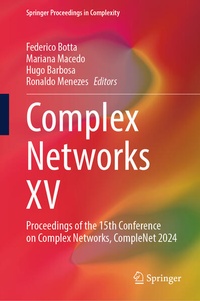
Complex Networks XV
Description

The International Conference on Complex Networks (CompleNet) brings together researchers and practitioners from diverse disciplines working on areas related to complex networks. CompleNet has been an active conference since 2009. Over the past two decades, we have witnessed an exponential increase in the number of publications and research centres dedicated to this field of Complex Networks (aka Network Science). From biological systems to computer science, from technical to informational networks, and from economic to social systems, complex networks are becoming pervasive for dozens of applications. It is the interdisciplinary nature of complex networks that CompleNet aims to capture and celebrate. The CompleNet conference is one of the most cherished events by scientists in our field. Maybe it is because of its motivating format, consisting of plenary sessions (no parallel sessions); or perhaps the reason is that it finds the perfect balance between young and senior participation, a balance in the demographics of the presenters, or perhaps it is just the quality of the work presented.
More details
Other editions
Additional editions

Content
Chapter 1: Mapping low-resolution edges to high-resolution paths: the case of traffic measurements in cities.- Chapter 2: From Low Resource Information Extraction to Identifying Influential Nodes in Knowledge Graphs.- Chapter 3: Inhomogenous Marketing Mix Diffusion.- Chapter 4: Modelling both pairwise interactions and group effects in polarization on interaction networks.- Chapter 5: Computing Motifs in Hypergraphs.- Chapter 6: Extending network tools to explore trends in temporal granular trade networks.- Chapter 7: Expressivity of Geometric Inhomogeneous Random Graphs-Metric and Non-Metric.- Chapter 8: Social Interactions Matter: Is Grey Wolf Optimizer a Particle Swarm Optimization Variation?.- Chapter 9: Exploring Ingredient Variability in Classic Russian Cuisine Dishes through Complex Network Analysis.- Chapter 10: Unraveling the Structure of Knowledge: Consistency in Everyday Networks, Diversity in Scientific.- Chapter 11: Kinetic-based force-directed graph embedding.- Chapter12: Deep Graph Machine Learning Models for Epidemic Spread Prediction and Prevention.- Chapter 13: EleMi: A robust method to infer soil ecological networks with better community structure.- Chapter 14: Interpreting Node Embedding Distances Through n-order Proximity Neighbourhoods.- Chapter 15: Edge Dismantling with Geometric Reinforcement Learning.- Chapter 16: Public Transit Inequality in the Context of the Built Environment.
