

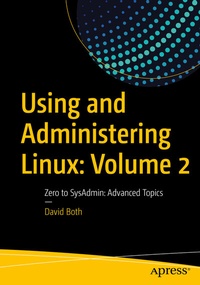
Using and Administering Linux: Volume 2
Description

Experience an in-depth exploration of logical volume management and the use of file managers to manipulate files and directories and the critical concept that, in Linux, everything is a file and some fun and interesting uses of the fact that everything is a file.
This book builds upon the skills you learned in Volume 1 of this course and it depends upon the virtual network and virtual machine created there. More experienced Linux users can begin with this volume and download the assigned script that will set up the VM for the start of Volume 2. Instructions with the script will provide specifications for configuration of the virtual network and the virtual machine. Refer to the volume overviews in the book's introduction to select the volume of this course most appropriate for your current skill level.
You'll see how to manage and monitor running processes, discover the power of the special filesystems, monitor and tune the kernel while it is running - without a reboot. You'll then turn to regular expressions and the power that using them for pattern matching can bring to the command line, and learn to manage printers and printing from the command line and unlock the secrets of the hardware on which your Linux operating system is running.
Experiment with command line programming and how to automate various administrative tasks, networking, and the many services that are required in a Linux system. Use the logs and journals to look for clues to problems and confirmation that things are working correctly, and learn to enhance the security of your Linux systems and how to perform easy local and remote backups.What You Will Learn
- Understand Logical Volume Management, using file managers, and special filesystems
- Exploit everything in a file
- Perform command line programming and basic automation
- Configure printers and manage other hardware
- Manage system services with systemd, user management, security, and local and remote backups using simple and freely available tools
Who This Book Is For
Anyone who wants to continue to learn Linux in depth as an advanced user and system administrator at the command line while using the GUI desktop to leverage productivity.
More details
Other editions
New editions
Additional editions
Person
Content
1. Logical Volume Management.- 2. File Managers.- 3. Everything is a file.- 4. Managing Processes .- 5. Special filesystems.- 6. Regular expressions.- 7. Printing.- 8. Hardware detection.- 9. Command line programming.- 10. Automation with BASH scripts.- 11. Time and Automation.- 12. Networking.- 13. systemd.- 14. D-bus and udev.- 15. Logs and Journals.- 16. Managing Users.- 17. Security.- 18. Backup Everything--Frequently.
