

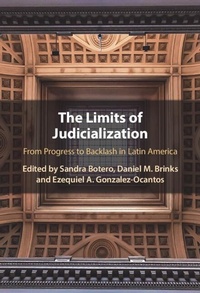
The Limits of Judicialization
From Progress to Backlash in Latin America
Published on 10. August 2022
978-1-009-10357-2 (ISBN)
Description

Latin America was one of the earliest and most enthusiastic adopters of what has come to be known as the judicialization of politics - the use of law and legal institutions as tools of social contestation to curb the abuse of power in government, resolve policy disputes, and enforce and expand civil, political, and socio-economic rights. Almost forty years into this experiment, The Limits of Judicialization brings together a cross-disciplinary group of scholars to assess the role that law and courts play in Latin American politics. Featuring studies of hot-button topics including abortion, state violence, judicial corruption, and corruption prosecutions, this volume argues that the institutional and cultural changes that empowered courts, what the editors call the 'judicialization superstructure,' often fall short of the promise of greater accountability and rights protection. Illustrative and expansive, this volume offers a truly interdisciplinary analysis of the limits of judicialized politics.
Reviews / Votes
"The Limits of Judicialization pushes the boundaries of the field. It is a seminal contribution to the study of judicial politics in comparative perspective, and an essential read for anyone interested in courts in Latin America, including graduate students, scholars, and practitioners. It engages masterfully with existing research and opens new and fruitful avenues for future work in the region and beyond." Raul Sanchez-Urribarri, Senior Lecturer in Crime, Justice and Legal Studies, La Trobe University, Melbourne "Illuminating how a 'superstructure of judicialization' propelled courts into politics in Latin America, this extraordinary volume examines the results, and indeed limitations, of judicial involvement in public policy and political disputes in the region. Through a rich cross-disciplinary, cross-regional dialogue, contributors' portraits reveal how institutional weakness and entrenched interests compromise courts' ability to enliven progressive promises and punish public misconduct." Diana Kapiszewski, Distinguished Associate Professor of Government, Georgetown University "Constitutional reform across Latin America in the late 20th century created new judicial pathways for addressing social and institutional challenges at the heart of the democratization project. This essential collection of essays from leading scholars illuminates the political challenges that the region's courts inherited as they attempted to carry out their new roles as well as several unintended consequences of judicializing politics." Jeffrey K. Staton, Professor of Political Science, Emory University "The Limits of Judicialization explains why the judicialization of politics failed to guarantee greater rights protection and signals key factors for understanding the role of courts in authoritarian regression. The combination of new empirical data and rigorous theory make this a particularly useful book for the classroom." Rachel Sieder, Senior Research Professor, Center for Research and Graduate Studies in Social Anthropology (CIESAS), Mexico CityMore details
Language
English
Place of publication
Cambridge
United Kingdom
Illustrations
Worked examples or Exercises
File size
5,84 MB
ISBN-13
978-1-009-10357-2 (9781009103572)
Copyright in bibliographic data and cover images is held by Nielsen Book Services Limited or by the publishers or by their respective licensors: all rights reserved.
Schweitzer Classification
Other editions
Additional editions
Sandra Botero | Daniel M. Brinks | Ezequiel A. Gonzalez-Ocantos
The Limits of Judicialization
From Progress to Backlash in Latin America
Book
07/2024
Cambridge University Press
€37.50
Shipment within 15-20 days
Sandra Botero | Daniel M. Brinks | Ezequiel A. Gonzalez-Ocantos
The Limits of Judicialization
From Progress to Backlash in Latin America
Book
08/2022
Cambridge University Press
€122.50
Shipment within 15-20 days
Persons
Content
1. Working in New Political Spaces: The Checkered History of Latin American Judicialization Sandra Botero, Daniel Brinks, and Ezequiel Gonzalez Ocantos; 2. Critical Disconnects: Progressive Jurisprudence and Tenacious Impunity in Mexico Janice Gallagher and Jorge Contesse; 3. When Winning in the Courts is Not Enough: Abortion and the Limits of Legal Mobilization Without Grassroots Involvement in Peru Camila Gianella; 4. Forms of Countermovement and Counter-Reform in Latin America: Judicial Backlash or Resources and Political and Legal Opportunities? Alba Ruibal; 5. Backlash against State Strengthening Reforms: The Rise and Fall of the CICIG in Guatemala Rachel E. Bowen; 6. Backlash against Corporate Accountability for Grave Human Rights Violations in Colombia Laura Bernal-Bermudez; 7. Courting Judicial Legitimacy: An Experimental Study of the Colombian Constitutional Court Sofia Forero-Alba and Juan Carlos Rodriguez-Raga; 8. Family Ties and Nepotism in the Mexican Federal Judiciary Julio Rios-Figueroa; 9. Judicial Corruption: The Constitutional Court of Ecuador in Comparative Perspective Santiago Basabe-Serrano; 10. Kickbacks, Crackdown, and Backlash: Legal Accountability in the Lava Jato Investigation Luciano Da Ros and Matthew M. Taylor; 11. Turning Corruption Trials into Political Tools in the Name of Transparency: The Lava Jato Case Mariana Mota Prado and Marta Rodriguez Machado; 12. Fighting Corruption, Dismantling Democracy: Antagonism, Communication, and the Political Use of Lava Jato in Brazil Joao Guilherme Bastos dos Santos and Esther Solano Gallego; 13. Prosecutorial Agency, Backlash and Resistance in the Peruvian Chapter of Lava Jato Viviana Baraybar and Ezequiel Gonzalez-Ocantos; Index.
