

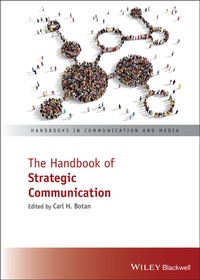
The Handbook of Strategic Communication
Description

The Handbook of Strategic Communication brings together work from leading scholars and practitioners in the field to explore the many practical, national and cultural differences in modern approaches to strategic communication. Designed to provide a coherent understanding of strategic communication across various subfields, this authoritative volume familiarizes practitioners, researchers, and advanced students with an inclusive range of international practices, current theories, and contemporary debates and issues in this dynamic, multidisciplinary field.
This Handbook covers an expansive range of strategic communication models, theories, and applications, comprising two dozen in-depth chapters written by international scholars and practitioners. In-depth essays discuss the three core areas of strategic communication--public relations, marketing communication, and health communication--and their many subfields, such as political communication, issues management, crisis and risk communication, environmental and science communication, public diplomacy, disaster management, strategic communication for social movements and religious communities, and many others. This timely volume:
* Challenges common assumptions about the narrowness of strategic communication
* Highlights ongoing efforts to unify the understanding and practice of strategic communication across a range of subfields
* Discusses models and theories applied to diverse areas such as conflict resolution, research and evaluation, tobacco control, climate change, and counter terrorism strategic communication
* Examines current research and models of strategic communication, such as the application of the CAUSE Model to climate change communication
* Explores strategic communication approaches in various international contexts, including patient-oriented healthcare in Russia, road and tunnel safety in Norway, public sector communication in Turkey, and ethical conflict resolution in Guatemala
The Handbook of Strategic Communication is an indispensable resource for practitioners, researchers, scholars, and students involved in any aspect of strategic communication across its many subfields.
More details
Other editions
Additional editions
Person
Carl H. Botan is Professor of Communication at George Mason University, Virginia, USA. He is the author of Strategic Communication Theory and Practice: The Cocreational View, the first known theoretic book on strategic communication and its applications. Dr Botan has won numerous awards, including the Public Relations Institute of Australia's Outstanding Practitioner-Scholar Award and the Outstanding Research Achievement Award in Public Relations Scholarship. He has served on the National Curriculum Commissions for Public Relations in both the United States and in Australia, has taught strategic communication/social marketing for the Centers for Disease Control and Prevention (CDC) and the U.S. Department of Health's Office of Women's Health.
Content
Introduction and Authors
Strategic communication (SC) is an increasingly popular term in business and higher education. In fact, it has become a widespread term used by millions. Unfortunately, this number includes many who do not understand what SC is and many more who consciously choose to use the term as a simple marketing gimmick to justify charging more for their services or products. This makes a volume such as this all the more important to explain and give examples of what SC really is, how it is practiced at the professional level, and how it is taught in leading universities in the United States and other countries.
Being strategic in communication means first researching both the groups of people we call publics and then our clients, as well as their sometimes very complex mutual relationships. Second, we develop and implement evidence-based communication plans for improving or modifying those relationships. Practiced at its best, SC employs both elements of social scientific research and experience/judgment. Thus, the best SC practitioners are those who learn to become comfortable with a mixture of both rigorous research and deep respect for experience and the "feel" of how groups and individuals think and behave. This, then, is the unifying thread of the book, valuing and using both rigorous research and a feel for the subjective humanistic aspects inherent in the relationships between organizations and their publics.
SC is practiced across many fields, few of which call it SC. Fields ranging from public health to selling dishwashing detergent, and from public relations to religious movements all use SC, often without calling it that. Among the myriad fields that practice SC, health communication and marketing communication should hold a special position in the eyes of many because of their advanced use of research and, in the case of the former, its advanced use of theories as well. Public relations should also hold a special place because of its breadth, its economic role, and its long history. Other subfields have earned special recognition in the eyes of SC practitioners because of their scope, social contributions, and the challenges they confront.
One effect of this scattering of labels for the practice has been the perpetuation of relatively isolated islands of social practice and research, each focused on its own uniqueness rather than on the more substantial communalities they share with other SC practices. The academic community may suffer even more from this balkanization than the practitioner community, in part because colleges and universities are subdivided into departments and schools that some have called silos. Because "operating dollars" typically get divided between these on the basis of how much enrollment they attract, each patrols its content and borders fairly assiduously. For example, business schools may be encouraged to teach marketing communication, while PR may be taught in communication or journalism. Of course, these are coarse generalizations that apply to many schools rather than necessarily any specific one.
The practitioner SC community may, or may not suffer from some of the same kinds of subdivision into units of turf. Professional communication firms often offer a mix of services to clients that cross many of the subdivisions colleges and universities use. There seems to be an emerging tendency in both academic and practitioner domains towards adopting the term strategic communication, however. Although in both cases it is often clear that the term is being used in quite different ways, or just to attempt to modernize or dress up what is being offered.
This kind of balkanization is counterproductive because knowledge and techniques developed for one SC campaign might well inform other kinds of SC campaign. This is particularly so when the publics involved are similar.
Government bodies often also steer away from terms like strategic communication or public relations in attempting to appear non-persuasive, ignoring the fact that they have a reason - a goal - for expending funds on a campaign. In pursuing this falsehood government agencies often take the further step of adopting a model of their relationship with publics that assumes the only thing publics need to hear about is the agency's expert knowledge, sometimes called the "best available science." Publics, however, may hear this as suggesting that government officials are attempting to be persuasive about only allowing them to get the kind of information that will lead them to reach decisions that conform to the government's wants and needs. The best SC campaigns, including public health campaigns, do not assume that the real problem is a public's lack of knowledge about what the client already knows; strategic homework is required to research what publics think they need, although in some cases - such as some weather emergencies - there is no time to do that research. This assumption that SC campaigns are necessary because of a lack of knowledge in publics and markets is called the "deficit model," and is the topic of Rowan et al.
Goals of the Book
This handbook has three main goals. First, and most importantly, the book seeks to identify examples of increasingly recognized areas of thought practice in SC by presenting the thinking of more than 50 leading practitioners and scholars in the field, many using case examples. Offering the views of scholars and practitioners from a wide range of SC specialties in one book may help make sharing strategic ideas and experiences between subfields easier by making it possible to see how very similar concepts may be used under different names in different fields. Identifying primarily as separate subfields has often made it difficult for similarities in practice between fields to be noticed. For example, the practitioner-based views of Rød and Nilsson may inform the academic views of Seeger, Islam, and Seeger, and vice versa.
No one benefits from multiple SC subfields thinking and acting as if what they do is somehow not SC because they use another term for it, thus partially isolating themselves from fellow practitioners and researchers. For example, it may be hard for those who call their planned communication campaigns health communication to learn from or share with those who call their planned campaigns "political communication," or marketing communication, or public relations. Likewise, those who call their planned campaigns environmental communication may find it hard to learn from, or share with, those who call their work religious communication, in part because they may well not think to check the other literature.
Second, this book also attempts to focus attention more on where the field of SC is going than where it has been. On what is pushing our boundaries rather than on what a lot has already been written about. For example, while Doble and MacNeil or June, Cho, and Kim do address aspects of the large core subfield of marketing communication, that subfield does not get a lot of attention in this handbook because there are currently about a dozen handbooks in print for marketing communication and its subset of advertising. See Botan (2018) for more about marketing communication and advertising and the former's contributions to the cocreational model in SC. Health communication, in contrast, only has two or three handbooks currently in print and a part is dedicated to it in this book.
Additionally, the growing role of social media is clearly an important topic that is mentioned in several chapters, but is the specific focus of Jin and Austin. The growth of social media is a good thing from the point of view of the cocreational model discussed by Jin and Austin, in part because it facilitates groups and individuals organizing themselves into publics. But social media has also become such a big part of virtually every kind of SC, at both the strategic and tactical levels, that I thought it better to simply allow each author to integrate it into their own work as they saw fit.
Third, since an understanding of key terms and concepts might help readers more clearly assess what the authors say, the first chapter briefly reviews the field, its key terms and concepts, and one new model of SC that informs many of the chapters herein. A more extended economic discussion of these three areas can be found in Botan (2018).
Organization and Structure of the Book
Structure
Organizing this book was an attempt to balance two, not quite incommensurable, goals. On the one hand is the clear understanding that SC is far too large and varied a field for any one book, even a handbook, to cover. Thus, chapters were recruited that tended to suggest where emerging issues, practices, and schools of thought may be leading SC in the coming decades, rather than offering a more retrospective analysis focusing on what we have been doing in the past decades.
Thus, the book's primary organization into six parts and 23 chapters is intended to reflect newly emerging or particularly fast-growing areas of interest by grouping chapters according to their primary topic. However, there are important instances of overlap between chapters, so in addition to the chapters in each main part there is also a short list in italics at the end of each part in the table of contents identifying other chapters in the book that address the main topic of that part to some degree.
Chapters and their Grouping
Following my introductory Chapter 1, Part I of the book involves chapters that focus mostly on what may be the most important trend in SC over the last quarter century, its growth and...
