

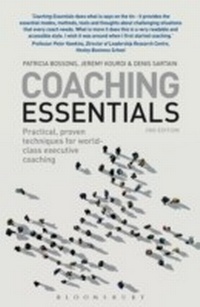
Coaching Essentials
Practical, Proven Techniques for World-Class Executive Coaching
1st Edition
Published on 30. June 2013
288 pages
978-1-4081-9483-6 (ISBN)
Description

Now a billion dollar industry, executive coaching is one of the fastest-growing sections of the coaching market and is widely used by senior managers and chief executives in large organisations.
In this accessible guide, fully updated for this second edition, Patricia Bossons, Jeremy Kourdi and Denis Sartain offer clear explanations of key coaching theories before putting that theory into context with a comprehensive selection of practical tools and techniques. Benefits and uses of each technique are explained and then followed with advice on how to apply the technique and make it work for you - allowing readers to match situations or issues with specific coaching techniques for optimum results.
In this accessible guide, fully updated for this second edition, Patricia Bossons, Jeremy Kourdi and Denis Sartain offer clear explanations of key coaching theories before putting that theory into context with a comprehensive selection of practical tools and techniques. Benefits and uses of each technique are explained and then followed with advice on how to apply the technique and make it work for you - allowing readers to match situations or issues with specific coaching techniques for optimum results.
More details
Edition
1. Auflage
Language
English
Place of publication
London
United Kingdom
Publishing group
Bloomsbury Publishing PLC
Target group
Professional and scholarly
ISBN-13
978-1-4081-9483-6 (9781408194836)
Copyright in bibliographic data and cover images is held by Nielsen Book Services Limited or by the publishers or by their respective licensors: all rights reserved.
Schweitzer Classification
Other editions
Additional editions
Patricia Bossons | Jeremy Kourdi | Denis Sartain
Coaching Essentials
Practical, proven techniques for world-class executive coaching
Book
08/2012
2nd Edition
A&C Black Business Information and Development
€24.50
Shipment within 10-20 days
Persons
Dr Patricia Bossons is Director of Coaching Services at Henley Business School. She is a Chartered Psychologist and an accredited NLP coach.
Content
- Cover
- Contents
- Part 1: Succeeding as a coach
- The case for coaching
- Essential skills for coaches
- Part 2: Typical challenges for coaches
- Clients worry about 'being found out'
- Clients want to communicate better with colleagues
- A client has recently been appointed to a senior position
- The client is unsure about where to start with their issues
- The client is uncertain about what they want
- Clients can't relate to (or don't work well with) their boss or colleagues
- New team, fast results
- Need to have a tough conversation
- Difficulties managing time or achieving a work-life balance
- Clients have recently arrived from somewhere completely different - what should they do here?
- The client is dealing with guilt
- Clients need to be more creative
- The client is working with people from different cultures
- A client needs to be more of a 'people person'
- Clients want to maintain their motivation
- Clients want to develop their career
- Struggling to deal with change
- Feeling lonely at the top
- Dealing with different generations
- Clients lack confidence, self-esteem, skills or ability, or feel they're too young or too old (or any other specific limiting beliefs)
- Contracting
- Selling yourself as a coach
- Time-keeping and ending a coaching session
- Clients need to think long term and plan for the future
- Getting the right coaching supervision
- Part 3: Difficult challenges for coaches
- Part 4: Coaching tools and useful models
- GROW
- Universal
- Managing stress
- Personal development and career planning
- Using emotional intelligence
- The Myers-Briggs type indicator (MBTI)
- Mentoring
- Visualisation and future orientation
- Coaching supervision
- Succeeding in a new job
- Setting objectives and SMART goals
- Achieving a sense of purpose
- Assess, challenge and support
- Transcending limiting beliefs
- Circles of excellence
- Well-formed outcomes
- Questioning
- Reframing
- Teach me
- Heron's six categories of intervention
- Decisions and problem-solving
- Force field analysis
- Miracle question
- Problem-solving
- The decision-making process
- Decision-making principles and techniques
- The leadership pipeline
- Kotter's eight-stage process for leading change
- Eight principles of motivation
- Enhancing motivation
- Empowerment
- The four stages of achieving emotional commitment
- Action-centred leadership
- Leadership styles
- Teamworking (Belbin's team types)
- Leading leaders
- Developing influence (the Thomas-Kilmann conflict instrument)
- Managing cross-cultural relationships and behaviour
- Managing different generations
- Defusing tensions (acknowledge, ask, answer)
- Developing business relationships
- The meta-mirror
- Logical levels
- Inspiring trust
- Fundamental interpersonal relations orientation (FIRO-B)
- 360-degree feedback
- Prioritising and managing your time
- Balancing work and personal life
- The wheel of life
- Thinking strategically
- The balanced scorecard
- Scenario thinking
- Avoiding active inertia and moving from good to great
- Developing innovation
- Six thinking hats
- Disney creativity strategy
- Part 5: Bibliography and further reading
- Index
- A
- B
- C
- D
- E
- F
- G
- H
- I
- J
- K
- L
- M
- N
- O
- P
- Q
- R
- S
- T
- U
- V
- W
