

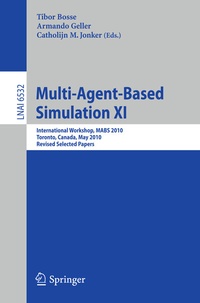
Multi-Agent-Based Simulation XI
International Workshop, MABS 2010, Toronto, Canada, May 11, 2010, Revised Selected Papers
Published on 24. January 2011
X, 167 pages
978-3-642-18345-4 (ISBN)
Description

This volume contains a selection of the papers presented at the 11th International Workshop on Multi-Agent-Based Simulation (MABS 2010), a workshop co-located with the 9th International Joint Conference on Autonomous Agents and Multiagent Systems (AAMAS 2010), which was held on May 10-14, 2010 in Toronto, Canada. The 11 revised full papers presented were carefully reviewed and selected from 26 submissions. The workshop has been an important source of inspiration for the body of knowledge that has been produced in the field of Multi-Agent Systems (MAS). As illustrated by this volume, the workshop continues to bring together researchers interested in MAS engineering with researchers focused on finding efficient ways to model complex social systems in social, economic and organizational areas. In all these areas, agent theories, metaphors, models, analyses, experimental designs, empirical studies, and methodological principles all converge into simulation as a way of achieving explanations and predictions, exploring and testing hypotheses, and producing better designs and systems.
More details
Other editions
Additional editions
Tibor Bosse | Armando Geller | Catholijn M. Jonker
Multi-Agent-Based Simulation XI
International Workshop, MABS 2010, Toronto, Canada, May 11, 2010, Revised Selected Papers
Book
01/2011
1st Edition
Springer
€53.49
Shipment within 7-9 days
Content
- Title
- Preface
- Organization
- Table of Contents
- Models and Frameworks for MAS Development
- Situational Programming: Agent Behavior Visual Programming for MABS Novices
- Introduction
- Visual Behavior Programming for MABS
- Motivations
- Examples of Visual Programming for MABS
- Limitations of Existing Approaches
- Situational Programming
- Objectives and Requirements
- Principle of the Approach
- Very High Level Perceptions and Actions
- Achieving Complex Behaviors without GUI Complexity
- Applying SP: The Warbot Video Game
- History and Objectives
- Warbot Domain-Oriented Percepts and Plans
- Warbot GUI
- First Feedbacks and Remaining Work
- Current Limitations of the Approach
- Related Works
- Conclusion
- References
- IRM4MLS: The Influence Reaction Model for Multi-Level Simulation
- Introduction
- The IRM4S Meta-Model
- The Influence Reaction Model for Multi-Level Simulation (IRM4MLS)
- Specification of the Levels and Their Interactions
- Agent Population and Environments
- Influence Production
- Reaction to Influences
- Simulation of IRM4MLS Models
- A Simple Simulation Model
- A Simulation Model with Level-Dependent Temporal Dynamics
- Discussion, Conclusion and Perspectives
- References
- Toward a Myers-Briggs Type Indicator Model of Agent Behavior in Multiagent Teams
- Introduction
- Approach
- Results
- Single Agent Results
- Multiagent Experimental Results, Homogeneous Teams
- Multiagent Experimental Results, Heterogeneous Teams
- Related Work
- Summary
- References
- Exploring MAS Behaviors
- Pheromones, Probabilities, and Multiple Futures
- Introduction
- The Problem of Multiple Futures
- Source of the Problem
- Multiple Futures in Conventional Modeling
- Pheromones and Probabilities
- The Polyagent Construct
- Pheromone Fields Are Probabilities
- Polyagents, Monte Carlo Tree Search, and Markov Decision Processes
- Counting Possible Futures
- Analyzing Multiple Futures
- Experimental Data
- Evaluating Distributions
- Conditional Distributions
- Conclusion
- References
- Finding Forms of Flocking: Evolutionary Search in ABM Parameter-Spaces
- Motivation
- Related Work
- Methods
- Flocking Models Overview
- Search Algorithms
- BehaviorSearch
- Explorations
- Investigation 1: Convergence
- Investigation 2: Non-convergence
- Investigation 3: Volatility
- Investigation 4: Vee Formations
- Conclusion and Future Work
- References
- Game Theory and Information Sharing
- On the Profitability of Incompetence
- Introduction
- Argumentation and Informedness
- Model
- Expenses, Turnover and Profit
- Consultancy Strategies
- Selection of Consultants
- Simulations
- Experiments
- Results
- Conclusions and Perspectives
- References
- Mechanisms for the Self-organization of Peer Groups in Agent Societies
- Introduction
- Background and Related Work
- Experimental Model
- Tag Groups
- Gossip Mechanism
- Social Ostracism
- Agent Attributes
- Experimental Setup
- Gossiping
- Leaving a Group
- Joining a Group
- Calculating the Entry Value
- Results and Comparison
- Adding Openness
- Results and Discussion
- Conclusion and Future Work
- References
- Multigame Dynamics: Structures and Strategies
- Introduction
- Multigame Requirements
- Characteristics
- Toward a Multidimensional Formalism
- Complex Multigames
- Strategies and Roles
- Strategies
- Roles and Relationships
- Illustrations of Multigame Interaction
- Conclusion
- References
- MAS in Economics and Negotiation
- Microstructure Dynamics and Agent-BasedFinancial Markets
- Introduction and Main Ideas
- Genetic Programming as a Rule-Inference Engine
- Self-organizing Maps as a Clustering Machine
- Genetic Programming
- An Illustration from the Taiwan Stock Market
- Short-Term Dynamics
- Long-Term Distribution
- Results from Multiple Runs
- Does the Number of Types Matter?
- Concluding Remarks
- References
- Computational Modeling of Culture's Consequences
- Introduction
- Modeling Method
- Integrated Computational Model
- Conclusion
- References
- Agent-Based Simulation Modelling of Housing Choice and Urban Regeneration Policy
- Introduction
- Urban Regeneration Policy and EASEL
- Social Simulations in the Housing Market
- The Model Defined
- Derivation of the Input Data
- Assignment of Households to Houses
- Time-Stepping
- Determination of Household Movers
- Selection of Destinations
- What Are the Environmental Variables?
- Results
- Brief Review and Discussion of Results
- Where to Next?
- Conclusion
- References
- Author Index
