

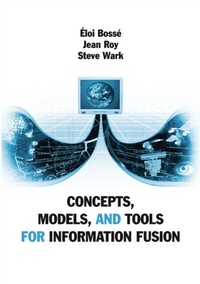
Concepts, Models, and Tools for Information Fusion
1st Edition
Published on 1. January 2007
392 pages
978-1-59693-082-7 (ISBN)
Description

In the heat of battle, a split second can be all the time a military commander has to give orders. Information fusion technology enables commanders to lead decisively and confidently during active conflict. Masses of live information are instantaneously integrated to create a coherent and precise picture of a rapidly evolving situation. This book brings together an international panel of leading experts that give a fresh and cohesive perspective on this technology's models, methods, mathematics, and computer systems. It considers the human factors key to the automated analysis process. Providing insight into implementation, this authoritative volume examines architectures and systems developed by the U.S. Department of Defense. The book also discusses systems interoperability among coalition forces as they prepare to confront future conflicts that transcend national boundaries.
More details
Other editions
Additional editions
Eloi Bosse | Jean Roy | Steve Wark
Concepts, Models, and Tools for Information Fusion
Book
03/2007
Artech House Publishers
€141.13
Shipment within 10-20 days
Content
- Concepts, Models, and Tools for Information Fusion
- Contents v
- Foreword xiii
- Chapter 1 Introduction 1
- 1.1 Traditional View of the Command-and-Control Process: The OODA Loop 2
- 1.2 An Information-Age View of the Traditional Command-and- Control Process 3
- 1.3 About This Book on Data and Information Fusion 7
- References 10
- Chapter 2 Decision-Making Models 11
- 2.1 Introduction 11
- 2.2 Rational Models 12
- 2.3 Naturalistic Decision-Making Models 16
- 2.4 Other Related Cognitive Models 20
- References 24
- Chapter 3 Situation Awareness and Analysis Models 27
- 3.1 Introduction 27
- 3.2 General Discussion of Situation Awareness 27
- 3.3 Defining Situation Awareness 31
- 3.4 Endsley's Model of Situation Awareness 37
- 3.5 Defining and Modeling Situation Analysis 40
- References 64
- Chapter 4 Data- and Information-Fusion Models 69
- 4.1 Introduction 69
- 4.2 The JDL Data-Fusion Model 69
- 4.3 The Visual Data-Fusion Model 86
- 4.4 The Unified Data-Fusion ( lJDL) Model 92
- 4.5 The Situation-Awareness Reference Model 108
- References 116
- Chapter 5 Situation Analysis and Decision-Support Systems 119
- 5.1 Introduction 119
- 5.2 Human Limitations 120
- 5.3 Technological Support for Situation Awareness and Decision-Making 122
- 5.4 Task-Technology Interactions and Technological Automation 124
- 5.5 Support-System Requirements: A Task/Human/Technology Triad Model 125
- 5.6 Cognitive Fit and Support-System Insertion into the Operational Environment 128
- 5.7 Cognitive Systems Engineering 129
- 5.8 Development Process of a Support System 133
- References 138
- Chapter 6 Knowledge, Belief, and Uncertainty 141
- 6.1 Introduction 141
- 6.2 Knowledge and Belief 142
- 6.3 Uncertainty 144
- 6.4 Conclusion 149
- References 149
- Chapter 7 Qualitative and Symbolic Approaches 151
- 7.1 Introduction 151
- 7.2 Classical Logic: Propositional Logic 151
- 7.3 Classical Logic: First-Order Logic 155
- 7.4 Modal Logics and Knowledge Logics 159
- 7.5 Nonmonotonic Logics 161
- References 166
- Chapter 8 Quantitative Approaches 169
- 8.1 Introduction 169
- 8.2 Probability Theory 169
- 8.3 Dempster-Shafer Theory 175
- 8.4 Fuzzy-Set Theory 183
- 8.5 Possibility Theory 189
- 8.6 Rough-Set Theory 195
- 8.7 Conditional Event Theory 200
- 8.8 Random-Set Theory 203
- References 208
- Chapter 9 Hybrid and Graphical Approaches 211
- 9.1 Introduction 211
- 9.2 Discussion of Quantitative Logics 211
- 9.3 Probabilistic Logic 212
- 9.4 Fuzzy Logic 214
- 9.5 Possibility Logic 215
- 9.6 Incidence Calculus 216
- 9.7 Introductory Discussion of Graph-Based Approaches 220
- 9.8 Bayesian Networks 222
- 9.9 Valuation-Based Systems 225
- References 228
- Computational Aspects of Information Fusion 231
- 10.1 Introduction 231
- 10.2 Information-Fusion Domain Characteristics 232
- 10.3 System Architectures 237
- 10.4 Computer Systems 243
- 10.5 Networks 244
- 10.6 Middleware 249
- 10.7 Information Sources 258
- 10.8 Human-Computer Interfaces 265
- References 275
- Chapter 11 Knowledge-Based and Artificial Intelligence Systems 279
- 11.1 Reason 279
- 11.2 Reaction 280
- 11.3 Logical Reasoning 290
- 11.4 Rule-Based Reasoning 299
- 11.5 Case-Based Reasoning 304
- References 306
- Chapter 12 Software Architectures 311
- 12.1 Visual Data Fusion Computational Model 311
- 12.2 Blackboard Systems 315
- 12.3 Multiagent Systems 321
- References 346
- Chapter 13 Conclusions 351
- List of Acronyms 353
- About the Authors 359
- Index 361
