

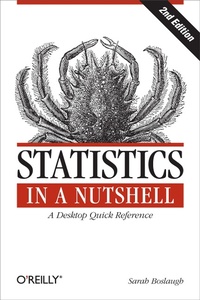
Statistics in a Nutshell
A Desktop Quick Reference
Published on 10. November 2012
594 pages
978-1-4493-6114-3 (ISBN)
Description

Need to learn statistics for your job? Want help passing a statistics course? Statistics in a Nutshell is a clear and concise introduction and reference for anyone new to the subject. Thoroughly revised and expanded, this edition helps you gain a solid understanding of statistics without the numbing complexity of many college texts.Each chapter presents easy-to-follow descriptions, along with graphics, formulas, solved examples, and hands-on exercises. If you want to perform common statistical analyses and learn a wide range of techniques without getting in over your head, this is your book.Learn basic concepts of measurement and probability theory, data management, and research designDiscover basic statistical procedures, including correlation, the t-test, the chi-square and Fishers exact tests, and techniques for analyzing nonparametric dataLearn advanced techniques based on the general linear model, including ANOVA, ANCOVA, multiple linear regression, and logistic regressionUse and interpret statistics for business and quality improvement, medical and public health, and education and psychologyCommunicate with statistics and critique statistical information presented by others
More details
Other editions
Additional editions
Sarah Boslaugh
Statistics in a Nutshell
Book
12/2012
2nd Edition
O'Reilly
€55.00
Article not available at the moment
Content
- Intro
- Table of Contents
- Preface
- OK, Just What Is Statistics?
- The Focus of This Book
- Statistics in the Age of Information
- Organization of This Book
- Conventions Used in This Book
- Using Code Examples
- Safari® Books Online
- How to Contact Us
- Acknowledgments
- Chapter 1. Basic Concepts of Measurement
- Measurement
- Levels of Measurement
- Nominal Data
- Ordinal Data
- Interval Data
- Ratio Data
- Continuous and Discrete Data
- Operationalization
- Proxy Measurement
- True and Error Scores
- Random and Systematic Error
- Reliability and Validity
- Reliability
- Validity
- Triangulation
- Measurement Bias
- Bias in Sample Selection and Retention
- Information Bias
- Exercises
- Chapter 2. Probability
- About Formulas
- Basic Definitions
- Trials
- Sample Space
- Events
- Union
- Intersection
- Complement
- Mutual Exclusivity
- Independence
- Permutations
- Combinations
- Defining Probability
- Expressing the Probability of an Event
- Conditional Probabilities
- Calculating the Probability of Multiple Events
- Union of mutually exclusive events
- Union of events that are not mutually exclusive
- Intersection of independent events
- Intersection of nonindependent events
- Bayes' Theorem
- Enough Exposition, Let's Do Some Statistics!
- Dice, Coins, and Playing Cards
- Exercises
- Closing Note: The Connection between Statistics and Gambling
- Chapter 3. Inferential Statistics
- Probability Distributions
- The Normal Distribution
- The Binomial Distribution
- Independent and Dependent Variables
- Populations and Samples
- Nonprobability Sampling
- Probability Sampling
- The Central Limit Theorem
- Hypothesis Testing
- Confidence Intervals
- p-values
- The Z-Statistic
- Data Transformations
- Exercises
- Chapter 4. Descriptive Statistics and Graphic Displays
- Populations and Samples
- Measures of Central Tendency
- The Mean
- The Median
- The Mode
- Comparing the Mean, Median, and Mode
- Measures of Dispersion
- The Range and Interquartile Range
- The Variance and Standard Deviation
- Outliers
- Graphic Methods
- Frequency Tables
- Bar Charts
- Pie Charts
- Pareto Charts
- The Stem-and-Leaf Plot
- The Boxplot
- The Histogram
- Bivariate Charts
- Scatterplots
- Line Graphs
- Exercises
- Chapter 5. Categorical Data
- The R×C Table
- Measures of Agreement
- The Chi-Square Distribution
- The Chi-Square Test
- Fisher's Exact Test
- McNemar's Test for Matched Pairs
- Proportions: The Large Sample Case
- Correlation Statistics for Categorical Data
- Binary Variables
- The Point-Biserial Correlation Coefficient
- Ordinal Variables
- The Likert and Semantic Differential Scales
- Exercises
- Chapter 6. The t-Test
- The t Distribution
- The One-Sample t-Test
- Confidence Interval for the One-Sample t-Test
- The Independent Samples t-Test
- Confidence Interval for the Independent Samples t-Test
- Repeated Measures t-Test
- Confidence Interval for the Repeated Measures t-Test
- Unequal Variance t-Test
- Exercises
- Chapter 7. The Pearson Correlation Coefficient
- Association
- Scatterplots
- Relationships Between Continuous Variables
- The Pearson Correlation Coefficient
- Testing Statistical Significance for the Pearson Correlation
- The Coefficient of Determination
- Exercises
- Chapter 8. Introduction to Regression and ANOVA
- The General Linear Model
- Linear Regression
- Assumptions
- Analysis of Variance (ANOVA)
- One-Way ANOVA
- Post Hoc Tests
- Calculating Simple Regression by Hand
- Exercises
- Regression
- ANOVA
- Chapter 9. Factorial ANOVA and ANCOVA
- Factorial ANOVA
- Interaction
- Two-Way ANOVA
- Three-Way ANOVA
- ANCOVA
- Exercises
- Chapter 10. Multiple Linear Regression
- Multiple Regression Models
- Dummy Variables
- Methods for Building Regression Models
- Forward entry
- Backward removal
- Exercises
- Example 1
- Example 2
- Chapter 11. Logistic, Multinomial, and Polynomial Regression
- Logistic Regression
- Converting Logits to Probabilities
- Multinomial Logistic Regression
- Polynomial Regression
- Overfitting
- Exercises
- Chapter 12. Factor Analysis, Cluster Analysis, and Discriminant Function Analysis
- Factor Analysis
- Cluster Analysis
- Discriminant Function Analysis
- Exercises
- Chapter 13. Nonparametric Statistics
- Between-Subjects Designs
- The Wilcoxon Rank Sum Test
- The Sign Test
- The Median Test
- Kruskal-Wallis H Test
- Within-Subjects Designs
- Wilcoxon Signed Ranks Test
- Friedman Test
- Exercises
- Chapter 14. Business and Quality Improvement Statistics
- Index Numbers
- Time Series
- Decision Analysis
- Minimax, Maximax, and Maximin
- Decision Making under Risk
- Decision Trees
- Quality Improvement
- Run Charts and Control Charts
- Exercises
- Chapter 15. Medical and Epidemiological Statistics
- Measures of Disease Frequency
- Ratio, Proportion, and Rate
- Prevalence and Incidence
- Crude, Category-Specific, and Standardized Rates
- The Risk Ratio
- Attributable Risk, Attributable Risk Percentage, and Number Needed to Treat
- The Odds Ratio
- Confounding, Stratified Analysis, and the Mantel-Haenszel Common Odds Ratio
- Power Analysis
- Sample Size Calculations
- Confidence Interval for a Proportion
- Power for the Test of the Difference between Two Sample Means (Independent Samples t-Test)
- Exercises
- Chapter 16. Educational and Psychological Statistics
- Percentiles
- Standardized Scores
- Test Construction
- Classical Test Theory: The True Score Model
- Reliability of a Composite Test
- Measures of Internal Consistency
- Split-Half Methods
- Coefficient Alpha
- Item Analysis
- Item Response Theory
- Exercises
- Chapter 17. Data Management
- An Approach, Not a Set of Recipes
- The Chain of Command
- Codebooks
- The Rectangular Data File
- Spreadsheets and Relational Databases
- Inspecting a New Data File
- String and Numeric Data
- Missing Data
- Chapter 18. Research Design
- Basic Vocabulary
- Observational Studies
- Quasi-Experimental Studies
- Experimental Studies
- Ingredients of a Good Design
- Gathering Experimental Data
- Identifying Experimental Units
- Identifying Treatments and Controls
- Specifying Treatment Levels
- Specifying Response Variables
- Blinding
- Retrospective Adjustment
- Blocking and the Latin Square
- Example Experimental Design
- Chapter 19. Communicating with Statistics
- General Notes
- Writing for a Professional Journal
- Writing the Article
- The Peer Review Process
- Writing for the General Public
- Writing for Your Workplace
- Chapter 20. Critiquing Statistics Presented by Others
- Evaluating the Whole Article
- The Misuse of Statistics
- Common Problems
- Quick Checklist
- Issues in Research Design
- Variation
- Population
- Sampling
- Controls
- The Power of Coincidence
- Descriptive Statistics
- Measures of Central Tendency
- Standard Error and Confidence Intervals
- Graphical Presentation of Data
- Extrapolation and Trends
- Inferential Statistics
- Assumptions of Statistical Tests
- t-tests
- ANOVA
- Linear regression
- Appendix A. Review of Basic Mathematics
- Laws of Arithmetic
- Order of Operations
- Properties of Real Numbers
- Exponents and Roots
- Properties of Roots
- Solving Equations
- Systems of Equations
- Graphing Equations
- Linear Inequalities
- Fractions
- Factorials, Permutations, and Combinations
- Exercises
- Laws of Arithmetic and Real Numbers
- Exponents, Roots, and Logarithms
- Natural Logarithms
- Solving Equations for x
- Systems of Linear Equations
- Linear Equations and Cartesian Coordinates
- Linear Inequalities
- Fractions, Decimals, and Percents
- Factorials, Permutations, and Combinations
- Answers
- Laws of Arithmetic and Real Numbers
- Exponents and Roots
- Logarithms
- Solving Equations for x
- Solving Systems of Linear Equations
- Linear Equations and Cartesian Coordinates
- Linear Inequalities
- Fractions, Decimals, and Percents
- Factorials, Permutations, and Combinations
- Appendix B. Introduction to Statistical Packages
- Minitab
- SPSS
- SAS
- R
- Microsoft Excel
- Appendix C. References
- Preface and General Sources
- Chapter 1
- Chapter 2
- Chapter 3
- Chapter 4
- Chapter 5
- Chapter 6
- Chapter 7
- Chapter 8
- Chapter 9
- Chapter 10
- Chapter 11
- Chapter 12
- Chapter 13
- Chapter 14
- Chapter 15
- Chapter 16
- Chapter 17
- Chapter 18
- Chapter 19
- Chapter 20
- Appendix D. Probability Tables for Common Distributions
- The Standard Normal Distribution
- The t-Distribution
- The Binomial Distribution
- The Chi-Square Distribution
- Appendix E. Online Resources
- General Resources
- Glossaries
- Probability Tables
- Online Calculators
- Online Textbooks
- Appendix F. Glossary of Statistical Terms
- Index
