

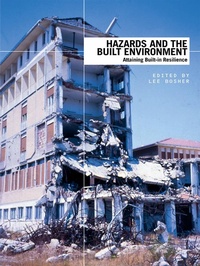
Hazards and the Built Environment
Attaining Built-in Resilience
Published on 6. May 2008
400 pages
978-1-134-09048-8 (ISBN)
Description

As a specialist in disaster preparation, you have huge responsibilities: a failure to prepare for natural and human-induced disasters costs lives and money. When a natural or human-induced disaster hits a built-up area the amount of damage it does will depend largely on the extent to which the built assets in the area were developed to withstand it. To fail in this respect is therefore both ethically and financially negligent.
What kinds of structural and non-structural alterations can be made to protect buildings from large-scale disasters?
How can we reduce the threat of these disasters, as well as the damage they cause?
Presenting seven guiding principles, drawn from a broad range of disciplines and approaches, this book tackles the difficult questions about what can be done to attain built-in resilience. With contributions from many renowned experts and upcoming researchers in the fields concerned, it comprehensively assesses the wide range of issues faced by practitioners. Whether you're studying construction management, researching hazard resilience issues or working on construction projects in hazardous regions, this book is for you.
What kinds of structural and non-structural alterations can be made to protect buildings from large-scale disasters?
How can we reduce the threat of these disasters, as well as the damage they cause?
Presenting seven guiding principles, drawn from a broad range of disciplines and approaches, this book tackles the difficult questions about what can be done to attain built-in resilience. With contributions from many renowned experts and upcoming researchers in the fields concerned, it comprehensively assesses the wide range of issues faced by practitioners. Whether you're studying construction management, researching hazard resilience issues or working on construction projects in hazardous regions, this book is for you.
More details
Language
English
Place of publication
London
United Kingdom
Publishing group
Taylor & Francis Ltd
Target group
College/higher education
Professional and scholarly
Illustrations
43 s/w Tabellen, 72 s/w Photographien bzw. Rasterbilder, 30 s/w Zeichnungen
43 Tables, black and white; 30 Line drawings, black and white; 72 Halftones, black and white
File size
16,89 MB
ISBN-13
978-1-134-09048-8 (9781134090488)
Copyright in bibliographic data and cover images is held by Nielsen Book Services Limited or by the publishers or by their respective licensors: all rights reserved.
Schweitzer Classification
Other editions
Additional editions
Book
05/2008
1st Edition
Routledge
€267.41
Shipment within 15-20 days
Book
05/2008
1st Edition
Routledge
€112.84
Shipment within 15-20 days
Person
Lee Bosher is a research fellow in the Department of Civil and Building Engineering at Loughborough University, UK. He is a Fellow of the Royal Geographical Society, and a Member of the Institute of Civil Defence and Disaster Studies.
Content
1. Mainstreaming Disaster Risk Management 2. Construction in Developing Nations 3. The Case of Central Vietnam 4. Structural Adaptation in India 5. Developments in Seismic Design and Retrofit of Structures 6. Flood Resilience in Residential Properties in England and Wales 7. Public Attitudes to 'Community Based' Small Scale Flood Risk Reduction Measures in England 8. Facing the Future by Designing in Resilience 9. Community-Based Construction for Disaster Risk Reduction 10. Informal Settlements and Natural Hazard Vulnerability in Rapid Growth Cities 11. Corruption, Construction and Catastrophe 12. Building Resilience by Focusing on Legal and Contractual Frameworks for Disaster Reconstruction 13. The Implications of the Civil Contingencies Act (CCA) 2004 for Engineers in the UK 14. Security Planning in the Resilient City 15. Adapting Settlements Before Disasters Strike
