

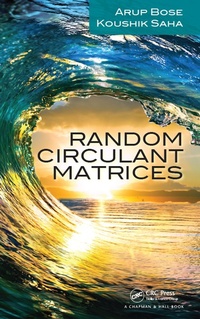
Random Circulant Matrices
1st Edition
Published on 5. November 2018
212 pages
978-0-429-78819-2 (ISBN)
Description

Circulant matrices have been around for a long time and have been extensively used in many scientific areas. This book studies the properties of the eigenvalues for various types of circulant matrices, such as the usual circulant, the reverse circulant, and the k-circulant when the dimension of the matrices grow and the entries are random.
In particular, the behavior of the spectral distribution, of the spectral radius and of the appropriate point processes are developed systematically using the method of moments and the various powerful normal approximation results. This behavior varies according as the entries are independent, are from a linear process, and are light- or heavy-tailed.
Arup Bose obtained his B.Stat., M.Stat. and Ph.D. degrees from the Indian Statistical Institute. He has been on its faculty at the Theoretical Statistics and Mathematics Unit, Kolkata, India since 1991. He is a Fellow of the Institute of Mathematical Statistics, and of all three national science academies of India. He is a recipient of the S.S. Bhatnagar Prize and the C.R. Rao Award. He is the author of three books: Patterned Random Matrices, Large Covariance and Autocovariance Matrices (with Monika Bhattacharjee) and U-Statistics, M_m-Estimators and Resampling (with Snigdhansu Chatterjee).
Koushik Saha obtained a B.Sc. in Mathematics from Ramakrishna Mission Vidyamandiara, Belur and an M.Sc. in Mathematics from Indian Institute of Technology Bombay. He obtained his Ph.D. degree from the Indian Statistical Institute under the supervision of Arup Bose. His thesis on circulant matrices received high praise from the reviewers. He has been on the faculty of the Department of Mathematics, Indian Institute of Technology Bombay since 2014.
In particular, the behavior of the spectral distribution, of the spectral radius and of the appropriate point processes are developed systematically using the method of moments and the various powerful normal approximation results. This behavior varies according as the entries are independent, are from a linear process, and are light- or heavy-tailed.
Arup Bose obtained his B.Stat., M.Stat. and Ph.D. degrees from the Indian Statistical Institute. He has been on its faculty at the Theoretical Statistics and Mathematics Unit, Kolkata, India since 1991. He is a Fellow of the Institute of Mathematical Statistics, and of all three national science academies of India. He is a recipient of the S.S. Bhatnagar Prize and the C.R. Rao Award. He is the author of three books: Patterned Random Matrices, Large Covariance and Autocovariance Matrices (with Monika Bhattacharjee) and U-Statistics, M_m-Estimators and Resampling (with Snigdhansu Chatterjee).
Koushik Saha obtained a B.Sc. in Mathematics from Ramakrishna Mission Vidyamandiara, Belur and an M.Sc. in Mathematics from Indian Institute of Technology Bombay. He obtained his Ph.D. degree from the Indian Statistical Institute under the supervision of Arup Bose. His thesis on circulant matrices received high praise from the reviewers. He has been on the faculty of the Department of Mathematics, Indian Institute of Technology Bombay since 2014.
More details
Edition
1. Auflage
Language
English
Place of publication
London
United Kingdom
Publishing group
Taylor & Francis Ltd
Target group
College/higher education
File size
25,66 MB
ISBN-13
978-0-429-78819-2 (9780429788192)
Copyright in bibliographic data and cover images is held by Nielsen Book Services Limited or by the publishers or by their respective licensors: all rights reserved.
Schweitzer Classification
Other editions
Additional editions
Arup Bose | Koushik Saha
Random Circulant Matrices
Book
12/2020
1st Edition
Chapman & Hall/CRC
€59.41
Shipment within 15-20 days
Arup Bose | Koushik Saha
Random Circulant Matrices
Book
10/2018
1st Edition
CRC Press
€237.70
Shipment within 10-20 days
Persons
Arup Bose obtained his B.Stat., M.Stat. and Ph.D. degrees from the Indian Statistical Institute. He has been on its faculty at the Theoretical Statistics and Mathematics Unit, Kolkata, India since 1991. He is a Fellow of the Institute of Mathematical Statistics, and of all three national science academies of India. He is a recipient of the S.S. Bhatnagar Prize and the C.R. Rao Award. He is the author of three books: Patterned Random Matrices, Large Covariance and Autocovariance Matrices (with Monika Bhattacharjee) and U-Statistics, M_m-Estimators and Resampling (with Snigdhansu Chatterjee).
Koushik Saha obtained a B.Sc. in Mathematics from Ramakrishna Mission Vidyamandiara, Belur and an M.Sc. in Mathematics from Indian Institute of Technology Bombay. He obtained his Ph.D. degree from the Indian Statistical Institute under the supervision of Arup Bose. His thesis on circulant matrices received high praise from the reviewers. He has been on the faculty of the Department of Mathematics, Indian Institute of Technology Bombay since 2014.
Koushik Saha obtained a B.Sc. in Mathematics from Ramakrishna Mission Vidyamandiara, Belur and an M.Sc. in Mathematics from Indian Institute of Technology Bombay. He obtained his Ph.D. degree from the Indian Statistical Institute under the supervision of Arup Bose. His thesis on circulant matrices received high praise from the reviewers. He has been on the faculty of the Department of Mathematics, Indian Institute of Technology Bombay since 2014.
Content
Circulants
Circulant
Symmetric circulant
Reverse circulant
k-circulant
Exercises
Symmetric and reverse circulant
Spectral distribution
Moment method
Scaling
Input and link
Trace formula and circuits
Words and vertices
(M) and Riesz's condition
(M) condition
Reverse circulant
Symmetric circulant
Related matrices
Reduced moment
A metric
Minimal condition
Exercises
LSD: normal approximation
Method of normal approximation
Circulant
k-circulant
Exercises
LSD: dependent input
Spectral density
Circulant
Reverse circulant
Symmetric circulant
k-circulant
Exercises
Spectral radius: light tail
Circulant and reverse circulant
Symmetric circulant
Exercises
Spectral radius: k-circulant
Tail of product
Additional properties of the k-circulant
Truncation and normal approximation
Spectral radius of the k-circulant
k-circulant for sn = kg +
Exercises
Maximum of scaled eigenvalues: dependent input
Dependent input with light tail
Reverse circulant and circulant
Symmetric circulant
k-circulant
k-circulant for n = k +
k-circulant for n = kg + , g >
Exercises
Poisson convergence
Point Process
Reverse circulant
Symmetric circulant
k-circulant, n = k +
Reverse circulant: dependent input
Symmetric circulant: dependent input
k-circulant, n = k + : dependent input
Exercises
Heavy tailed input: LSD
Stable distribution and input sequence
Background material
Reverse circulant and symmetric circulant
k-circulant: n = kg +
Proof of Theorem
Contents vii
k-circulant: n = kg ?
Tail of the LSD
Exercises
Heavy-tailed input: spectral radius
Input sequence and scaling
Reverse circulant and circulant
Symmetric circulant
Heavy-tailed: dependent input
Exercises
Appendix
Proof of Theorem
Standard notions and results
Three auxiliary results
Circulant
Symmetric circulant
Reverse circulant
k-circulant
Exercises
Symmetric and reverse circulant
Spectral distribution
Moment method
Scaling
Input and link
Trace formula and circuits
Words and vertices
(M) and Riesz's condition
(M) condition
Reverse circulant
Symmetric circulant
Related matrices
Reduced moment
A metric
Minimal condition
Exercises
LSD: normal approximation
Method of normal approximation
Circulant
k-circulant
Exercises
LSD: dependent input
Spectral density
Circulant
Reverse circulant
Symmetric circulant
k-circulant
Exercises
Spectral radius: light tail
Circulant and reverse circulant
Symmetric circulant
Exercises
Spectral radius: k-circulant
Tail of product
Additional properties of the k-circulant
Truncation and normal approximation
Spectral radius of the k-circulant
k-circulant for sn = kg +
Exercises
Maximum of scaled eigenvalues: dependent input
Dependent input with light tail
Reverse circulant and circulant
Symmetric circulant
k-circulant
k-circulant for n = k +
k-circulant for n = kg + , g >
Exercises
Poisson convergence
Point Process
Reverse circulant
Symmetric circulant
k-circulant, n = k +
Reverse circulant: dependent input
Symmetric circulant: dependent input
k-circulant, n = k + : dependent input
Exercises
Heavy tailed input: LSD
Stable distribution and input sequence
Background material
Reverse circulant and symmetric circulant
k-circulant: n = kg +
Proof of Theorem
Contents vii
k-circulant: n = kg ?
Tail of the LSD
Exercises
Heavy-tailed input: spectral radius
Input sequence and scaling
Reverse circulant and circulant
Symmetric circulant
Heavy-tailed: dependent input
Exercises
Appendix
Proof of Theorem
Standard notions and results
Three auxiliary results
