

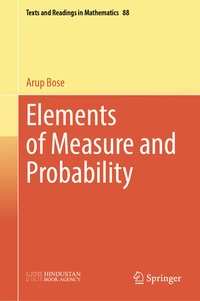
Elements of Measure and Probability
Description

This book can serve as a first course on measure theory and measure theoretic probability for upper undergraduate and graduate students of mathematics, statistics and probability. Starting from the basics, the measure theory part covers Caratheodory's theorem, Lebesgue-Stieltjes measures, integration theory, Fatou's lemma, dominated convergence theorem, basics of Lp spaces, transition and product measures, Fubini's theorem, construction of the Lebesgue measure in Rd, convergence of finite measures, Jordan-Hahn decomposition of signed measures, Radon-Nikodym theorem and the fundamental theorem of calculus.
The material on probability covers standard topics such as Borel-Cantelli lemmas, behaviour of sums of independent random variables, 0-1 laws, weak convergence of probability distributions, in particular via moments and cumulants, and the central limit theorem (via characteristic function, and also via cumulants), and ends with conditional expectation as a natural application of the Radon-Nikodym theorem. A unique feature is the discussion of the relation between moments and cumulants, leading to Isserlis' formula for moments of products of Gaussian variables and a proof of the central limit theorem avoiding the use of characteristic functions.
For clarity, the material is divided into 23 (mostly) short chapters. At the appearance of any new concept, adequate exercises are provided to strengthen it. Additional exercises are provided at the end of almost every chapter. A few results have been stated due to their importance, but their proofs do not belong to a first course. A reasonable familiarity with real analysis is needed, especially for the measure theory part. Having a background in basic probability would be helpful, but we do not assume a prior exposure to probability.
More details
Other editions
Additional editions
Person
Arup Bose is an Honorary Visiting Professor at the Indian Statistical Institute since his superannuation in 2024. He has published more than 150 research articles in probability, statistics, econometrics and economics., as well as six books (singly or with others) covering topics in random matrices, non-commutative probability, U-statistics, Mm estimates, resampling, and martingales. He is a Fellow of the Institute of Mathematical Statistics, the Indian National Science Academy, the National Academy of Science and the Indian Academy of Sciences. He has won the Shanti Swarup Bhatnagar Prize and the C.R. Rao award from the Governemtn of India, and the Mahalanobis International Award for Lifetime Achievements from the International Statistical Institute.
Content
Preliminaries.- Classes of Sets.- Introduction to Measures.- Extension of Measures.- Lebesgue-Stieltjes Measures.- Measurable Functions.- Integral.- Basic Inequalities.- Lp Spaces: Topological Properties.- Product Spaces and Transition Measures.- Random Variables and Vectors.- Moments and Cumulants.- Further Modes of Convergence of Functions.- Independence and Basic Conditional Probability.- 0-1 Laws.- Sums of Independent Random Variables.- Convergence of Finite Measures.- Characteristic Functions.- Central Limit Theorem.- Signed Measure.- Randon-Nikodym Theorem .- Fundamental Theorem of Calculus.- Conditional Expectation.
