

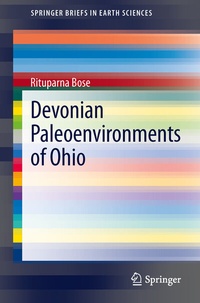
Devonian Paleoenvironments of Ohio
Description

Rituparna Bose used new microscopic and imaging techniques in qualitatively analyzing the biotic interactions in small invertebrate shells. More importantly, she solved complex hypotheses in newly emerging problems in the field of geology and paleontology, such as the biodiversity crisis. Her study involved exploring the Devonian geology and paleontology of a geologic formation of a new unexplored quarry in Ohio, namely the Whitehouse Quarry in Lucas County, Ohio. She identified Devonian brachiopods to the genus level based on their morphology, and diagnosed paleoecological entities on host brachiopods and further measured episkeletobiont traces on hosts to understand the effects of environment and evolution on extinct species.
Such studies have implications in predicting future biodiversity, ecosystem conservation and climate change. This research will also assist future workers to compare the ecology of brachiopod hosts of the Dundee Limestone with that of other Devonian brachiopods, from both carbonate and siliciclastic settings.
More details
Other editions
Additional editions
Person
Dr. Rituparna Bose obtained her Ph.D. from Indiana University, Bloomington. For her outstanding Ph.D. dissertation she was rewarded with a Springer Theses Prize. She is currently an adjunct Assistant Professor at the City University of New York and has been interviewed as an expert in the field of biodiversity by the Times of India (leading news daily in her home country). She has won numerous awards in her career including the nationally recognized Theodore Roosevelt Memorial Grant awarded by the American Museum of Natural History.
She has been recently invited to serve as an Editor for Acta Paleontologica Sinica by the Chinese Academy of Sciences. She is the Associate Editor-in-Chief for the International Journal of Environmental Protection and the Associate Editor for the Journal of Geography and Geology at the Canadian Center of Science. She also serves on the editorial board of some of the most prestigious journals in geology including Historical Biology: An International Journal of Palaeobiology (Taylor and Francis), Bulletins of American Paleontology (Paleontological Research Institute, Cornell University), Springer Plus (Earth and Environmental Science) and Geological Journal (Wiley).
The foreword of this book has been written by Prof. David Harper who is presently the Vice President of the Palaeontographical Society and Chairman of the International Subcommission on Ordovician Stratigraphy. He was previously the President of the International Palaeontological Association (2006-2010). He is the Editor of the journal Lethaia and Advisory Editor of the Journal of the Geological Society, London.
Content
Research Objectives.- Geological Background.- Paleoenvironmental Interpretation of the Dundee Formation (Whitehouse Quarry).- Previous Paleontological Faunal List from the Dundee Formation.- Materials and Methods.- Results - Paleontological Analysis.- Taphonomy of Shells.- Trace Types.- Nature and Position of Traces on Rhipidomella Shells.- Encrustation of Trace-Makers.- Discussion.- Epizoan-Host Relationships.- Four Possible Causes for Rare Encrustation in the Dundee Formation.
