

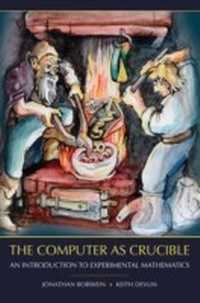
The Computer as Crucible
An Introduction to Experimental Mathematics
1st Edition
Published on 28. October 2008
170 pages
978-1-4398-7691-6 (ISBN)
Description

Keith Devlin and Jonathan Borwein, two well-known mathematicians with expertise in different mathematical specialties but with a common interest in experimentation in mathematics, have joined forces to create this introduction to experimental mathematics. They cover a variety of topics and examples to give the reader a good sense of the current sta
Reviews / Votes
The long experience of both authors can be clearly seen in the way they describe a number of problems ... they succeeded in exactly the right balance between mathematical depth and accessibility for a wide audience. The result is an easily digestible book full of humor for anyone with an affinity for mathematics ...-Dan Roozemond, Nieuw Archief voor Wiskunde
The sleuth-like style and lucid writing certainly make this book an enjoyable read. Many explanations are framed by relevant historical context and tales of mathematicians whose use of experimental mathematics helped them gain insights into difficult problems. . . . I thoroughly enjoyed reading this short introduction to experimental mathematics. It will no doubt appeal to a broad mathematical audience, both professional and amateur alike.
-Mitch Wheat, Gazette of the Australian Mathematical Society, July 2009
It is a pleasant and readable book for any working mathematician who wants to know something more about the use of computers for generating hypotheses on relations among known and less known special numbers.
-Newsletter of the European Mathematical Society, June 2009
... allows [the reader] to take a look at some interesting problems and solve [them] using [a] computer. The authors are showing how a mathematician can use a computer as a tool. ... The book covers a variety of topics and examples in order to give the reader a good sense of the current state of play in the rapidly growing new field of experimental mathematics. ... The writing is clear and the explanations are enhanced by relevant historical facts and stories of mathematicians and their encounters with the field over time. The book will be of interest to any reader who would like to taste the solving of mathematical problems with a computer. No matter if readers may not have much mathematical knowledge: they can catch the essentials with the book, and have fun exploring some questions.
-Valentina Dagiene, Zentralblatt MATH, September 2009
... a pleasant and readable book for any working mathematician who wants to know something more about the use of computers for generating hypotheses on relations among known and less known special numbers.
-EMS Newsletter, June 2009
... a lovely little book which builds a strong case for experimental mathematics. Any practicing mathematician or serious amateur should consider checking out this introduction to a topic that will no doubt transform mathematics.
-Antonio Cangiano, Math-Blog.com, July 2010
More details
Language
English
Place of publication
Florida
United States
Publishing group
Taylor & Francis Inc
Target group
College/higher education
File size
3,02 MB
ISBN-13
978-1-4398-7691-6 (9781439876916)
Copyright in bibliographic data and cover images is held by Nielsen Book Services Limited or by the publishers or by their respective licensors: all rights reserved.
Schweitzer Classification
Other editions
Additional editions
Book
11/2017
1st Edition
CRC Press
€289.69
Shipment within 10-20 days
Book
10/2008
1st Edition
A K Peters
€48.50
Shipment within 3-4 weeks
Content
Preface, 1 What Is Experimental Mathematics?, 2 What Is the Quadrillionth Decimal Place of p?, 3 What Is That Number?, 4 The Most Important Function in Mathematics, 5 Evaluate the Following Integral, 6 Serendipity, 7 Calculating p, 8 The Computer Knows More Math Than You Do, 9 Take It to the Limit, 10 Danger! Always Exercise Caution When Using the Computer, 11 Stuff We Left Out (Until Now), Answers and Reflections, Final Thought, Additional Reading and References
