

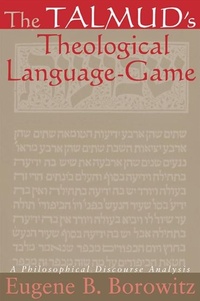
The Talmud's Theological Language-Game
Description

In this pioneering effort, noted Jewish philosopher Eugene B. Borowitz opens up the rules by which the language-game of aggadic discourse is carried on in the Talmud, the foundational document of rabbinic and all later Judaism. These findings are compared with the aggadah (the realm in which almost all explicit statements about classic Jewish religious belief occur) of some other early rabbinic writings. Two issues drive Borowitz's inquiry: What, if anything, constrains the unprecedented freedom of this realm? and How might one positively characterize the aggadah? Borowitz introduces us to the rabbis not only in their amazing profundity, but also in their unguarded humanity. He concludes with a reflection on how this old Jewish language-game should influence contemporary Jewish thought, and, perhaps, other religious thought as well.
Eugene B. Borowitz is Distinguished University Professor and the Sigmund L. Falk Distinguished Professor of Education and Jewish Religious Thought at the Hebrew Union College-Jewish Institute of Religion. He is the author of many books, including Studies in the Meaning of Judaism and The Mask Jews Wear: The Self-Deceptions of American Jewry, winner of the National Jewish Book Award in the realm of Jewish thought.
More details
Other editions
Additional editions
Person
Eugene B. Borowitz is Distinguished University Professor and the Sigmund L. Falk Distinguished Professor of Education and Jewish Religious Thought at the Hebrew Union College-Jewish Institute of Religion. He is the author of many books, including Studies in the Meaning of Judaism and The Mask Jews Wear: The Self-Deceptions of American Jewry, winner of the National Jewish Book Award in the realm of Jewish thought.
Content
Preface
Part One. Entering the Maze of Rabbinic Diction
Introduction to a Religious Puzzle
1. What Is the Aggadah Problem?
Part Two. Scrutinizing Talmudic Aggadah at Three Levels
2. The Surface Characteristics
3. The Substantive Concerns
4. The "Logic"
5. Does Extending the Sample Alter the Finding?
Part Three. The Limits and Nature of Aggadah
6. Is Aggadic Discourse Self-Limiting?
7. Positively, What Is Aggadah
8. Reconstruing the Aggadah Problem
Afterword
Notes
Bibliography of Works Cited
Tina Weiss
Index
