

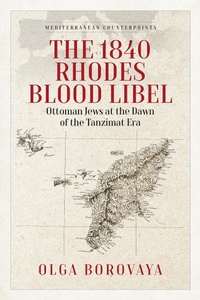
The 1840 Rhodes Blood Libel
Description

Based on newly discovered Ottoman and Jewish sources and using a legal lens on Levantine practices, The 1840 Rhodes Blood Libel argues that the acquittal of Rhodian Jews following a ritual murder charge is only adequately understood in the context of the Tanzimat and the Sublime Porte's foreign relations, and in the context of a shared Ottoman and Jewish history.
More details
Other editions
Additional editions
Person
Olga Borovaya is an independent scholar who has taught Sephardi history and Ladino literature at Stanford, Johns Hopkins, and other US universities. She is the author of Modern Ladino Culture: Press, Belles Lettres, and Theater in the Late Ottoman Empire (Indiana University Press, 2011), which was a finalist for the National Jewish Book Award, and The Beginnings of Ladino Literature: Moses Almosnino and His Readers (Indiana University Press, 2017).
Content
Acknowledgments
Note on Translations and Transcriptions
Introduction
Part I: 1840: Events and Analysis
Chapter 1. Rhodes: The Island and Its Inhabitants
Chapter 2. The Crisis, Rhodes, February-May
Chapter 3. The Rhodes Affair: An Episode in the History of Ottoman Reforms
Part II: 1840-1893: Voices from Rhodes
Chapter 4. Immediate Reactions: The Prose Accounts
Chapter 5. From Collective Memory to History: The Songs and the Notes
Conclusion
Appendix I
Appendix II
Appendix III
Appendix IV
Bibliography
Index
