

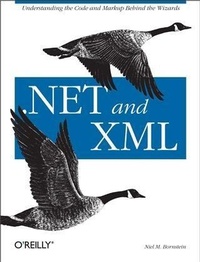
.NET & XML
Understanding the Code and Markup Behind the Wizards
Published on 24. November 2003
476 pages
978-1-4919-0130-4 (ISBN)
Description

If you're seeking ways to build network-based applications or XML-based web services, Microsoft provides most of the tools you'll need. XML is integrated into the .NET Framework and Visual Studio .NET, but if you want to get a grasp on how .NET and XML actually work together, that's a different story. With .NET & XML, you can get under the hood to see how the .NET Framework implements XML, giving you the skills to write understandable XML-based code that interoperates with code written with other tools, and even other languages..NET & XML starts by introducing XML and the .NET Framework, and then teaches you how to read and write XML before moving on to complex methods for manipulating, navigating, transforming, and constraining it. To demonstrate the power of XML in .NET, author Niel Bornstein builds a simple hardware store inventory system throughout the book. As you move from chapter to chapter, you'll absorb increasingly complex information until you have enough knowledge to successfully program your own XML-based applications. This tutorial also contains a quick reference to the API, plus appendices present additional .NET assemblies that you can use to work with XML, and how to work with the .NET XML configuration file format.One study puts the potential market for new software based on XML at or near $100 billion over the next five years. The .NET Framework gives you a way to become a part of it. But to use XML and .NET effectively, you need to understand how these two technologies work together. This book gives you the insight to take full advantage of the power the two provide.
More details
Other editions
Additional editions
Content
- Cover
- Copyright
- Table of Contents
- Copyright
- Preface
- Organization of This Book
- Who Should Read This Book?
- About XML and Web Services
- About the Sample Code
- Why C#?
- Running the Examples
- Style Conventions
- How to Contact Us
- Acknowledgments
- Part I. Processing XML with .NET
- Chapter 1. Introduction to .NET and XML
- The .NET Framework
- The XML Family of Standards
- Introduction to XML in .NET
- Key Concepts
- Moving On
- Chapter 2. Reading XML
- Reading Data
- Filesystem I/O
- Network I/O
- Network Access Through a Web Proxy
- XmlReader
- Pull Parser Versus Push Parser
- When to Use XmlReader
- Using the XmlReader
- Moving On
- Chapter 3. Writing XML
- Writing Data
- Filesystem I/O
- Network I/O
- XmlWriter and Its Subclasses
- When to Use XmlWriter
- Using the XmlWriter
- Moving On
- Chapter 4. Reading and Writing Non-XML Formats
- Reading Non-XML Documents with XmlReader
- Reading a PYX Document
- Writing an XmlPyxReader
- Testing XmlPyxReader
- Using XmlPyxReader
- Writing an XmlPyxWriter
- Moving On
- Chapter 5. Manipulating XML with DOM
- What Is the DOM?
- A Brief Introduction to the DOM Specification
- When to Use the DOM
- The .NET DOM Implementation
- The XmlImplementation
- The XmlNode Type Hierarchy
- Creating an XmlDocument
- Reading an XmlDocument
- Changing an XmlDocument
- Moving On
- Chapter 6. Navigating XML with XPath
- What Is XPath?
- Introduction to the XPath Specification
- When to Use XPath
- Using XPath
- XmlNode
- XPathDocument
- Navigating a Non-XML Document with XPath
- Moving On
- Chapter 7. Transforming XML with XSLT
- The Standards
- Introducing XSLT
- A Brief Introduction to the XSLT Specification
- When to Use XSLT
- Using XSLT
- Transforming an XML Document
- Associating a Stylesheet with an XML Document
- Working with a Stylesheet Programmatically
- Scripting with XslTransform
- Moving On
- Chapter 8. Constraining XML with Schemas
- Introducing W3C XML Schema
- Using W3C XML Schema
- When to Use W3C XML Schema
- Other Ways to Constrain XML Structure
- Using the XSD Tool
- Generating a Schema from an XML Document
- Generating a Schema from a DLL or Executable
- Generating Types from a Schema
- Generating a DataSet Subclass from a Schema
- Working with Schemas
- Creating a Schema Programmatically
- Manipulating an Existing Schema
- Moving On
- Chapter 9. SOAP and XML Serialization
- Defining Serialization
- Introducing the SOAP Specification
- When to Use Serialization
- SOAP Versus XML-RPC
- Runtime Serialization
- XML Serialization
- SOAP Serialization
- Moving On
- Chapter 10. XML and Web Services
- Defining Web Services
- HTTP
- XML
- XML Schema
- SOAP
- WSDL
- UDDI
- Where to Learn More About Web Services
- Using Web Services
- Choosing a Web Services Provider
- Creating a Web Service
- Issuing a Web Service Request
- Generating Client Code
- Building Requests with Remoting
- Publishing a Web Service
- Moving On
- Chapter 11. XML and Databases
- Introduction to ADO.NET
- Reading Data
- Updating Data
- Building a SQL Command
- Manipulating Data Offline
- Creating a DataSet
- Populating a DataSet
- Generating a DataSet
- Connecting a DataSet to the Database
- Tracking Changes to a DataSet
- Reading XML from a Database
- Reading XML Data Directly
- Reading Data Into a DOM Tree
- Hierarchical XML
- Transformation
- Synchronizing Data
- Part II. .NET XML Namespace Reference
- Chapter 12. How to Use These Quick Reference Chapters
- Finding a Quick-Reference Entry
- Reading a Quick-Reference Entry
- Type Name, Namespace, Assembly, Type Category, and Flags
- Description
- Synopsis
- Class Hierarchy
- Cross References
- A Note About Type Names
- Chapter 13. The Microsoft.XmlDiffPatch Namespace
- Using the XmlDiffPatch Namespace
- The XDL Diffgram format
- Using the XmlDiff and XmlPatch Executables
- Microsoft.XmlDiffPatch Namespace Reference
- Chapter 14. The Microsoft.XsdInference Namespace
- Using the XsdInference Namespace
- Using the Infer Executable
- Microsoft.XsdInference Namespace Reference
- Chapter 15. The System.Configuration Namespace
- The Configuration Files
- The Security Configuration Files
- The Machine Configuration File
- The Application Configuration File
- Adding Your Own Configuration Settings
- Using the appSettings Element
- Custom Elements
- System.Configuration Namespace Reference
- Chapter 16. The System.Xml Namespace
- Chapter 17. The System.Xml.Schema Namespace
- Chapter 18. The System.Xml.Serialization Namespace
- Chapter 19. The System.Xml.XPath Namespace
- Chapter 20. The System.Xml.Xsl Namespace
- Chapter 21. Type, Method, Property, and Field Index
- About the Author
