

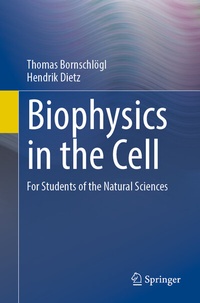
Biophysics in the Cell
Description

This textbook is for all students of the natural sciences who want to understand and apply physical concepts to better describe fundamental cellular processes. For example, the phenomena of diffusion as well as the mechanics of macromolecules and of the cell membrane are treated and illustrated with many examples. Furthermore, the formation of fibrous proteins of the cytoskeleton as well as enzyme kinetics and the functioning of molecular motors are discussed.
This compact book builds on a two-semester lecture entitled Biophysics in the Cell, given at the Technical University of Munich. To emphasize different approaches and thus make them more comprehensible, important formulas are often derived in different ways. "By the way" sections, highlighting historical or current backgrounds and the scientific zeitgeist of the respective research, enrich the material in an entertaining way. Attractive, clear and modern illustrations give the book a special charm in addition to the technically up-to-date andcomprehensibly presented content.
From the contents:
- Origin and structure of cells, basic concepts of biophysics and important basics of thermodynamics and statistical mechanics
- Passive motion by diffusion: physical description of diffusion, lattice models, diffusion in a potential, biochemical reactions
- Mechanics of beams, polymers and membranes: elastic properties of biological components, forces, bending, stretching, stretching and rupture of the cell membrane and cytoskeleton.
- Active movement and enzyme kinetics: functioning of enzymes, molecular motors and the dynamics of fibre proteins in the cytoskeleton
More details
Other editions
Additional editions
Persons
The authors
After studying physics at the LMU Munich, Thomas Bornschlögl completed his doctorate in the field of single-molecule force spectroscopy, where he investigated the mechanics of special protein structures, and subsequently researched the mechanics and dynamics of the cytoskeleton of cells at the Institut Curie in Paris. Since 2016, he has headed the microscopy department at L'Oréal's research facility in Paris.
Hendrik Dietz studied physics in Paderborn, Zaragoza (Spain) and at the LMU Munich. After receiving his PhD in biophysics on protein mechanics from TU Munich, he did research at Harvard Medical School, Boston, USA and turned to creating artificial molecular structures. Since 2009, he has been Professor of Experimental Biophysics at TU Munich, where he specifically uses self-assembly and self-organization to develop new molecular nanodevices and molecular machines.Content
Preface.- About the Authors.- List of "By the way" Sections.- Introduction.- Things You Might Already Know.- Passive Movement by Diffusion.-
On the Mechanics of Beams, Polymers, and Membranes.- Active Movement and Enzyme Kinetics.- What We Haven't Talked About.- Bibliography.- Index.
