

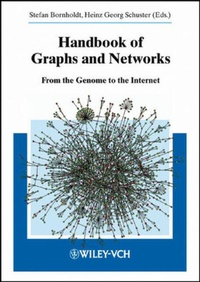
Handbook of Graphs and Networks
From the Genome to the Internet
1st Edition
Published on 6. March 2006
XVI, 401 pages
978-3-527-60633-7 (ISBN)
Description

Complex interacting networks are observed in systems from such diverse areas as physics, biology, economics, ecology, and computer science. For example, economic or social interactions often organize themselves in complex network structures. Similar phenomena are observed in traffic flow and in communication networks as the internet. In current problems of the Biosciences, prominent examples are protein networks in the living cell, as well as molecular networks in the genome. On larger scales one finds networks of cells as in neural networks, up to the scale of organisms in ecological food webs.
This book defines the field of complex interacting networks in its infancy and presents the dynamics of networks and their structure as a key concept across disciplines.
The contributions present common underlying principles of network dynamics and their theoretical description and are of interest to specialists as well as to the non-specialized reader looking for an introduction to this new exciting field.
Theoretical concepts include modeling networks as dynamical systems with numerical methods and new graph theoretical methods, but also focus on networks that change their topology as in morphogenesis and self-organization. The authors offer concepts to model network structures and dynamics, focussing on approaches applicable across disciplines.
This book defines the field of complex interacting networks in its infancy and presents the dynamics of networks and their structure as a key concept across disciplines.
The contributions present common underlying principles of network dynamics and their theoretical description and are of interest to specialists as well as to the non-specialized reader looking for an introduction to this new exciting field.
Theoretical concepts include modeling networks as dynamical systems with numerical methods and new graph theoretical methods, but also focus on networks that change their topology as in morphogenesis and self-organization. The authors offer concepts to model network structures and dynamics, focussing on approaches applicable across disciplines.
Reviews / Votes
"Overall, this reviewer highly recommends this 'Handbook of Graphs and Networks', both for the nonspecialist students and researchers and the experts as well. It serves as a good source of reference for both communities...:... an interested reader does profit from this collection of minireviews and likely becomes invigorated to do his/her own research in this fascinating field. Being so, this book belongs on the desk of any practitioner of this new and exciting research area."Chemphyschem
"This book is excellent for inspiring ecologist brains."
Community Ecology
More details
Other editions
Additional editions
Stefan Bornholdt | Heinz Georg Schuster
Handbook of Graphs and Networks
From the Genome to the Internet
Book
11/2002
1st Edition
Wiley-VCH
€142.00
Article exhausted; check for reprint
Persons
Authors:
Lada A. Adamic, Uri Alon, Daniel ben-Avraham, Albert-Lásló Barabási, Béla Bollobás, Reuven Cohen, Sergei N. Dorogovtsev, Barbara Drossel, Shlomo Havlin, Bernardo A. Huberman, Sanjay Jain, Wolfgang Kinzel, Alan Kirman, Sandeep Krishna, Rajan M. Lukose, Sergei Maslov, Alan J. McKane, Jose F. F. Mendes, Kai Nagel, Mark Newman, Romualdo Pastor-Satorras, Oliver M. Riordan, Kim Sneppen, Ricard V. Solé, Sorin Solomon, Ralf J. Sommer, Alessandro Vespignani, Gérard Weisbuch
Lada A. Adamic, Uri Alon, Daniel ben-Avraham, Albert-Lásló Barabási, Béla Bollobás, Reuven Cohen, Sergei N. Dorogovtsev, Barbara Drossel, Shlomo Havlin, Bernardo A. Huberman, Sanjay Jain, Wolfgang Kinzel, Alan Kirman, Sandeep Krishna, Rajan M. Lukose, Sergei Maslov, Alan J. McKane, Jose F. F. Mendes, Kai Nagel, Mark Newman, Romualdo Pastor-Satorras, Oliver M. Riordan, Kim Sneppen, Ricard V. Solé, Sorin Solomon, Ralf J. Sommer, Alessandro Vespignani, Gérard Weisbuch
Content
Bela Bollobas and Oliver Riordan:
1. Mathematical Results on Scale-free Random Graphs
Mark Newman:
2. Random Graphs as Models of Networks
Albert-Lázló Barabási:
3. Emergence of Scaling in Complex Networks
R. Cohen, S. Havlin, and D. ben-Avraham:
4. Structural Properties of Scale-Free Networks
Romualdo Pastor-Satorras and Alessandro Vespignani:
5. Epidemics and Immunization in Scale-free Networks
Ralf J. Sommer:
6. Cells and Genes as Networks in Nematode Development and Evolution
Ricard V. Solé and Romualdo Pastor-Satorras:
7. Complex Networks in Genomics and Proteomics
Sergei Maslov, Kim Sneppen and Uri Alon:
8. Correlation Profiles and Motifs in Complex Networks
Wolfgang Kinzel:
9. Theory of Interacting Neural Networks
B. Drossel and A. J. McKane:
10. Modelling Food Webs
Kai Nagel:
11. Traffic Networks
Alan Kirman:
12. Economic Networks
Lada A. Adamic, Rajan M. Lukose and Bernardo A. Huberman:
13. Local Search in Unstructured Networks
S.N. Dorogovtsev and J.F.F. Mendes:
14. Accelerated Growth of Networks
Gérard Weisbuch and Sorin Solomon:
15. Social Percolators and Self
Organized Criticality
Sanjay Jain and Sandeep Krishna:
16. Graph Theory and the Evolution of Autocatalytic Networks
1. Mathematical Results on Scale-free Random Graphs
Mark Newman:
2. Random Graphs as Models of Networks
Albert-Lázló Barabási:
3. Emergence of Scaling in Complex Networks
R. Cohen, S. Havlin, and D. ben-Avraham:
4. Structural Properties of Scale-Free Networks
Romualdo Pastor-Satorras and Alessandro Vespignani:
5. Epidemics and Immunization in Scale-free Networks
Ralf J. Sommer:
6. Cells and Genes as Networks in Nematode Development and Evolution
Ricard V. Solé and Romualdo Pastor-Satorras:
7. Complex Networks in Genomics and Proteomics
Sergei Maslov, Kim Sneppen and Uri Alon:
8. Correlation Profiles and Motifs in Complex Networks
Wolfgang Kinzel:
9. Theory of Interacting Neural Networks
B. Drossel and A. J. McKane:
10. Modelling Food Webs
Kai Nagel:
11. Traffic Networks
Alan Kirman:
12. Economic Networks
Lada A. Adamic, Rajan M. Lukose and Bernardo A. Huberman:
13. Local Search in Unstructured Networks
S.N. Dorogovtsev and J.F.F. Mendes:
14. Accelerated Growth of Networks
Gérard Weisbuch and Sorin Solomon:
15. Social Percolators and Self
Organized Criticality
Sanjay Jain and Sandeep Krishna:
16. Graph Theory and the Evolution of Autocatalytic Networks
