

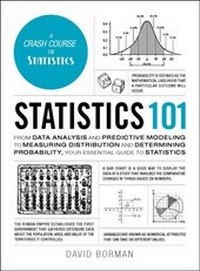
Statistics 101
From Data Analysis and Predictive Modeling to Measuring Distribution and Determining Probability, Your Essential Guide to Statistics
1st Edition
Published on 18. December 2018
240 pages
978-1-5072-0818-2 (ISBN)
Description

A comprehensive guide to statistics?with information on collecting, measuring, analyzing, and presenting statistical data?continuing the popular 101 series.
Data is everywhere. In the age of the internet and social media, we're responsible for consuming, evaluating, and analyzing data on a daily basis. From understanding the percentage probability that it will rain later today, to evaluating your risk of a health problem, or the fluctuations in the stock market, statistics impact our lives in a variety of ways, and are vital to a variety of careers and fields of practice.
Unfortunately, most statistics text books just make us want to take a snooze, but with Statistics 101, you'll learn the basics of statistics in a way that is both easy-to-understand and apply. From learning the theory of probability and different kinds of distribution concepts, to identifying data patterns and graphing and presenting precise findings, this essential guide can help turn statistical math from scary and complicated, to easy and fun.
Whether you are a student looking to supplement your learning, a worker hoping to better understand how statistics works for your job, or a lifelong learner looking to improve your grasp of the world, Statistics 101 has you covered.
Data is everywhere. In the age of the internet and social media, we're responsible for consuming, evaluating, and analyzing data on a daily basis. From understanding the percentage probability that it will rain later today, to evaluating your risk of a health problem, or the fluctuations in the stock market, statistics impact our lives in a variety of ways, and are vital to a variety of careers and fields of practice.
Unfortunately, most statistics text books just make us want to take a snooze, but with Statistics 101, you'll learn the basics of statistics in a way that is both easy-to-understand and apply. From learning the theory of probability and different kinds of distribution concepts, to identifying data patterns and graphing and presenting precise findings, this essential guide can help turn statistical math from scary and complicated, to easy and fun.
Whether you are a student looking to supplement your learning, a worker hoping to better understand how statistics works for your job, or a lifelong learner looking to improve your grasp of the world, Statistics 101 has you covered.
More details
Other editions
Additional editions
David Borman
Statistics 101
From Data Analysis and Predictive Modeling to Measuring Distribution and Determining Probability, Your Essential Guide to Statistics
Book
12/2018
Adams Media Corporation
€16.50
Shipment within 10-20 days
Person
David Borman has been involved in the financial markets and trading since 1999. He has professionally worked at Deutsche Bank, Merrill Lynch, TCM Custom House, Morgan Stanley, and Phillip Capital. He has been exposed to the trading and day trading of mutual funds, stocks, ETFs, Leveraged ETFs, Commodities, and Derivatives. He has worked right alongside the Risk Management Desk of a Singapore Based Futures Commission Merchant, where fifty million dollar margin calls were a daily occurrence. Within his own account, he has traded extensively using ETFs, precious metals, and currencies. He holds a BS in finance from Southern Illinois University, and a masters in accounting from DePaul University, and is working on his PhD in financial management from Northcentral University. When not trading, David finds the time shop for treasures at local antique shops. He is the author of Day Trading 101.
Content
- Intro
- Introduction
- The Basics of Statistics
- How Statistics Are Used
- Key Points of Statistical Analytics
- Mixing Up the Test
- Knowing the Quality of Your Data
- Modeling Risk, Measuring Samples, and Predicting
- Frequency Distributions
- Dot Plots, Bar Charts, Histograms, Frequency Polygons
- More Ways to See Numbers-Based Data
- The Mean, the Median, and the Mode
- The Range and Interquartile Range
- Mean Deviations and Variations
- The Law of Large Numbers
- Empirical Probability and Subjective Probability
- Yes or No
- Basics of Probability Distributions
- Analyzing Probability Distributions
- The Roll of the Dice
- Normal Distribution
- The Central Limit Theorem
- Outliers on the Bell Curve
- Limited and Unlimited Data
- Variance as a Measure of Risk
- Size Matters
- Measuring Distribution
- What Are Confidence Intervals?
- Measuring Confidence Intervals
- The Basics of Hypothesis Testing
- Taking It to the Next Level
- Measuring Large Sample Population Proportions
- The Hypothesis Test
- Patterns in Data
- Predicting the Future
- The t-Distribution
- Groups of Data
- Tests for Two Populations
- Statistics in Academic Research
- Getting Good Data
- A Regression Example
- What Regression Data Tables Tell Us
- Determining the Causes
- Chi-Square Distribution
- ANOVA Basics
- ANOVA at Work
- Quantitative Research Design
- Quality of the Data
- Quantity and Sourcing of the Data
- Appropriate Survey Design
- The Ethics of Statistics
- Big Data, Supercomputers, and Artificial Intelligence
- Photographs
- About the Author
- Index
- Copyright
