

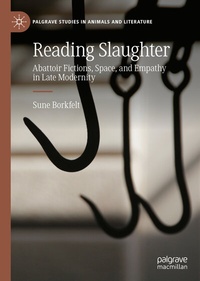
Reading Slaughter
Description

Reading Slaughter: Abattoir Fictions, Space, and Empathy in Late Modernity examines literary depictions of slaughterhouses from the development of the industrial abattoir in the late nineteenth century to today. The book focuses on how increasing and ongoing isolation and concealment of slaughter from the surrounding society affects readings and depictions of slaughter and abattoirs in literature, and on the degree to which depictions of animals being slaughtered creates an avenue for empathic reactions in the reader or the opportunity for reflections on human-animal relations. Through chapters on abattoir fictions in relation to narrative empathy, anthropomorphism, urban spaces, rural spaces, human identities and horror fiction, Sune Borkfelt contributes to debates in literary animal studies, human-animal studies and beyond.
Reviews / Votes
"Reading Slaughter makes an important contribution to animal studies. Well-researched and wide-ranging, it is a commendable work of survey and close reading that takes one of the key sites of human-animal relations, the slaughterhouse, and subjects it to a long overdue book-length interrogation. . it is a welcome reminder of why we have literary animal studies in the first place." (Dominic O'Key, The Year's Work in Critical and Cultural Theory, May 8, 2023)More details
Other editions
Additional editions
Person
Sune Borkfelt lectures at Aarhus University, Denmark. His publications include articles and book chapters on nonhuman otherness, postcolonial animals, the naming of nonhuman animals, and the ethics of animal product marketing. He is also co-author of a critical research-based Danish book on hunting.
Content
1. Introduction: Fleshing Out Invisibilities.- 2. Literary Narratives and the Empathics of Slaughter.- 3. Anthropomorphism and the Abattoir.- 4. Flesh of the City: Slaughterhouses and the Urban.- 5. Ruralities and the Abattoir.- 6. Who Slaughters and Who Consumes? On Butcher(ing) Identities.- 7. Dark Spaces: The Horrific Slaughterhouse.- 8. Coda.
