

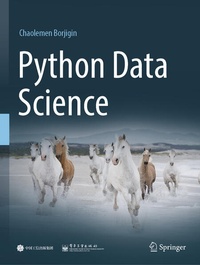
Python Data Science
Description

Rather than presenting Python as Java or C, this textbook focuses on the essential Python programming skills for data scientists and advanced methods for big data analysts.
Unlike conventional textbooks, it is based on Markdown and uses full-color printing and a code-centric approach to highlight the 3C principles in data science: creative design of data solutions, curiosity about the data lifecycle, and critical thinking regarding data insights. Q&A-based knowledge maps, tips and suggestions, notes, as well as warnings and cautions are employed to explain the key points, difficulties, and common mistakes in Python programming for data science. In addition, it includes suggestions for further reading.
This textbook provides an open-source community via GitHub, and the course materials are licensed for free use under the following license: Creative Commons Attribution-NonCommercial-NoDerivatives 4.0 International (CC BY-NC-ND 4.0).
More teaching materials including Codes, Datasets, Slides, Syllabus can be found at https://github.com/LemenChao/PythonDataScience
More details
Other editions
Additional editions
Person
Chaolemen Borjigin is an associate professor at Renmin University of China, and one of the top 50 data science influencers in China. He is a member of the Information System Special Committee of the Chinese Computer Federation, deputy director of the Expert Committee of the National University Artificial Intelligence and Big Data Innovation Alliance of China, executive editorial board member of the academic journal Computer Science , and deputy editor-in-chief of the international journal Data Science and Informatics .
He is the author of Data Science (Tsinghua University Press, 2016), the first monograph in China that systematically introduced data science principles, theories, methods, technologies, and tools. His textbook Data Science Theory and Practice (Second Edition) was recognized as a high-quality textbook by the Beijing Municipal Education Commission in 2019. His course Introduction to Data Science is one of the China National First-ClassUndergraduate Courses.
