

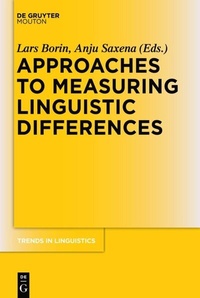
Approaches to Measuring Linguistic Differences
1st Edition
Published on 14. October 2013
VIII, 545 pages
978-3-11-030525-8 (ISBN)
Description

The present volume collects contributions addressing different aspects of the measurement of linguistic differences, a topic which probably is as old as language itself but at the same time has acquired renewed interest over the last decade or so, reflecting a rapid development of data-intensive computing in all fields of research, including linguistics.
More details
Series
Language
English
Place of publication
Berlin/Boston
Germany
Publishing group
de Gruyter Mouton
Target group
Professional and scholarly
US School Grade: College Graduate Student
Illustrations
62 s/w Tabellen
62 b/w tbl.
File size
8,86 MB
ISBN-13
978-3-11-030525-8 (9783110305258)
Schweitzer Classification
Other editions
Additional editions
Lars Borin | Anju Saxena
Approaches to Measuring Linguistic Differences
Book
06/2016
1st Edition
De Gruyter Mouton
€29.95
Shipment within 7-9 days
Lars Borin | Anju Saxena
Approaches to Measuring Linguistic Differences
Book
09/2013
1st Edition
De Gruyter Mouton
€189.95
Shipment within 7-9 days
Persons
Lars Borin, University of Gothenburg, Sweden; Anju Saxena, Uppsala University, Sweden.
Content
1 - Preface [Seite 5]
2 - Introduction [Seite 9]
2.1 - The why and how of measuring linguistic differences [Seite 11]
3 - Case studies [Seite 35]
3.1 - Contrasting linguistics and archaeology in the matrix model: GIS and cluster analysis of the Arawakan languages [Seite 37]
3.2 - Predicting language-learning difficulty [Seite 65]
3.3 - How aberrant are divergent Indo-European subgroups? [Seite 91]
3.4 - Measuring socially motivated pronunciation differences [Seite 115]
3.5 - Distance-based phylogenetic inference algorithms in the subgrouping of Dravidian languages [Seite 149]
3.6 - Carving Tibeto-Kanauri by its joints: Using basic vocabulary lists for genetic grouping of languages [Seite 183]
3.7 - The effect of linguistic distance across Indo-European mother tongues on learning Dutch as a second language [Seite 207]
3.8 - Using semantically restricted word-lists to investigate relationships among Athapaskan languages [Seite 239]
3.9 - Languages with longer words have more lexical change [Seite 257]
4 - Methods and tools [Seite 291]
4.1 - The Intercontinental Dictionary Series - a rich and principled database for language comparison [Seite 293]
4.2 - Towards automated language classification: A clustering approach [Seite 311]
4.3 - Dependency-sensitive typological distance [Seite 337]
4.4 - Degrees of semantic control in measuring aggregated lexical distances [Seite 361]
4.5 - Word similarity, cognation, and translational equivalence [Seite 383]
4.6 - Comparing linguistic systems of categorisation [Seite 395]
4.7 - Black box approaches to genealogical classification and their shortcomings [Seite 437]
4.8 - Semantic typologies by means of network analysis of bilingual dictionaries [Seite 455]
4.9 - Measuring morphosemantic language distance in parallel texts [Seite 483]
4.10 - Information-theoretic modeling of etymological sound change [Seite 515]
5 - Index [Seite 541]
2 - Introduction [Seite 9]
2.1 - The why and how of measuring linguistic differences [Seite 11]
3 - Case studies [Seite 35]
3.1 - Contrasting linguistics and archaeology in the matrix model: GIS and cluster analysis of the Arawakan languages [Seite 37]
3.2 - Predicting language-learning difficulty [Seite 65]
3.3 - How aberrant are divergent Indo-European subgroups? [Seite 91]
3.4 - Measuring socially motivated pronunciation differences [Seite 115]
3.5 - Distance-based phylogenetic inference algorithms in the subgrouping of Dravidian languages [Seite 149]
3.6 - Carving Tibeto-Kanauri by its joints: Using basic vocabulary lists for genetic grouping of languages [Seite 183]
3.7 - The effect of linguistic distance across Indo-European mother tongues on learning Dutch as a second language [Seite 207]
3.8 - Using semantically restricted word-lists to investigate relationships among Athapaskan languages [Seite 239]
3.9 - Languages with longer words have more lexical change [Seite 257]
4 - Methods and tools [Seite 291]
4.1 - The Intercontinental Dictionary Series - a rich and principled database for language comparison [Seite 293]
4.2 - Towards automated language classification: A clustering approach [Seite 311]
4.3 - Dependency-sensitive typological distance [Seite 337]
4.4 - Degrees of semantic control in measuring aggregated lexical distances [Seite 361]
4.5 - Word similarity, cognation, and translational equivalence [Seite 383]
4.6 - Comparing linguistic systems of categorisation [Seite 395]
4.7 - Black box approaches to genealogical classification and their shortcomings [Seite 437]
4.8 - Semantic typologies by means of network analysis of bilingual dictionaries [Seite 455]
4.9 - Measuring morphosemantic language distance in parallel texts [Seite 483]
4.10 - Information-theoretic modeling of etymological sound change [Seite 515]
5 - Index [Seite 541]
