

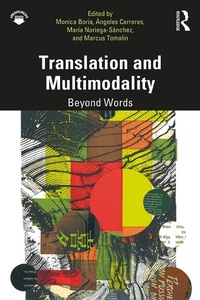
Translation and Multimodality
Beyond Words
1st Edition
Published on 17. October 2019
224 pages
978-1-000-68144-4 (ISBN)
Description

Translation and Multimodality: Beyond Words is one of the first books to explore how translation needs to be redefined and reconfigured in contexts where multiple modes of communication, such as writing, images, gesture, and music, occur simultaneously. Bringing together world-leading experts in translation theory and multimodality, each chapter explores important interconnections among these related, yet distinct, disciplines.
As communication becomes ever more multimodal, the need to consider translation in multimodal contexts is increasingly vital. The various forms of meaning-making that have become prominent in the twenty-first century are already destabilising certain time-honoured translation-theoretic paradigms, causing old definitions and assumptions to appear inadequate. This ground-breaking volume explores these important issues in relation to multimodal translation with examples from literature, dance, music, TV, film, and the visual arts.
Encouraging a greater convergence between these two significant disciplines, this text is essential for advanced students and researchers in Translation Studies, Linguistics, and Communication Studies.
As communication becomes ever more multimodal, the need to consider translation in multimodal contexts is increasingly vital. The various forms of meaning-making that have become prominent in the twenty-first century are already destabilising certain time-honoured translation-theoretic paradigms, causing old definitions and assumptions to appear inadequate. This ground-breaking volume explores these important issues in relation to multimodal translation with examples from literature, dance, music, TV, film, and the visual arts.
Encouraging a greater convergence between these two significant disciplines, this text is essential for advanced students and researchers in Translation Studies, Linguistics, and Communication Studies.
Reviews / Votes
'Translation and multimodality walk a fine line that separates and blends verbal and non-verbal signs. From the interpretations of an ambiguous sign in Dante's Paradiso to the significance of touch in the operating room, the contributors to this volume tackle multimodality in unexplored spaces and in its newest modes.'Delia Chiaro, University of Bologna, Italy
'The role of multimodality in audiovisual translation has been addressed quite widely over the last few years, but Translation and Multimodality: Beyond Words takes us a step further in exploring the impact of multimodality studies on more diverse forms of translation, and indeed on translation tout court. It is a very welcome addition to the subject.'
Christopher Taylor, University of Trieste, Italy
More details
Edition
1. Auflage
Language
English
Place of publication
London
United Kingdom
Publishing group
Taylor & Francis Ltd
Target group
College/higher education
Illustrations
8 Line drawings, black and white; 12 Halftones, black and white; 20 Illustrations, black and white
ISBN-13
978-1-000-68144-4 (9781000681444)
Copyright in bibliographic data and cover images is held by Nielsen Book Services Limited or by the publishers or by their respective licensors: all rights reserved.
Schweitzer Classification
Other editions
Additional editions
Book
10/2019
1st Edition
Routledge
€205.50
Shipment within 10-20 days
Book
10/2019
1st Edition
Routledge
€63.50
Shipment within 10-20 days
Persons
Monica Boria is Affiliated Lecturer in the Department of Italian at the University of Cambridge and a translator.
Angeles Carreres is Senior Language Teaching Officer in the Department of Spanish and Portuguese at the University of Cambridge.
Maria Noriega-Sanchez is Senior Language Teaching Officer in Spanish at the University of Cambridge, and a Fellow in Modern Languages at Sidney Sussex College.
Marcus Tomalin is Fellow at Trinity Hall College, Cambridge, and a Senior Research Associate in the Cambridge Machine Intelligence Laboratory.
Angeles Carreres is Senior Language Teaching Officer in the Department of Spanish and Portuguese at the University of Cambridge.
Maria Noriega-Sanchez is Senior Language Teaching Officer in Spanish at the University of Cambridge, and a Fellow in Modern Languages at Sidney Sussex College.
Marcus Tomalin is Fellow at Trinity Hall College, Cambridge, and a Senior Research Associate in the Cambridge Machine Intelligence Laboratory.
Content
Contents
Acknowledgements
List of figures
List of contributors
Introduction
1. Transposing meaning
2. A theoretical framework for a multimodal conception of translation
3. Meaning-(re)making in a world of untranslated signs
4. From the "cinema of attractions" to danmu
5. Translating "I"
6. The multimodal dimensions of literature in translation
7. Translations between music and dance
8. Writing drawingly
Beyond Words: concluding remarks
Index
Acknowledgements
List of figures
List of contributors
Introduction
1. Transposing meaning
2. A theoretical framework for a multimodal conception of translation
3. Meaning-(re)making in a world of untranslated signs
4. From the "cinema of attractions" to danmu
5. Translating "I"
6. The multimodal dimensions of literature in translation
7. Translations between music and dance
8. Writing drawingly
Beyond Words: concluding remarks
Index
