

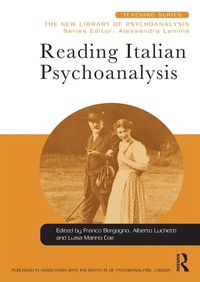
Reading Italian Psychoanalysis
Published on 22. February 2016
758 pages
978-1-317-38812-8 (ISBN)
Description

Winner of the American Board & Academy of Psychoanalysis Prize for best Edited book published in 2016
Psychoanalysis in Italy is a particularly diverse and vibrant profession, embracing a number of influences and schools of thought, connecting together new thinking, and producing theorists and clinicians of global renown. Reading Italian Psychoanalysis provides a comprehensive guide to the most important Italian psychoanalytic thinking of recent years, including work by major names such as Weiss, E.Gaddini, Matte Blanco, Nissim Momigliano, Canestri, Amati Mehler, and Ferro. It covers the most important theoretical developments and clinical advances, with special emphasis on contemporary topics such as transference, trauma and primitive states of mind where Italian work has been particular influential.
In this volume, Franco Borgogno, Alberto Luchetti and Luisa Marino Coe of the Italian Psychoanalytical Society provide an overview of how Italian psychoanalysis has developed from the 1920's to the present day, tracing its early influences and highlighting contemporary developments. Forty-six seminal and representative papers of psychoanalysts belonging to the two Italian psychoanalytical societies (the Italian Psychoanalytical Society and the Italian Association of Psychoanalysis) have been chosen to illuminate what is special about Italian theoretical and clinical thinking, and what is demonstrative of the specificity of its psychoanalytic discourse. The selected papers are preceded by a first introductory section about the history of psychoanalysis in Italy and followed by a "swift glance at Italian psychoanalysis from abroad". They are grouped into sections which represent the areas particularly explored by Italian psychoanalysis. Each section is accompanied by introductory comments which summarize the main ideas and concepts and also their historical and cultural background, so as to offer to the reader either an orientation and stimulus for the debate and to indicate their connections to other papers included in the present volume and to the international psychoanalytic world.
The book is divided into six parts including:
History of psychoanalysis in Italy
Metapsychology
Clinical practice, theory of technique, therapeutic factors
The person of the analyst, countertransference and the analytic relationship/field
Trauma, psychic pain, mourning and working-through
Preverbal, precocious, fusional, primitive states of the mind
This volume offers an excellent and detailed "fresco" of Italian psychoanalytic debate, shining a light on thinking that has evolved differently in France, England, North and Latin America. It is an ideal book for beginners and advanced students of clinical theory as well as experienced psychoanalysts wanting to know more about Italian psychoanalytic theory and technique, and how they have developed.
Psychoanalysis in Italy is a particularly diverse and vibrant profession, embracing a number of influences and schools of thought, connecting together new thinking, and producing theorists and clinicians of global renown. Reading Italian Psychoanalysis provides a comprehensive guide to the most important Italian psychoanalytic thinking of recent years, including work by major names such as Weiss, E.Gaddini, Matte Blanco, Nissim Momigliano, Canestri, Amati Mehler, and Ferro. It covers the most important theoretical developments and clinical advances, with special emphasis on contemporary topics such as transference, trauma and primitive states of mind where Italian work has been particular influential.
In this volume, Franco Borgogno, Alberto Luchetti and Luisa Marino Coe of the Italian Psychoanalytical Society provide an overview of how Italian psychoanalysis has developed from the 1920's to the present day, tracing its early influences and highlighting contemporary developments. Forty-six seminal and representative papers of psychoanalysts belonging to the two Italian psychoanalytical societies (the Italian Psychoanalytical Society and the Italian Association of Psychoanalysis) have been chosen to illuminate what is special about Italian theoretical and clinical thinking, and what is demonstrative of the specificity of its psychoanalytic discourse. The selected papers are preceded by a first introductory section about the history of psychoanalysis in Italy and followed by a "swift glance at Italian psychoanalysis from abroad". They are grouped into sections which represent the areas particularly explored by Italian psychoanalysis. Each section is accompanied by introductory comments which summarize the main ideas and concepts and also their historical and cultural background, so as to offer to the reader either an orientation and stimulus for the debate and to indicate their connections to other papers included in the present volume and to the international psychoanalytic world.
The book is divided into six parts including:
History of psychoanalysis in Italy
Metapsychology
Clinical practice, theory of technique, therapeutic factors
The person of the analyst, countertransference and the analytic relationship/field
Trauma, psychic pain, mourning and working-through
Preverbal, precocious, fusional, primitive states of the mind
This volume offers an excellent and detailed "fresco" of Italian psychoanalytic debate, shining a light on thinking that has evolved differently in France, England, North and Latin America. It is an ideal book for beginners and advanced students of clinical theory as well as experienced psychoanalysts wanting to know more about Italian psychoanalytic theory and technique, and how they have developed.
Reviews / Votes
Until recently psychoanalysis in Italy has evolved in relative isolation from other communities. With the publication of this volume, Anglophone analysts have the opportunity to familiarize themselves with the wide range of perspectives that contribute to what has become an unusually vibrant and creative tradition. Guided by introductions that masterfully illuminate both historical and clinical developments, the reader becomes immersed in ideas that are original and stimulating. This book is essential for analysts interested in learning more about what is happening in Italy, and also for anybody who wishes to enrich their own conceptual and clinical thinking. - Jay Greenberg, Ph.D. Editor, The Psychoanalytic QuarterlyDrs. Borgogno, Luchetti and Marino Coe have done a masterful job in bringing together a comprehensive overview of Italian psychoanalysis. This work offers a rare opportunity for English-speaking colleagues to become acquainted with the outstanding contributions of our Italian colleagues. This book provides an essential education for students and practitioners alike. - Theodore Jacobs, Clinical Professor of Psychiatry Albert Einstein College of Medicine, Emeritus
Reading Italian Psychoanalysis eloquently constitutes an original contribution which questions the great issues of Contemporary Psychoanalysis. This work offers the reader an encounter with the broad Italian psychoanalytic thought from its origins to the present day and constitutes a rich, and unexpected, source for explorations. On the one hand, it encourages the broadening of the psychoanalytic perspective and on the other, it reveals the eloquent manifestations of this perspective in culture and in society. This book has manifold interests, but in particular I would like to emphasize its human dimension and the fervour conveyed by its authors. It is this fervour that turns the reading of this book into a profound, transforming experience. - Luis Kancyper, Training and Supervising Psychoanalyst, Argentine Psychoanalytic Association; Recipient of the M. Sigourney Award, 2014
Despite a long and illustrious history, Italian psychoanalysis has gained international recognition only in recent decades. Now, including such legendary names as Edoardo Weiss, Ignacio Matte Blanco, Parthenope Bion Talamo, and Luciana Nissim Momigliano, as well as its many brilliant contemporary representatives, the collective achievement of this school of interpsychic masters can be appreciated for the first time in this authoritative volume superbly edited by Franco Borgogno, Alberto Luchetti and Luisa Marino Coe. - Peter L. Rudnytsky, University of Florida and Florida Psychoanalytic Institute Until recently psychoanalysis in Italy has evolved in relative isolation from other communities. With the publication of this volume, Anglophone analysts have the opportunity to familiarize themselves with the wide range of perspectives that contribute to what has become an unusually vibrant and creative tradition. Guided by introductions that masterfully illuminate both historical and clinical developments, the reader becomes immersed in ideas that are original and stimulating. This book is essential for analysts interested in learning more about what is happening in Italy, and also for anybody who wishes to enrich their own conceptual and clinical thinking. - Jay Greenberg, Ph.D. Editor, The Psychoanalytic Quarterly
Drs. Borgogno, Luchetti and Marino Coe have done a masterful job in bringing together a comprehensive overview of Italian psychoanalysis. This work offers a rare opportunity for English-speaking colleagues to become acquainted with the outstanding contributions of our Italian colleagues. This book provides an essential education for students and practitioners alike. - Theodore Jacobs, Clinical Professor of Psychiatry Albert Einstein College of Medicine, Emeritus
Reading Italian Psychoanalysis eloquently constitutes an original contribution which questions the great issues of Contemporary Psychoanalysis. This work offers the reader an encounter with the broad Italian psychoanalytic thought from its origins to the present day and constitutes a rich, and unexpected, source for explorations. On the one hand, it encourages the broadening of the psychoanalytic perspective and on the other, it reveals the eloquent manifestations of this perspective in culture and in society. This book has manifold interests, but in particular I would like to emphasize its human dimension and the fervour conveyed by its authors. It is this fervour that turns the reading of this book into a profound, transforming experience. - Luis Kancyper, Training and Supervising Psychoanalyst, Argentine Psychoanalytic Association; Recipient of the M. Sigourney Award, 2014
Despite a long and illustrious history, Italian psychoanalysis has gained international recognition only in recent decades. Now, including such legendary names as Edoardo Weiss, Ignacio Matte Blanco, Parthenope Bion Talamo, and Luciana Nissim Momigliano, as well as its many brilliant contemporary representatives, the collective achievement of this school of interpsychic masters can be appreciated for the first time in this authoritative volume superbly edited by Franco Borgogno, Alberto Luchetti and Luisa Marino Coe. - Peter L. Rudnytsky, University of Florida and Florida Psychoanalytic Institute
More details
Series
Language
English
Place of publication
London
United Kingdom
Publishing group
Taylor & Francis Ltd
Target group
College/higher education
Professional and scholarly
Product notice
Reflowable
Illustrations
1 s/w Tabelle
1 Tables, black and white
File size
3,56 MB
ISBN-13
978-1-317-38812-8 (9781317388128)
Copyright in bibliographic data and cover images is held by Nielsen Book Services Limited or by the publishers or by their respective licensors: all rights reserved.
Schweitzer Classification
Other editions
Additional editions
Franco Borgogno | Alberto Luchetti | Luisa Marino Coe
Reading Italian Psychoanalysis
Book
03/2016
1st Edition
Routledge
€108.50
Shipment within 10-20 days
Franco Borgogno | Alberto Luchetti | Luisa Marino Coe
Reading Italian Psychoanalysis
Book
02/2016
1st Edition
Routledge
€386.04
Shipment within 10-20 days
Persons
Franco Borgogno is Professor of Clinical Psychology (Turin University), Training and Supervising Psychoanalyst of the Italian Psychoanalytical Society and member of the Board of many international psychoanalytic journals and book series. In 2010 he received the Mary S. Sigourney Award.
Alberto Luchetti is Training and Supervising Psychoanalyst of the Italian Psychoanalytical Society. Past Editor of the Rivista di Psicoanalisi, he is Member of the Scientific Board of the Jean Laplanche Foundation's 'New Foundations for Psychoanalysis' of the Institut de France.
Luisa Marino Coe is a member of the Italian Psychoanalytical Society and a guest member of the British Psychoanalytic Society. She is former President of the International Psychoanalytic Studies Organization (IPSO) and Chair of the IPA IPSO Relations Committee. She was Editor of the Italian Psychoanalytic Annual.
Alberto Luchetti is Training and Supervising Psychoanalyst of the Italian Psychoanalytical Society. Past Editor of the Rivista di Psicoanalisi, he is Member of the Scientific Board of the Jean Laplanche Foundation's 'New Foundations for Psychoanalysis' of the Institut de France.
Luisa Marino Coe is a member of the Italian Psychoanalytical Society and a guest member of the British Psychoanalytic Society. She is former President of the International Psychoanalytic Studies Organization (IPSO) and Chair of the IPA IPSO Relations Committee. She was Editor of the Italian Psychoanalytic Annual.
Content
General Introduction Franco Borgogno and Alberto Luchetti Section I: History of psychoanalysis in Italy 1 Psychoanalysis in Italy Giuseppe Di Chiara 2 Themes and developments of psychoanalytic thought in Italy Anna Ferruta Section II: Metapsychology Introduction Alberto Luchetti 3 Expression in Symbolic Logic of the Characteristics of the System Ucs or the logic of the system Ucs Ignacio Matte Blanco 4 Morphology and transformations of psychoanalytic models Francesco Corrao 5 The object in psychoanalysis Jacqueline Amati-Mehler 6 Psychoanalytic transformations Fernando Riolo7 A Bionian hypothesis on the origin of thought Alberto Meotti 8 Transference: Notes on the history of a paradox Francesco Napolitano 9 Transference and unconscious communication: Countertransference, theories and the analyst's narcissism Antonio Alberto Semi 10 Dreams that mirror the session Giuseppe Civitarese 11 Notes on the metapsychological status of reality Francesco Conrotto 2 At the origins of psychoanalysis. Freud, Lipps and the issue of sound and music Francesco Barale (with Vera Minazzi) 13 The discontents of psychoanalysis in the postmodern age Fausto Petrella Section III: Clinical practice, theory of technique, therapeutic factors Introduction Luisa Marino 14 Tact, contact and tactics Glauco Carloni 15 From Strachey's mutative interpretations to interpretations of the relations between internal objects Stefania Turillazzi Manfredi 16 Meeting, telling, and parting: Three basic factors in the psychoanalytic experience Giuseppe Di Chiara 17 Interpretation and construction: The work of transformation in the psychoanalytic practice Jorge Canestri 18 Transformations in dreaming and characters in the psychoanalytic field Antonino Ferro 19 Laying low and saying (almost) nothing Parthenope Bion Talamo 20 Which is the relevant superego for clinical analytic work? Franco De Masi 21 On termination of the analysis Gilda De Simone 22 Transferences in adolescence Anna Maria Nicolo 23 How much reality can we bear? Loredana Micati 24 The foretold lie Giovanna Ambrosio Section IV: The person of the analyst, countertransference and the analytic relationship/field Introduction Franco Borgogno 25 Two people talking in a room: An investigation into the analytic dialogue Luciana Nissim Momigliano 26 The countertransference in the perspective of the persona Davide Lopez 27 The complex nature of psychoanalytic empathy: A theoretical and clinical exploration Stefano Bolognini 28 Chiasma Domenico Chianese 29 Reverie and metaphor: A particular way to investigate the unconscious in psychoanalytical practice Roberto Speziale-Bagliacca 30 Field Theory and trans-generational phantasies Claudio Neri 31 On countertransference Lucio Russo 32 The person of the analyst. Interpreting, not interpreting, and countertransference Vincenzo Bonaminio Section V: Trauma, psychic pain, mourning and working-through Introduction Franco Borgogno 33 Agoraphobia and its relation to hysterical attacks and to traumas Edoardo Weiss 34 The rejected infant: Reflections on depersonalisation Roberto Tagliacozzo 35 Surviving, existing, living: Reflections on the analyst's anxiety Dina Vallino Maccio 36 Some thoughts on inauthenticity Franca Meotti 37 On the patient's becoming an individual: The importance of the
analyst's personal response to a deprived schizoid patient Franco Borgogno 38 'The dead Sybil': Reparation and restitution of an absence Andreas Giannakoulas 39 Violated minds. Thoughts on Dora, Schreber, Paul and others Giovanna Goretti Regazzoni 40 Trauma and psychic pain during the first life experiences Tonia Cancrini Section VI: Preverbal, precocious, fusional, primitive states of the mind Introduction Franco Borgogno 41 On imitation Eugenio Gaddini 42 Psychic birth Franco Fornari 43 Defence mechanisms and very early levels Simona Argentieri 44 Personification Eugenio Gaburri 45 Reverie deficits and tyrannical transference Marta Badoni 46 'White psychoses': Silence and delusions Adolfo Pazzagli 47 Hysteria, from the origins to the Oedipal constellation: The 'feminine' and the conflict against the otherness Agostino Racalbuto 48 Primitive mental states and the body: A personal view of Armando B. Ferrari's concrete original object Riccardo Lombardi Afterword 49 A swift glance at Italian psychoanalysis from abroad Lesley Caldwell
analyst's personal response to a deprived schizoid patient Franco Borgogno 38 'The dead Sybil': Reparation and restitution of an absence Andreas Giannakoulas 39 Violated minds. Thoughts on Dora, Schreber, Paul and others Giovanna Goretti Regazzoni 40 Trauma and psychic pain during the first life experiences Tonia Cancrini Section VI: Preverbal, precocious, fusional, primitive states of the mind Introduction Franco Borgogno 41 On imitation Eugenio Gaddini 42 Psychic birth Franco Fornari 43 Defence mechanisms and very early levels Simona Argentieri 44 Personification Eugenio Gaburri 45 Reverie deficits and tyrannical transference Marta Badoni 46 'White psychoses': Silence and delusions Adolfo Pazzagli 47 Hysteria, from the origins to the Oedipal constellation: The 'feminine' and the conflict against the otherness Agostino Racalbuto 48 Primitive mental states and the body: A personal view of Armando B. Ferrari's concrete original object Riccardo Lombardi Afterword 49 A swift glance at Italian psychoanalysis from abroad Lesley Caldwell
