

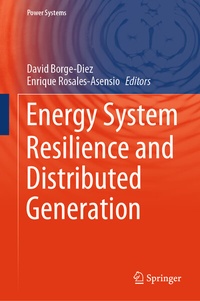
Energy System Resilience and Distributed Generation
Description

This book presents a methodology for assessing the advantages of microgrids from both a business and energy resilience perspective. Microgrids incorporate distributed generators and electrochemical energy storage systems within end-user facilities that have critical loads. By utilizing renewable energy sources and electrochemical energy storage, the life-cycle cost of energy within microgrids connected to the electrical grid can be significantly reduced. Moreover, the book explores how the design of microgrids can enhance the resilience of power supply to customers, as measured by the duration for which the microgrid can sustain an electrical consumer during an outage. This aspect is particularly crucial for buildings with critical loads. The book contains case studies from around the world that demonstrate these lessons.
The book is of interest to researchers and graduate students in power and energy as well as professionals in the power industry.
More details
Other editions
Additional editions
Persons
Dr. David Borge-Diez has a Ph.D. in Energy Engineering and master's degrees in Industrial Technology Research and is an industrial engineer and bachelor in industrial engineering. His work in teaching and as a researcher is focused on the field of energy, with special emphasis on the use of unconventional energy sources and energy efficiency. For more than 8 years, he has worked in different private companies nationally and internationally developing research projects and engineering work, whilst he has made this activity compatible with teaching and research in different universities and organizations.
Dr. Rosales-Asensio (Ph.D.) is an industrial engineer with postgraduate degrees in electrical engineering, business administration, and quality, health, safety, and environment management systems. Currently, he is an associate professor at the University of Las Palmas de Gran Canaria. He has also worked as a plant engineer for a company that focuses on the design, development, and manufacture of waste-heat-recovery technology for large reciprocating engines and as a project manager in a world-leading research centre
Content
1. Energy resilience: definition and assessment.- 2. Adaptive Resilience Metrics for DER-Rich Electric Distribution Systems.- 3. Maintaining energy resilience through adaptation.- 4. External Resilience Assessment of Energy Critical Infrastructure.- 5. Enhancing resilience of active distribution networks to extreme weather events now and in the future.- 6. Peak load reduction and resilience benefits in critical microgrids.- 7. A Multilayer Approach for Resilience Assessment of Power Distribution Systems using Dynamic Bayesian Networks.- 8. Economic and resilience improvement for radial and meshed grids.- 9. Resilience improvement in office buildings with critical loads.- 10. Resilience improvement in preCOVID-19 medical centers.- 11. Resilience improvement in postCOVID-19 medical centers.
