

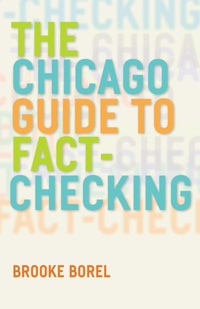
The Chicago Guide to Fact-Checking
Description

An accessible, one-stop guide to the why, what, and how of contemporary editorial fact-checking.
"An indispensable resource in the age of 'fake news,' this slim but informative title offers writers, researchers, and journalists best practices for fact-checking in a wide variety of media."- Library Journal, Best Reference Titles of 2016
In The Chicago Guide to Fact-Checking, Brooke Borel, an experienced fact-checker, draws on the expertise of more than 200 writers, editors, and fellow checkers representing the New Yorker, Popular Science, This American Life, Vogue, and many other outlets. She covers best practices for editorial fact-checking in a variety of media-from magazine and news articles, both print and online, to books and podcasts-and the perspectives of both in-house and freelance checkers.
In this second edition, Borel explores the evolving media landscape, with new guidance on checking audio and video sources, polling data, and sensitive subjects such as trauma and abuse. The sections on working with writers, editors, and producers have been expanded, and new material includes fresh exercises and advice on getting fact-checking gigs. Borel also addresses the challenges of fact-checking in a world where social media, artificial intelligence, and the metaverse can make it increasingly difficult for everyone-including fact-checkers-to identify false information. The answer, she says, is for everyone to approach information with skepticism-to learn to think like a fact-checker.
The Chicago Guide to Fact-Checkingis the practical-and thoroughly vetted-guide that writers, editors, and publishers continue to consult to maintain their credibility and solidify readers' trust.More details
Other editions
Additional editions
Person
Content
- Intro
- Contents
- Introduction
- Chapter One: Why We Fact-Check
- Chapter Two: What We Fact-Check
- Chapter Three: How We Fact-Check
- Fact-Checking Magazine Articles
- Fact-Checking Other Media
- Navigating Relationships with Editors, Writers, and Producers
- Fact-Checking on a Budget
- Fact-Checking Your Own Writing
- Chapter Four: Checking Different Types of Facts
- Basic Facts
- Numbers
- Quotes
- Concepts
- Analogies
- Images
- Physical Descriptions
- Sports
- Historical Quotes and Stories
- Product Claims
- Foreign Languages
- Foreign Outlets
- "Common Knowledge"
- Headlines and Cover Lines
- Facts from Anonymous or Sensitive Sources
- Conflicting Facts
- Gray Areas
- Litigious Material
- Plagiarism and Fabrication
- Chapter Five: Sourcing
- People
- Interview Recordings and Transcripts
- The Internet
- Maps and Atlases
- Press Releases
- Books
- Newspapers
- Academic Literature
- Chapter Six: Record Keeping
- Paper Backup
- Electronic Backup
- Chapter Seven: Test Your Skills
- Conclusion
- Acknowledgments
- Appendix One: "Test Your Skills" Answer Key
- Appendix Two: Suggested Reading and Listening
- References
- Index
