

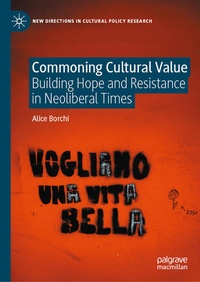
Commoning Cultural Value
Description

This book formalizes a commons-oriented framework for the formation of cultural value as a way to oppose current neoliberal understandings of the value of culture. In doing so, it analyses the impact of two economic theories on culture: on the one hand, the book assesses how neoliberalism has changed our understanding of culture; on the other, it explains how the concept of the commons provides a way to resist this narrative, and how its emergence in the cultural sphere responds to the need of such an alternative.
This book provides an argument for a more imaginative, radical and fair approach to culture and cultural policy. Indeed, the book represents a first book-length examination of the concept of the commons in relation to cultural policy, especially for the purpose of creating a novel theoretical framework. Such an approach is based on a relational understanding of culture which finds its value as a collective process, rather than an individual product. This framework is not meant to reinforce the idea of culture as a universal panacea for the shortcomings of both the marketing and the state; quite the opposite, it looks to illuminate how culture can be the ideal site for prefigurative politics, to experiment with new political imaginations and to provide hope in neoliberal times. It appeals to practitioners and policymakers, while remaining a work of original and rigorous scholarship.
More details
Other editions
Additional editions
Person
Alice Borchi is a Lecturer in Creative Industries at the School of Performance and Cultural Industries, University of Leeds. Her research interests include the study of cultural policy and cultural value, with a focus on participatory practices and shared governance in cultural policy and management. She is also interested in interdisciplinary approaches to the safeguard of the commons that bring together environmental and cultural perspectives.
