

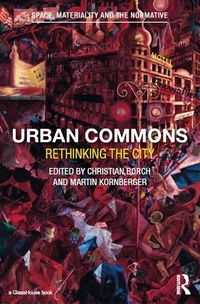
Urban Commons
Rethinking the City
1st Edition
Published on 10. April 2015
186 pages
978-1-317-70297-9 (ISBN)
Description

This book rethinks the city by examining its various forms of collectivity - their atmospheres, modes of exclusion and self-organization, as well as how they are governed - on the basis of a critical discussion of the notion of urban commons. The idea of the commons has received surprisingly little attention in urban theory, although the city may well be conceived as a shared resource. Urban Commons: Rethinking the City offers an attempt to reconsider what a city might be by studying how the notion of the commons opens up new understandings of urban collectivities, addressing a range of questions about urban diversity, urban governance, urban belonging, urban sexuality, urban subcultures, and urban poverty; but also by discussing in more methodological terms how one might study the urban commons. In these respects, the rethinking of the city undertaken in this book has a critical dimension, as the notion of the commons delivers new insights about how collective urban life is formed and governed.
Reviews / Votes
'Cities are set to rule the world, yet how they work as collectives is poorly understood or misinterpreted through borrowed ideas on the commons. This insightful volume looks from within the city to propose atmospheres, active usage of the shared, and commoners as key collectives, in the process revealing the true nature of the urban commons and gesturing the kind of politics needed to secure a better urban and global future. A marvelous original book'. Ash Amin, 1931 Chair of Geography, University of Cambridge and author of Land of Strangers (Polity, 2012).'It is exciting to see a book that tackles the urban commons from so many angles and scholarly perspectives. We get insights from planning, philosophy, urban studies and beyond, and a kaleidoscopic focus on the commons in relation to non-humans, waste, exclusion, atmosphere and more. It is also heartening to see the careful and critical attention that the commons - a slippery, multivalent and mobile category - deserves'. Nicholas Blomley, Professor of Geography, Simon Fraser University and author of Rights of Passage (Routledge, 2011).
'Urban Commons presents a fresh and innovative approach to investigating the city through the organisation of collectivity. Its point of departure is a critique of the conventional understanding of urban commons as finite resource pools. Instead, the book tests the city as a non-subtractive resource which implies that its consumption simultaneously becomes a form of production. In other words, using the city does not diminish but increases its value. Based on this conceptual framework, the book brings together a broad range of theoretical and empirical contributions and engages the reader with a rich, multidisciplinary juxtaposition of critical inquiries. Urban Commons addresses fundamental questions of the contemporary urban condition. It establishes perspectives that can enrich diverse discourses ranging from sustainable development in cities to issues of urban governance, collaboration and co-production. Its combination of theorising and presenting case studies makes it accessible to a broad audience of urban scholars, practitioners and students. It is a highly recommendable resource for anyone interested in how the wider notion of 'the commons' can be translated to urban studies'. Philipp Rode, Executive Director, LSE Cities, London School of Economics and Political Science.
More details
Series
Edition
1. Auflage
Language
English
Place of publication
London
United Kingdom
Publishing group
Taylor & Francis Ltd
Target group
College/higher education
Illustrations
11 s/w Abbildungen
11 Illustrations, black and white
File size
8,71 MB
ISBN-13
978-1-317-70297-9 (9781317702979)
Copyright in bibliographic data and cover images is held by Nielsen Book Services Limited or by the publishers or by their respective licensors: all rights reserved.
Schweitzer Classification
Other editions
Additional editions
Book
10/2016
1st Edition
Routledge
€84.10
Shipment within 10-20 days
Book
03/2015
1st Edition
Routledge
€207.30
Shipment within 10-20 days
Persons
Christian Borch is Professor of Political Sociology at the Department of Management, Politics and Philosophy, Copenhagen Business School, Denmark. His work focuses on crowds, architecture, financial markets and urban theory. His previous books include The Politics of Crowds: An Alternative History of Sociology (Cambridge University Press, 2012) and Foucault, Crime and Power: Problematisations of Crime in the Twentieth Century (Routledge, 2015).
Martin Kornberger is Professor of Strategy and Organization at Copenhagen Business School and visiting professor at the Research Institute for Urban Management and Governance at the WU Wien. He received his PhD in philosophy from the University of Vienna. Amongst other things, his work focuses on urban strategy and governance.
Martin Kornberger is Professor of Strategy and Organization at Copenhagen Business School and visiting professor at the Research Institute for Urban Management and Governance at the WU Wien. He received his PhD in philosophy from the University of Vienna. Amongst other things, his work focuses on urban strategy and governance.
Content
Martin Kornberger and Christian Borch: Introduction: Urban Commons 1. Jonathan Metzger: The City is not a Menschenpark: Rethinking the Tragedy of the Urban Commons beyond the Human/Non-Human Divide 2. Leif Jerram: The False Promise of the Commons: Historical Fantasies, Sexuality and the 'Really-Existing' Urban Common of Modernity 3. Orvar Loefgren: Sharing an Atmosphere: Spaces in Urban Commons 4. Patrik Zapata and Maria Jose Zapata Campos: Producing, Appropriating, and Recreating the Myth of the Urban Commons 5. Martina Loew: Managing the Urban Commons: Public Interest and the Representation of Interconnectedness 6. Greg M. Nielsen: Mediated Exclusions from the Urban Commons: Journalism and Poverty 7. Maja Hojer Bruun: Community and the Commons: Open Access and Community Ownership of the Urban Commons
