

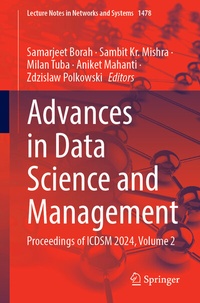
Advances in Data Science and Management
Description

This book includes high-quality papers presented at the Third International Conference on Data Science and Management (ICDSM 2024), organized by the Gandhi Institute for Education and Technology, Bhubaneswar, from December 13-14, 2024. It features research in which data science is used to facilitate the decision-making process in various application areas and covers a wide range of learning methods and their applications in a number of learning problems. The empirical studies, theoretical analyses and comparisons to psychological phenomena described contribute to the development of products to meet market demands. The work is presented in two volumes.
More details
Other editions
Additional editions
Persons
Dr. Samarjeet Borah is currently working as a professor and head in the Department of Computer Applications, SMIT, Sikkim Manipal University, India. Dr. Borah has carried out various funded projects from AICTE and DST-CSRI. He has published around 90 research papers in journals and conferences of repute. Dr. Borah has organized several workshops and conferences in national and international levels. He is involved with book series and journals of repute from Springer, IEEE, Inderscience and IGI Global as a guest editor. He is also serving as the editor-in-chief of the book and proceedings series-Research Notes on Computing and Communication Sciences, Apple Academic Press, USA. Dr. Borah has served as a keynote as well as invited speaker in several international conferences. His areas of research are data mining, machine learning and information security.
Dr. Sambit Kumar Mishra is having more than 26 years of teaching experience in different AICTE approved institutions in India. He obtained his bachelor's degree in engineering in Computer Engineering from Amravati University, Maharashtra, India, in 1991, M.Tech. in Computer Science from Indian School of Mines, Dhanbad (Now IIT, Dhanbad), India, in 1998, and Ph.D. in Computer Science and Engineering from Siksha 'O' Anusandhan University, Bhubaneswar, Odisha, India, in 2015. He has more than 37 publications in different peer-reviewed international indexed Journals and editorial board member of different peer-reviewed indexed Journals. He is involved with book series and journals of repute from Springer, Inderscience and IGI Global as a guest editor. His areas of research are data mining, database engineering and computer architecture. Presently, he is working as a professor in the Department of Computer Science and Engineering, Gandhi Institute for Education and Technology, Baniatangi, Bhubaneswar, Odisha, India.
Milan Tuba is the vice-rector for International Relations, Singidunum University, Belgrade, Serbia, and was the head of the Department for Mathematical Sciences at State University of Novi Pazar and the dean of the Graduate School of Computer Science at John Naisbitt University. He is listed in the World's Top 2% Scientists by Stanford University in 2020 and 2021. Prof. Tuba is the author or co-author of more than 200 scientific papers (cited more than 5000 times, h-index 42) and editor, coeditor or member of the editorial board or scientific committee of number of scientific journals and conferences. He was invited and delivered around 60 keynote lectures at international conferences. He received B. S. in Mathematics, M. S. in Mathematics, M. S. in Computer Science, M. Ph. in Computer Science, Ph.D. in Computer Science from the University of Belgrade and New York University.
Dr. Aniket Mahanti is a researcher, educator and award-winning author who brings over 15 years of experience designing, measuring, analyzing and modeling complex distributed systems. Currently, he is a senior lecturer (Rest of the world: Associate Professor) of Computer Science at The University of Auckland. He received doctorate in computer science from the University of Calgary, Canada, in 2012. Between 2006 and 2008, Dr. Mahanti worked as a research associate with the Computer Networks group at the University of Calgary. His expertise spans multiple domains such as computer science, social sciences and business. His post-secondary education was fully funded by prestigious scholarships like the National Natural Sciences and Engineering Research Council of Canada (NSERC) Canada Graduate Scholarship (CGS) and the provincial Alberta Innovates Technology Futures (AITF) graduate student scholarship.
Content
Advanced Fake News Detection Using BERT and Ensemble Learning: A Performance Study.- An In-Depth Comparative Analysis of Credit Card Fraud Detection Leveraging the XGBoost Algorithm.- Forecasting Currency Prices through the Implementation of Gated Recurrent Units (GRUs) in Neural Networks.- A Comparative Analysis of Spillover Effect in the Cryptocurrency Market Using Deep Learning Approach.- Cybersecurity for Industrial Control Systems using AI.
