

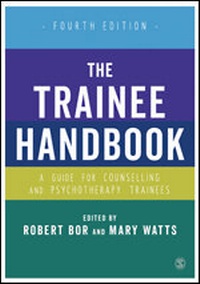
The Trainee Handbook
A Guide for Counselling & Psychotherapy Trainees
4th Edition
Published on 8. November 2016
504 pages
978-1-4739-9824-7 (ISBN)
Description

Written by a team of leading trainers, practitioners and supervisors, this bestselling classic is the trainee therapist's best friend. It identifies and guides trainees through the practical skills and knowledge they'll need to make a success of their training - from writing essays through to case formulation and on to preparing for their first meeting with a client. Along the way, it addresses and allays the concerns which are common to all students.
Now in its fourth edition, the book has been fully updated to take account of the significant changes in the therapy professions in recent years. It now includes new and important chapters on:
Evidence-based practice
Working with diversity
Reflective practice
Using social media, technology and online therapy
The Trainee Handbook is an invaluable companion, and source of information and guidance for all trainees in counselling, psychotherapy and counselling psychology, and newly-qualified therapists entering into practice.
Now in its fourth edition, the book has been fully updated to take account of the significant changes in the therapy professions in recent years. It now includes new and important chapters on:
Evidence-based practice
Working with diversity
Reflective practice
Using social media, technology and online therapy
The Trainee Handbook is an invaluable companion, and source of information and guidance for all trainees in counselling, psychotherapy and counselling psychology, and newly-qualified therapists entering into practice.
Reviews / Votes
I found the Trainee Handbook really useful for the students that I work with. It is well set out from setting the scene to future job role as a counsellor. I'm aware that it isn't necessarily for Level 2 students but some aspects are and the students found them to be very useful. Some specific headings that are used in counselling may help such as contracting.-- Baljeet Singh Gill I welcome this fourth edition which will continue to function as a key support for trainees as they navigate their way through a range of professional issues and course requirements. There are some important updates in this edition, and a review of many key topics that span philosophical, theoretical, ethical and practical matters. In my view, an excellent and timely resource.
-- Prof. Vanja Orlans For many years Bor and Watt's Handbook serves as the best entry point to counseling, counseling psychology, and psychotherapy training for students embarking on the journey. This new edition again thoroughly covers relevant topics and issues, is well-updated and offers plenty of practical and valuable tips to students. I highly recommend it as the book to have when starting your training!
-- Dr. Ladislav Timulak
More details
Edition
Fourth Edition
Language
English
Place of publication
London
United Kingdom
Target group
College/higher education
ISBN-13
978-1-4739-9824-7 (9781473998247)
Copyright in bibliographic data and cover images is held by Nielsen Book Services Limited or by the publishers or by their respective licensors: all rights reserved.
Schweitzer Classification
Other editions
Additional editions
Book
11/2016
4th Edition
SAGE Publications Inc
€106.40
Shipment within 10-20 days
Book
11/2016
4th Edition
SAGE Publications Inc
€190.90
Shipment within 10-20 days
Persons
Professor Robert Bor trained in the UK, South Africa and the USA. He is a Chartered Clinical, Counselling and Health Psychologist as well as a Fellow of the British Psychological Society. He is a UKCP Registered Family Therapist, having completed his specialist training at the Tavistock Clinic, London and a clinical member of the Institute of Family Therapy, London. He has a special interest in developing psychological support services for those affected by chronic or acute medical conditions, and especially those with cancer.
He has published more than 150 articles and chapters in peer-review publications as well as 20 books on the psychological impact of illness and serves on the editorial board of numerous international journals. He is also the Consulting Psychologist to several leading schools in London including St Pauls School, The Royal Ballet School and JFS.
He is an active member of the International Psycho-Oncology Society, consults to Chai Cancer Care in London and he is a Churchill Fellow. Mary Watts is emeritus professor of psychology and former pro-vice-chancellor for learning and teaching at City, University of London. She combines her knowledge and experience of academic, professional and business development within current freelance roles. A chartered psychologist and registered member of the Health Care Professions Council, Mary has specialisms in health and wellbeing, coaching, counselling and psychotherapy. She is a Meyler Campbell Business Coach Graduate and currently director of their Mastered Programme, former chair of the British Psychological Society's Special Group in Coaching Psychology and also the 2015 International Congress in Coaching Psychology.
He has published more than 150 articles and chapters in peer-review publications as well as 20 books on the psychological impact of illness and serves on the editorial board of numerous international journals. He is also the Consulting Psychologist to several leading schools in London including St Pauls School, The Royal Ballet School and JFS.
He is an active member of the International Psycho-Oncology Society, consults to Chai Cancer Care in London and he is a Churchill Fellow. Mary Watts is emeritus professor of psychology and former pro-vice-chancellor for learning and teaching at City, University of London. She combines her knowledge and experience of academic, professional and business development within current freelance roles. A chartered psychologist and registered member of the Health Care Professions Council, Mary has specialisms in health and wellbeing, coaching, counselling and psychotherapy. She is a Meyler Campbell Business Coach Graduate and currently director of their Mastered Programme, former chair of the British Psychological Society's Special Group in Coaching Psychology and also the 2015 International Congress in Coaching Psychology.
Content
Setting the scene - Sheelagh Strawbridge
Routes into the profession of counselling, counselling psychology and psychotherapy in the United Kingdom - Tony Ward
The trainee experience - Susan Maise Strauss
Students top tips - Tami Avis, Fran Smith, Genevieve Solomou and Ingrid Sorhus
Getting the most out of personal therapy - Mark Donati and Charles Legg
Effective essay writing - Frances Mielewczyk
How to write a client case study - John Davy
How to write a process report - Christine Parrott
Planning and preparing your research study - Don Rawson
Producing and presenting your research report - Don Rawson
Guidelines for professional practice - Tim Bond
Research, practice and reflection - Margaret Oakes
The clinical placement in therapy training - Victoria E. Galbraith
Handling and processing a referral - Mary Creaner
Developing skills in formulation - Sarah Corrie and David A. Lane
The first session with a new client: five stages - Robert Bor, Sara Chaudry and (the late) Riva Miller
Assessing a client's mental state - Yvette Lewis
Psychopharmacology: a primer - Diane Hammersley, Jo Sexton and Charles Legg
Written communication and counselling - Peter Du Plessis and Fiona Hirst
Supervision: making it work for you - Damian McCann
What do I do if ... ? Questions commonly asked by trainees - Malcolm C. Cross and Linda Papadopoulos
Preparing for a job after professional registration - Elaine Kasket
Working with diversity: enhancing practice and challenging oppression - Martin Milton
The reflective practitioner: some personal reflections - Mary Watts
Setting the scene for continuing professional development (CPD) and life-long learning - Barabara Hannigan
The use of social media, technology and online therapy - Anne Stokes
Looking to the future - Sheelagh Strawbridge
Routes into the profession of counselling, counselling psychology and psychotherapy in the United Kingdom - Tony Ward
The trainee experience - Susan Maise Strauss
Students top tips - Tami Avis, Fran Smith, Genevieve Solomou and Ingrid Sorhus
Getting the most out of personal therapy - Mark Donati and Charles Legg
Effective essay writing - Frances Mielewczyk
How to write a client case study - John Davy
How to write a process report - Christine Parrott
Planning and preparing your research study - Don Rawson
Producing and presenting your research report - Don Rawson
Guidelines for professional practice - Tim Bond
Research, practice and reflection - Margaret Oakes
The clinical placement in therapy training - Victoria E. Galbraith
Handling and processing a referral - Mary Creaner
Developing skills in formulation - Sarah Corrie and David A. Lane
The first session with a new client: five stages - Robert Bor, Sara Chaudry and (the late) Riva Miller
Assessing a client's mental state - Yvette Lewis
Psychopharmacology: a primer - Diane Hammersley, Jo Sexton and Charles Legg
Written communication and counselling - Peter Du Plessis and Fiona Hirst
Supervision: making it work for you - Damian McCann
What do I do if ... ? Questions commonly asked by trainees - Malcolm C. Cross and Linda Papadopoulos
Preparing for a job after professional registration - Elaine Kasket
Working with diversity: enhancing practice and challenging oppression - Martin Milton
The reflective practitioner: some personal reflections - Mary Watts
Setting the scene for continuing professional development (CPD) and life-long learning - Barabara Hannigan
The use of social media, technology and online therapy - Anne Stokes
Looking to the future - Sheelagh Strawbridge
