

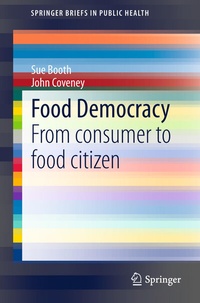
Food Democracy
Description

This book explores the links between food and democracy. It addresses how democratic principles can be used to shape our food system and takes a practical 'how-to' approach to using democratic processes to regain control of the food we eat. It also highlights what food democracy looks like on the ground and how individuals, communities and societies can be empowered to access, cook and eat healthy food in ways that are sustainable.
Food democracy, as a concept, is a social movement based on the idea that people can and should be able to actively participate in shaping the food system rather than being passive spectators. The book is useful for university and advanced TAFE courses that cover topics examining food in health sciences, social sciences and other areas of study. It is also relevant to health practitioners, nutritionists, food advocates, policy makers and others with a keen interest in exploring an alternative to the industrial food system known as "Big Food."
More details
Other editions
Additional editions
Persons
Sue Booth has worked in community nutrition, public health, health promotion, research and academic settings for over twenty years in Australia and Canada. Her teaching and research interests include food policy, the sociology of food, qualitative research methods and food poverty. She has written and co-authored a range of materials including nutrition education materials, policy papers, book chapters, articles, reports and peer-reviewed papers.
John Coveney has worked in clinical nutrition, and community and public health in Papua New Guinea, Australia and UK. John has academic interests that span nutrition, public health, social sciences, and the humanities. His teaching and research includes public health nutrition, food policy and health promotion. He has written and co-authored over 120 publications, including books, book chapters, articles and peer-reviewed papers.
Content
Acknowledgements.- Preface.- Chapter 1: Introduction.- Chapter 2: 'Big Food' - The Industrial Food System.- Chapter 3: Foundations of food democracy.- Chapter 4: Home-made Food Democracy- Exerting control over the food supply from home.- Chapter 5: Neighbourhood and community food democracy.- Chapter 6: Democracy at Work - From consumers to food citizens.- Chapter 7: Food Democracy in reflection.
