

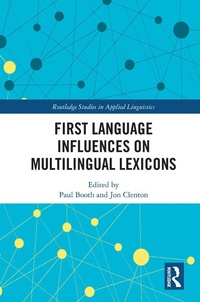
First Language Influences on Multilingual Lexicons
1st Edition
Published on 26. February 2020
212 pages
978-0-429-63187-0 (ISBN)
Description

This collection brings together recent research on the influences between first and additional languages with a focus on the development of multilingual lexicons. Featuring work from an international group of scholars, the volume examines the complex dynamics underpinning vocabulary in second and third languages and the role first languages play within this process. The book is organized around three different facets of research in this area - lexical recognition, processing, and knowledge; the effects of first languages on second language reading and writing, collocations, and translation skills; and, vocabulary testing - drawing on examples from a variety of languages, including European languages, Arabic, and Japanese. Setting the stage for further research on the interplay between first languages and multilingual lexicons, this volume is key reading for students and researchers in applied linguistics, language learning and teaching, bilingualism, second language acquisition, and translation studies.
More details
Series
Edition
1. Auflage
Language
English
Place of publication
London
United Kingdom
Publishing group
Taylor & Francis Ltd
Target group
College/higher education
Product notice
Reflowable
Illustrations
30 Tables, black and white; 10 Line drawings, black and white; 10 Illustrations, black and white
ISBN-13
978-0-429-63187-0 (9780429631870)
Copyright in bibliographic data and cover images is held by Nielsen Book Services Limited or by the publishers or by their respective licensors: all rights reserved.
Schweitzer Classification
Other editions
Additional editions
Paul Booth | Jon Clenton
First Language Influences on Multilingual Lexicons
Book
09/2021
1st Edition
Routledge
€67.10
Shipment within 10-20 days
Paul Booth | Jon Clenton
First Language Influences on Multilingual Lexicons
Book
03/2020
1st Edition
Routledge
€206.20
Shipment within 15-20 days
Persons
Paul Booth is a Senior Lecturer at Kingston University (London) and course leader for the MA in Applied Linguistics for TESOL. His publications include: L1 - L2 semantic and syntactic processing: The influence of language proximity, System 78 and The variance of lexical diversity profiles and its relationship to learning style, IRAL 52.
Jon Clenton is an Associate Professor of Applied Linguistics at Hiroshima University. His publications include Testing the Revised Hierarchical Model: Evidence from word associations. Bilingualism: Language and Cognition, and Making sense of learner performance on tests of productive vocabulary knowledge. (with T. Fitzpatrick) TESOL Quarterly.
Jon Clenton is an Associate Professor of Applied Linguistics at Hiroshima University. His publications include Testing the Revised Hierarchical Model: Evidence from word associations. Bilingualism: Language and Cognition, and Making sense of learner performance on tests of productive vocabulary knowledge. (with T. Fitzpatrick) TESOL Quarterly.
Content
List of Tables and Figures
Acknowledgments
Contributors
Introduction
First language influences on multilingual lexicons - pulling apart the threads.
Part 1: Recognition, comprehension, and reading
The Pseudohomophone Effect in visual word recognition in a Second Language
L1 - L2 semantic and syntactic processing: the influence of language proximity.
The effect of Arabic word structure and L1 reading processes on the structure of the English L2.
Part 2: Production, translation and writing
The Multilingual Lexicon: Evidence from Primed Translation Lexical Decision and Verbal Fluency Tasks.
Beyond literal: expanding vocabulary for translation skills in the diverse, multilingual undergraduate MFL classroom.
Processing L2 vocabulary in writing.
Use of Collocations in Written Text: a comparative analysis of collocations produced by Native Speakers and Nigerian Learners of English.
Part 3: Vocabulary assessment
First and second language cognate effects in third language vocabulary knowledge.
The Reassessment of Vocabulary Tests Based on Cognate Distribution.
Conclusion
First language influences on multilingual lexicons - drawing the threads together.
Index
Acknowledgments
Contributors
Introduction
First language influences on multilingual lexicons - pulling apart the threads.
Part 1: Recognition, comprehension, and reading
The Pseudohomophone Effect in visual word recognition in a Second Language
L1 - L2 semantic and syntactic processing: the influence of language proximity.
The effect of Arabic word structure and L1 reading processes on the structure of the English L2.
Part 2: Production, translation and writing
The Multilingual Lexicon: Evidence from Primed Translation Lexical Decision and Verbal Fluency Tasks.
Beyond literal: expanding vocabulary for translation skills in the diverse, multilingual undergraduate MFL classroom.
Processing L2 vocabulary in writing.
Use of Collocations in Written Text: a comparative analysis of collocations produced by Native Speakers and Nigerian Learners of English.
Part 3: Vocabulary assessment
First and second language cognate effects in third language vocabulary knowledge.
The Reassessment of Vocabulary Tests Based on Cognate Distribution.
Conclusion
First language influences on multilingual lexicons - drawing the threads together.
Index
