

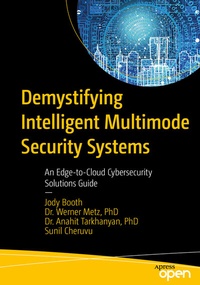
Demystifying Intelligent Multimode Security Systems
Description

This open access book. Use this practical guide to understand the concepts behind Intelligent Multi-modal Security Systems (IMSS) and how to implement security within an IMSS system to improve the robustness of the devices and of the end-to-end solution.
There are nearly half a million active IMSS cameras globally, with over 100 million added annually. These cameras are used across enterprises (companies, traffic monitoring, driver enforcement, etc.), in peoples' homes, on mobile devices (drones, on-vehicle, etc.), and are worn on the body.
IMSS systems with a camera and network video recorder for storage are becoming the normal infrastructure for capturing, storing, and transmitting video content (sometimes up to 100 streams) in a secure manner and while protecting privacy.
Military, aerospace, and government entities are also embracing digital security and surveillance. IMSS content serves as evidence in courts of law.
Security within all of these types of IMSS systems needs to be bolstered by leveraging Intel hardware and software as the last line of defense, and this book provides you with best practices and solutions for maximizing security in your system implementation.
What You Will Learn
- Review the relevant technologies in a surveillance system
- Define and dissect the data pipeline with a focus on key criteria and understand the mapping of this pipeline to Intel hardware blocks
- Optimize the partition and future-proof it with security and manageability
- Understand threat modeling terminology, the assets pertinent to DSS, and emerging threats, and learn how to mitigate these threats using Intel hardware and software
- Understand the unique risks and threats to the intelligence in IMSS (machine learning training and inferencing, regulations, and standards) and explore the solution space for mitigations to these threats
- Sample applications illustrate how to design in security for several types of IMSS.-
- Explore ways to keep both yourself and your systems up to date in a rapidly changing technology and threat environment
Who This Book Is For
Surveillance system designers, integrators, and consultants; professional systems, hardware, and software designers who design, recommend, or integrate surveillance systems; security system integrators; video analytics engineers; agencies that write RFPs and/or RFIs; government, police, and security agencies; and corporate security divisionsThis is an open access book.
More details
Other editions
Additional editions
Persons
Lawrence Booth has been a systems architect and a systems-on-silicon architect focused on imaging and media-related processing for more than 30 years. After three years in secure video gateway cybersecurity architecture, he joined Intel's Internet of Things group, returning to his greatest interest-vision systems.
Dr. Werner Metz
is a system architect with over 30 years of experience in architecting, developing, and implementing digital imaging systems. He has contributed at the level of image sensor architecture and design, conventional and deep learning imaging algorithms, digital image processor architecture, and analog image signal processor design. He has architected a wide range of consumer, commercial, and industrial imaging systems spanning visible, IR, thermal, and UV wavelengths for both human viewing and computer vision. He is currently responsible for the E2E video architecture at Intel, spanning camera to gateway to data center, with an emphasis onedge devices.
Dr. Anahit Tarkhanyan
PhD is a security architect who leads the security definitions for Intel's broad IoT/Edge products portfolio. Anahit has 20+ years of vast industry experience delivering end-to-end security solutions to the market. Her deep expertise includes hardware and software systems security applied to IoT/OT/ICS and AI/ML cybersecurity risks, principles, and practices. Anahit is a technical expert at ISO/IEC/ JTC1 and a senior member of IEEE. She holds a Ph.D. in Distributed Computer Systems and Networks and authored several patents and publications in diverse areas of security technologies.
Sunil Cheruvu is Chief IoT Security Architect in the Internet of Things group at Intel Corporation. He has over 27 years of experience in architecting complex systems involving HW/FW/SW on multiple architectures, including Intel, ARM, and MIPS/PowerPC. At Intel, he leads security across all of the IoT vertical domains andhe was the Content Protection and Trusted Data Path System Architect (end-to-end premium content protection within an SoC). He is the subject matter expert for IoT security across Intel and outside of Intel. At Microsoft, as a SW design engineer, he was the tech lead for vehicle bus networking stacks, threat modeling, and mitigations in the Windows Mobile for Automotive (WMfA) platform. At 3com and Conexant, he implemented the code for baseline privacy security in DOCSIS-compliant cable modems.
Content
Introduction.- Chapter 1: Introduction and Overview.- Chapter 2: Architecting an E2E IMSS Data Pipeline.- Chapter 3: Architecting an E2E DSS Data Pipeline .- Chapter 4: Securing the IMSS Assets.- Chapter 5: Machine Learning Security .- Chapter 6: Sample Applications.- Chapter 7: Looking Into the Future.- Chapter 8: As We Go To Press.
