

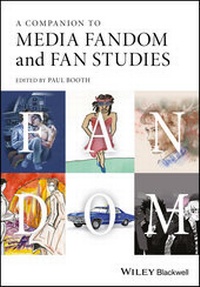
A Companion to Media Fandom and Fan Studies
Description

More details
Other editions
Additional editions
Content
Notes on Contributors xi
Acknowledgments xix
Introduction 1
Paul Booth
Part I Histories, Genealogies, Methodologies 11
1 Fandom, Negotiation, and Participatory Culture 13
Henry Jenkins
2 Foundational Discourses of Fandom 27
Daniel Cavicchi
3 Literature Fandom and Literary Fans 47
Alexandra Edwards
4 The Fan Experience 65
Karen Hellekson
5 Soap Fans, Revisited 77
C. Lee Harrington and Denise Bielby
6 Not My Lifeblood: Autoethnography, Affective Fluctuations and Popular Music Antifandom 91
Ross Garner
7 Representations of Fans and Fandom in the British Newspaper Media 107
Lucy Bennett
8 Ethics in Fan Studies Research 123
Ruth A. Deller
Part II Fan Practices 143
9 Make Space for Us! Fandom in the Real World 145
Lynn Zubernis and Katherine Larsen
10 Nostalgia, Fandom and the Remediation of Children's Culture 161
Lincoln Geraghty
11 Fan Fashion: Re?-enacting Hunger Games through Clothing and Design 175
Nicolle Lamerichs
12 Slash/Drag: Appropriation and Visibility in the Age of Hamilton 189
Francesca Coppa
13 "Becoming a Part of the Storytelling": Fan Vidding Practices and Histories 207
Katharina Freund
Part III Fandom and Cultural Studies 225
14 "Angry False?-Teeth?-Chattering Mayhem": Synecdochic Fandom, Representation and Performance in Mature Woman Fandom of British Professional Wrestling 227
Tom Phillips
15 It's About Who You Know: Social Capital, Hierarchies and Fandom 243
Bertha Chin
16 Ontological Security and the Politics of Transcultural Fandom 257
Lori Morimoto
17 Fandom and Otaku 277
Miranda Ruth Larsen
18 Otaku Pedestrians 289
Marc Steinberg and Edmond Ernest dit Alban
19 The Unbearable Whiteness of Fandom and Fan Studies 305
Mel Stanfill
20 Who Do You Mean by "Fan?" Decolonizing Media Fandom Identity 319
Rukmini Pande
21 Racebending and Prosumer Fanart Practices in Harry Potter Fandom 333
Jessica Seymour
Part IV Digital Fandom 349
22 Tumblr Pedagogies 351
Melanie E.S. Kohnen
23 Active Fandom: Labor and Love in The Whedonverse 369
Casey J. McCormick
24 "May We Meet Again": Social Bonds, Activities, and Identities in the #Clexa Fandom 385
Mélanie Bourdaa
25 Of Spinoffs and Spinning Off 401
Louisa Stein
26 #AskELJames, Ghostbusters, and #Gamergate: Digital Dislike and Damage Control 415
Bethan Jones
27 Red Pillers, Sad Puppies, and Gamergaters: The State of Male Privilege in Internet Fan Communities 431
Katie Wilson
28 "Fate Has a Habit of Not Letting Us Choose Our Own Endings": Post?]object Fandom, Social Media and Material Culture at the End of Hannibal 447
Rebecca Williams
Part V The Future of Fan Studies 461
29 Understanding Which Fandom? Insights from Two Decades as a Music Fan Researcher 463
Mark Duffett
30 Implicit Fandom in the Fields of Theatre, Art, and Literature: Studying "Fans" Beyond Fan Discourses 477
Matt Hills
31 Janeites and Sherlockians: Literary Societies, Cultural Legitimacy, and Gender 495
Roberta Pearson
32 Porn Consumers as Fans 509
Alan McKee
33 Kant/Squid (The Fanfiction Assemblage) 521
Anne Jamison
34 Interdisciplinarity in Fan Studies 539
Tisha Turk
Index 553
Notes on Contributors
Editor Biography
Paul Booth is Associate Professor at DePaul University, Chicago, USA. He is the author of Crossing Fandoms (Palgrave, 2016), Digital Fandom 2.0 (Peter Lang, 2016), Playing Fans (University of Iowa Press, 2015), Game Play (Bloomsbury, 2015), Time on TV (Peter Lang, 2012), and Digital Fandom (Peter Lang, 2010). He has edited Seeing Fans (Bloomsbury, 2016, with Lucy Bennett), Controversies in Digital Ethics (Bloomsbury, 2016, with Amber Davisson), and Fan Phenomena: Doctor Who (Intellect, 2013). He is currently enjoying a cup of coffee.
Contributor Biographies
Lucy Bennett is a lecturer in media audiences at JOMEC, Cardiff University, UK. Her work on fan cultures appears in journals such as New Media & Society, Journal of Fandom Studies, Transformative Works and Cultures, Social Semiotics, Continuum, Cinema Journal, Celebrity Studies and Participations. She is the co-founder and co-chair of the Fan Studies Network and is the co-editor of Seeing Fans: Representations of Fandom in Media and Popular Culture (with Paul Booth, Bloomsbury, 2016) and Crowdfunding the Future (with Bertha Chin and Bethan Jones, Peter Lang, 2015).
Denise Bielby is Distinguished Professor of Sociology at the University of California, Santa Barbara, USA, and an affiliate of Film & Media Studies. Her research on media culture focuses on the industries and audiences of television and film. The author of numerous scholarly publications, her edited collection, Brokerage and Production in the American and French Entertainment Industries: Invisible Hands in Cultural Markets (Lexington Books, 2015, with Violaine Roussel), examines the activities of talent representatives and production professionals. A recipient of national awards for her research, she has been funded by the National Science Foundation and the National Institute of Mental Health, and was statistical consultant to the Writers Guild of America, West.
Mélanie Bourdaa is Associate Professor in Communication and Information Sciences at the Université Bordeaux Montaigne, France. She studies American TV, fandom in the digital age, and production strategies (transmedia storytelling). She co-funded CATS (Cluster Aquitain du Transmedia Storytelling), a non-profit organization to develop research and links to the media industries with transmedia and cross-media strategies. She is the head of the Master Degree Designing Digital Projects. She coordinated (with Benjamin Derhy Kurtz) The Rise of the Transtexts: Challenges and Opportunities for Routledge. She is in charge of the research project MediaNum, aiming at studying cultural heritage and transmedia storytelling.
Daniel Cavicchi is Associate Provost for Research | Global | Practice at Rhode Island School of Design, Providence, USA. His books include Listening and Longing: Music Lovers in the Age of Barnum; Tramps Like Us: Music and Meaning Among Springsteen Fans; and My Music: Explorations of Music in Daily Life, with Charles Keil and Susan D. Crafts.
Bertha Chin is a Lecturer and Coordinator in Social Media in Swinburne University of Technology, Sarawak Campus. She has published extensively, is a board member of the Fan Studies Network, and co-editor of Crowdfunding the Future: Media Industries, Ethics and Digital Society (2015, Peter Lang). Her research interests include fan and producer relationships, fan labor, social media, crowdfunding, antifandom, and transcultural fandom.
Francesca Coppa is Professor of English at Muhlenberg College, Pennsylvania, PA, and a founding member of the Organization for Transformative Works, a nonprofit established by fans to provide access to and preserve the history of fanworks and culture. She is the editor of The Fanfiction Reader: Folk Tales for the Digital Age (University of Michigan, 2017) and is currently writing a book on fan music video.
Ruth A. Deller is a Principal Lecturer and Program Leader for Journalism, Media and Public Relations at Sheffield Hallam University, Sheffield, UK. She has published on a range of media and journalism-related topics, including religion and the media, reality and lifestyle television, and social media cultures. Her fan and audience studies research has looked at a range of fandoms, including Cliff Richard, Neighbours, Fifty Shades. and The Sims. Her own fandoms include Kylie Minogue, Doctor Who and Roxette.
Mark Duffett is a Reader in Media and Cultural Studies at the University of Chester, Chester, UK. His research interest is primarily in fandom and the dynamics of popular music audiences. Mark is the author of Understanding Fandom (Bloomsbury, 2013). In 2012, he was keynote speaker at the MARS conference in Finland. He has edited two special issues of the journal Popular Music and Society and two books: Popular Music Fandom (Routledge, 2015) and Fan Identities and Practices in Context (Routledge, 2016). He is currently working on a book about Elvis Presley for Equinox and a non-academic book for Scarecrow Press called Counting Down Elvis: His 100 Finest Songs.
Alexandra Edwards received her PhD in English from the University of Georgia, Athens, USA. Her dissertation, "Fanaticism, Yes! Literary Fan Cultures of the Early Twentieth Century," explores the alternative literary history of US media fandom from 1890-1949. She is best known for her transmedia work on The Lizzie Bennet Diaries and Emma Approved, modernized, interactive webseries adaptations of Jane Austen's beloved novels. Edwards won Primetime Emmy Awards in 2013 and 2015 for these shows.
Edmond Ernest dit Alban is a PhD candidate in the Film and Moving Images PhD program at Concordia University, Montreal, Canada. He studies various objects relevant to Japanese popular cultures, like otaku and dôjin cultures. He obtained his Masters degree working on the visual novel Higurashi no naku koro ni and its media mix history at Paris Diderot and Meiji University. His new project reassembles the subcultural history of Shônenai manga and fanzine for girls with the emergence of the otaku sanctuary of Ikebukuro's Otome Road (the Girl's Road) to explain how such niche media circulation has created the actual media mix strategies of Otome games (visual novels for girls).
Katharina Freund is a researcher on fandom, television culture, and digital communication, and education technologies. She completed her dissertation on fan video editing from the University of Wollongong, Australia, and has published on fan communities, online fandom, and copyright. Katharina now works as a Senior Learning Designer at the Australian National University in Canberra, Australia, designing education technology initiatives.
Ross Garner is a Lecturer in Media and Cultural Studies in the School of Journalism, Media and Cultural Studies at Cardiff University, Cardiff, UK. He has published articles on cult media forms in journals, including Popular Communication and Cinema Journal and has contributed chapters to multiple edited collections published by I.B. Tauris. He is preparing the monograph Nostalgia, Digital Television and Transmediality for publication by Bloomsbury and is also currently researching overlaps between media tourism and transmediality.
Lincoln Geraghty is a Reader in Popular Media Cultures in the School of Media and Performing Arts at the University of Portsmouth, Portsmouth, UK. He is author of numerous books, including Living with Star Trek (I.B. Tauris, 2007), American Science Fiction Film and Television (Berg, 2009) and Cult Collectors (Routledge, 2014). He has edited numerous titles including The Influence of Star Trek on Television, Film and Culture (McFarland, 2008) and, with Mark Jancovich, The Shifting Definitions of Genre (McFarland, 2008). His most recent collection, entitled Popular Media Cultures: Fans, Audiences and Paratexts, was published by Palgrave in 2015.
C. Lee Harrington received her PhD in Sociology from the University of California-Santa Barbara, and is a faculty member at Miami University, Ohio, USA. Her research is on media/television studies and audience/fan studies, with a current interest in aging, death, and media. With Denise D. Bielby, she is the author of Soap Fans: Pursuing Pleasure and Making Meaning in Everyday Life (Temple University Press, 1995) and Global TV: Exporting Television and Culture in the World Market (New York University Press, 2008). She is the co-editor of several anthologies on popular culture, fan studies, soap opera, and aging and media. Her research has been published in a variety of media and communications journals.
Karen Hellekson, an independent scholar, has published on science fiction, media studies, and Doctor Who. She is the founding coeditor of Transformative Works and Cultures, an Open Access Gold media studies journal. She lives in Maine.
Matt Hills is Professor of Media and Film at the University of Huddersfield, Huddersfield, UK, and co-director of the Centre for Participatory Culture. He is the author of six books ranging from Fan Cultures (Routledge, 2002) to Doctor Who: The Unfolding Event (Palgrave Macmillan, 2015), and is the editor of New...
