

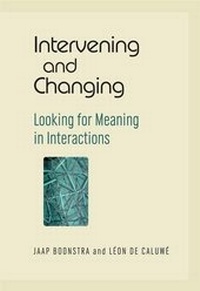
Intervening and Changing
Description

More details
Other editions
Additional editions
Persons
Jaap J. Boonstra is a Professor of Organizational Change and Development in the Faculty of Social and Behavioural Sciences at the University of Amsterdam, The Netherlands. He is also Dean and Scientific Director of Sioo, Inter-university Centre for Organizational Change and Learning. Founded by the Dutch universities, Sioo has been the bridge between scientifically founded theory and the practice of organizational and change processes in the Netherlands since 1958. He is also a visiting professor in Esade Business School in Barcelona, Spain. He is a research fellow and member of the scientific staff of The Netherlands School of Communications Research and the Amsterdam School of Social Research. After studying social and organizational psychology at Leiden University, The Netherlands, he obtained his doctorate with a thesis on integral organizational development and management of complex change processes. Previously, he was Associate Professor in organizational psychology at Leiden University, and has worked as a consultant, researcher, and managing partner at the Research Foundation for NewTechnology and Organizational Development. He lectures on the management of change, strategic decision-making, power and politics in organizations, and organizational learning. He has conducted research into the social and organizational aspects of technological innovations, sustainable development and change of organizations, strategic decision-making, and innovation. His research interests focus on barriers to organizational change and innovation, power dynamics in organizational change, sustainable development of organizations, democratic governance, and societal development. He has published over a hundred articles on technological and organizational innovation, management of organizational change, organizational learning, politics in organizations, strategic decision-making and fundamental change programmes in the service sector, and public administration in the Academy of Management Review, Concepts and Transformations, the European Journal of Work and Organizational Psychology, and Applied Psychology: An International Review. He is a member of the editorial board of several journals. Recently, he published a book on designing and developing organizations, and edited a special issue of the European Journal of Work and Organizational Psychology on power dynamics and organizational change.
Leon de Caluwe is a Management Consultant and Professor of Change Management at the Vrije Universteit - VU . Together with Hans Vermaak he co-created the Thinking in Colors theory. In 2001, Leon de Caluwe was appointed as a professor at Vrije Universiteit and he manages the Center for Research in Consultancy which studies the role, interventions and effectiveness of management consultants.
