

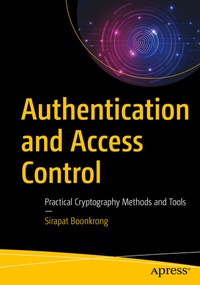
Authentication and Access Control
Description

Cybersecurity is a critical concern for individuals and for organizations of all types and sizes. Authentication and access control are the first line of defense to help protect you from being attacked.
This book begins with the theoretical background of cryptography and the foundations of authentication technologies and attack mechanisms. You will learn about the mechanisms that are available to protect computer networks, systems, applications, and general digital technologies.
Different methods of authentication are covered, including the most commonly used schemes in password protection: two-factor authentication and multi-factor authentication. You will learn how to securely store passwords to reduce the risk of compromise. Biometric authentication-a mechanism that has gained popularity over recent years-is covered, including its strengths and weaknesses.Authentication and Access Control explains the types of errors that lead to vulnerabilities in authentication mechanisms. To avoid these mistakes, the book explains the essential principles for designing and implementing authentication schemes you can use in real-world situations. Current and future trends in authentication technologies are reviewed.
What You Will Learn
- Understand the basic principles of cryptography before digging into the details of authentication mechanisms
- Be familiar with the theories behind password generation and the different types of passwords, including graphical and grid-based passwords
- Be aware of the problems associated with the use of biometrics, especially with establishing a suitable level of biometric matching or the biometric threshold value
- Study examples of multi-factor authentication protocols and be clear on the principles
- Know how to establish authentication and how key establishment processes work together despite their differences
- Be well versed on the current standards for interoperability and compatibility
- Consider future authentication technologies to solve today's problems
Who This Book Is For
Cybersecurity practitioners and professionals, researchers, and lecturers, as well as undergraduate and postgraduate students looking for supplementary information to expand their knowledge on authentication mechanisms
More details
Other editions
Additional editions
Person
Sirapat Boonkrong has more than 15 fifteen years of experience in the field of information security as a student, researcher, and lecturer. After spending more than 10 years getting his education from high school to PhD in the UK, Sirapat began his career in 2006 as a full-time researcher at the National Electronics and Computer Technology Centre, Thailand. He then moved into full-time teaching at King Mongkut's University of Technology North Bangkok, Thailand and stayed there from 2009 to 2017. Sirapat is currently a full-time lecturer at the School of Information Technology and DIGITECH at Suranaree University of Technology, Thailand. His main teaching and research interests are in cyber security, authentication technologies, and cryptographic protocol design.
Content
Chapter 1: Introduction to Cryptography.- Chapter 2: Public Key Infrastructure.- Chapter 3: Methods and Threats of Authentication.- Chapter 4: Password-Based Authentication.- Chapter 5: Biometric Authentication.- Chapter 6: Multi-Factor Authentication.- Chapter 7: Authentication and Key Establishment Protocols.- Chapter 8: Current and Future Trends of Authentication.
