

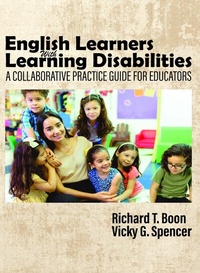
English Learners with Learning Disabilities
A Collaborative Practice Guide for Educators
1st Edition
Published on 1. April 2023
161 pages
979-8-88730-200-3 (ISBN)
Description

This edited book is intended to offer a practical guide for general, special, and bilingual/English as a second language educators working with English learners (ELs) with learning disabilities (LD) in the K-12 inclusive classroom. Authored by leading scholars with expertise in the fields of special and bilingual education, the book provides educators with a solid foundation of the growing demographics of ELs in our schools, an understanding of second language acquisition, and further knowledge of the referral, assessment, and identification process.A detailed discussion addresses cultural competence and the development of the individualized education program (IEP) and provides an overview of legal and instructional foundations for developing culturally and linguistically responsive (CLR) IEPs for diverse learners, with a specific focus on students with LD who are acquiring English as an additional language. Federal legislative mandates, required IEP components, and the significant role that families assume in quality IEP development is presented along with practical examples that demonstrate a strengths-based perspective for engaging colleagues and families in the development of CLR IEPs for ELs.The remaining chapters of the book provide content on the use of a multi-tiered systems of support (MTSS) framework, effective instructional practices, and research-based language and literacy interventions. To assist with the implementation of these interventions, a variety of co-teaching models are provided. Finally, the authors suggest ways to better communicate with parents and/or families to enhance collaboration between home and school.
More details
Other editions
Additional editions
Richard T. Boon | Vicky G. Spencer
English Learners with Learning Disabilities
A Collaborative Practice Guide for Educators
Book
04/2023
Information Age Publishing
€62.20
Shipment within 10-20 days
Content
- Cover
- English Learners with Learning Disabilities: A Collaborative Practice Guide for Educators
- English Learners with Learning Disabilities: A Collaborative Practice Guide for Educators
- Copyright Page
- Contents
- 1: English Learners With Learning Disabilities: Demographic Imperatives
- WHO ARE ELS?
- HOW ARE ELS IDENTIFIED?
- LIEPS
- WITHIN- AND ACROSS-GROUP DIVERSITY AMONG ELS
- LANGUAGE DIVERSITY
- RACE/ETHNICITY AND NATIONAL ORIGIN
- SOCIOECONOMIC STATUS
- SCHOOLING HISTORIES
- CULTURAL INFLUENCES
- ELS WITH LDS
- TEACHER PREPARATION
- CONCLUSION
- REFERENCES
- 2: Second Language Acquisition
- LANGUAGE ACQUISITION
- First Language Acquisition
- Second Language Acquisition
- Cross-Linguistic Transfer
- SECOND LANGUAGE ACQUISITION IN THE CLASSROOM
- Practices that Support Language Acquisition
- Comprehensible Input
- Comprehensible Output
- Academic Language
- TEACHER COLLABORATION
- CONCLUSION
- REFERENCES
- 3: Referral, Assessment, and Identification
- ELS AND ELS WITH LD
- ISSUES IN REFERRAL, ASSESSMENT, & IDENTIFICATION OF ELS WITH LD
- PROMISING PRACTICES AND CHALLENGES IN MTSS MODELS FOR ELS
- WHAT THE RESEARCH SAYS: MTSS MODELS FOR ELS
- WHERE DO WE GO FROM HERE? CONTINUAL IMPROVEMENT OF REFERRAL, ASSESSMENT, & IDENTIFICATION PRACTICES
- REFERENCES
- 4: Legislation, Pedagogy, and Multi-Tiered Systems of Support
- LEGISLATION
- Individuals with Disabilities Education Improvement Act (IDEIA)
- Elementary and Secondary Education Act
- PEDAGOGY
- THE MULTI-TIERED SCHOOL
- WORKING TOGETHER FOR SUCCESS
- CONCLUSION
- REFERENCES
- 5: The Individualized Education Program (IEP)
- IEP LEGISLATION AND RESEARCH
- IEP COMPONENTS
- PRESENT LEVEL OF ACADEMIC ACHIEVEMENT AND FUNCTIONAL PERFORMANCE (PLAAFP)
- Academic Performance
- Functional Skills Performance
- English Language Development Performance
- Measurable Annual Goals
- Special Education and Related Services
- General Education Curriculum Participation
- Assessment, Progress Monitoring, and Accommodations
- Mandated District/State Assessments
- Progress Monitoring
- Accommodations
- Transition Services
- English Language Development (ELD)
- Other Requirements
- IEPS AS INSTRUCTIONAL TOOLS
- FAMILY ENGAGEMENT AND ADVOCACY
- Cultural and Linguistic Competence
- Family IEP Engagement Cycle
- Pre-IEP Meeting Engagement
- IEP Meeting Engagement
- Post-IEP Meeting Engagement
- SCHOOL ADVOCACY PRACTICES
- EXAMPLES OF CULTURALLY AND LINGUISTICALLY RESPONSIVE (CLR) IEP COMPONENTS
- CONCLUSION
- REFERENCES
- 6: Effective Instruction
- INTRODUCTION
- Components of Effective Instruction
- Develop Language and Literacy
- Foster Understanding of the Learning Environment
- Adopt Explicit and Instructive Behaviors
- RELEVANT RESEARCH-BASED PRACTICES
- CREATE Lesson Enhancements
- PACT Lesson Enhancements
- IMPLICATIONS FOR PRACTICE
- CONCLUSION
- REFERENCES
- 7: Co-Teaching Models
- WHAT IS CO-TEACHING?
- Why Co-Teach?
- Required Components for Successful Co-Teaching
- Growing Application of Co-Teaching
- RESEARCH SUPPORTING CO-TEACHING
- PREPARING FOR CO-TEACHING
- Trust, Respect and Parity
- Diverse Expertise
- Strong Communication Practices and Working to Strengths
- District and School-Level Structures
- BEST PRACTICES IN CO-PLANNING
- Why Co-Plan and With Whom?
- How, What and When to Co-Plan
- BEST PRACTICES IN CO-ASSESSMENT
- Why Co-Assess?
- Beginning to Co-Assess
- What If We Disagree?
- IMPLEMENTATION OF CO-TEACHING: THE CO-TEACHING APPROACHES
- One Teach-One Support (OTOS) and One Teach-One Observe (OTOO)
- Team Teaching
- Alternative Teaching
- Parallel Teaching
- Station Teaching
- Considerations for Regrouping Approaches
- UDL in the Co-Taught Classroom
- CONCLUSIONS
- REFERENCES
- 8: Communication and Collaboration With Families
- MAKING CO-TEACHING PLANNING ACCESSIBLE FOR FAMILIES
- INVOLVING FAMILIES WHEN EVALUATING AND MONITORING LEARNING
- SUPPORTING LANGUAGE AND LITERACY DEVELOPMENT
- FINAL THOUGHTS AND CONCLUSIONS
- REFERENCES
- Biographies
- EDITORS
- CONTRIBUTORS
