

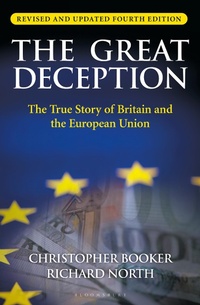
The Great Deception
The True Story of Britain and the European Union
1st Edition
Published on 19. August 2021
656 pages
978-1-4729-9373-1 (ISBN)
Description

Now published with a new preface explaining why The Great Deception is of the utmost importance today as it was when it was first published and to coincide with Great Britain's EU referendum in 2016, this book suggests that the United States of Europe and its edict of 'ever closer union' have been based on a colossal confidence trick.
This book tells for the first time the inside story of the most audacious political project of modern times: the plan to unite Europe under a single 'supranational' government. From the 1920s, when the blueprint for the European Union was first conceived by a British civil servant, this meticulously documented account takes the story right up to the moves to give Europe a political constitution, already planned 60 years ago to be the 'crowning dream' of the whole project.
The book shows how the gradual assembling of a European government has amounted to a 'slow motion coup d'etat', based on a strategy of deliberate deception, into which Britain's leaders, Macmillan and Heath, were consciously drawn. Drawing on a wealth of new evidence, scarcely an episode of the story does not emerge in startling new light, from the real reasons why de Gaulle kept Britain out in the 1960s to the fall of Mrs Thatcher. The book chillingly shows how Britain's politicians, not least Tony Blair, were consistently outplayed in a game the rules of which they never understood. But it ends by asking whether, from the euro to enlargement, the 'project' has now overreached itself, as a gamble doomed to fail.
Since their collaboration began in 1992, Christopher Booker, a Sunday Telegraph columnist, and Richard North, who worked for four years in Brussels and Strasbourg as a senior researcher, have won a unique reputation for their expertise on Britain's relationship to the European Union. Their previous publications included The Mad Officials (1994) and The Castle of Lies (1996). But they regard The Great Deception as the book they had been waiting to write for ten years.
This book tells for the first time the inside story of the most audacious political project of modern times: the plan to unite Europe under a single 'supranational' government. From the 1920s, when the blueprint for the European Union was first conceived by a British civil servant, this meticulously documented account takes the story right up to the moves to give Europe a political constitution, already planned 60 years ago to be the 'crowning dream' of the whole project.
The book shows how the gradual assembling of a European government has amounted to a 'slow motion coup d'etat', based on a strategy of deliberate deception, into which Britain's leaders, Macmillan and Heath, were consciously drawn. Drawing on a wealth of new evidence, scarcely an episode of the story does not emerge in startling new light, from the real reasons why de Gaulle kept Britain out in the 1960s to the fall of Mrs Thatcher. The book chillingly shows how Britain's politicians, not least Tony Blair, were consistently outplayed in a game the rules of which they never understood. But it ends by asking whether, from the euro to enlargement, the 'project' has now overreached itself, as a gamble doomed to fail.
Since their collaboration began in 1992, Christopher Booker, a Sunday Telegraph columnist, and Richard North, who worked for four years in Brussels and Strasbourg as a senior researcher, have won a unique reputation for their expertise on Britain's relationship to the European Union. Their previous publications included The Mad Officials (1994) and The Castle of Lies (1996). But they regard The Great Deception as the book they had been waiting to write for ten years.
More details
Edition
1. Auflage
Language
English
Place of publication
London
United Kingdom
Publishing group
Bloomsbury Publishing PLC
ISBN-13
978-1-4729-9373-1 (9781472993731)
Copyright in bibliographic data and cover images is held by Nielsen Book Services Limited or by the publishers or by their respective licensors: all rights reserved.
Schweitzer Classification
Other editions
Additional editions
Christopher Booker | Richard North
The Great Deception
The True Story of Britain and the European Union
Book
08/2021
Bloomsbury Continuum
€50.95
Article exhausted; check different version
Persons
Christopher Booker writes for the Sunday Telegraph and is the bestselling author of The Seven Basic Plots, The Real Global Warming Disaster, The Great Deception and Scared to Death. He was the founding editor of the satirical magazine Private Eye.
Richard North has in recent years won a reputation as one of Britain's most expert defence analysts, through his 'Defence of the Realm' blog. Formerly a research director in the European Parliament, North is also a political analyst through his EU Referendum blog and an author.
Richard North has in recent years won a reputation as one of Britain's most expert defence analysts, through his 'Defence of the Realm' blog. Formerly a research director in the European Parliament, North is also a political analyst through his EU Referendum blog and an author.
Content
Foreword and acknowledgements
1 The Early Days: 1918-1945
2 Try, Try and Try Again: The First Attempts at European Integration: 1945-1949
3 The Rocky Road to Rome: 1950-1957
4 'A Triumph for Monet': 1958-1961
5 Why de Gaulle Kept Britain Out: 1961-1969
6 The Real Deceit of Edward Heath: 1970-1972
7 Britain Stays In: 1973-1975
8 The Awkward Partner: 1975-1984
9 Enter Mr Spinelli: 1979-1986
10 Decline and Fall: 1986-1990
11 'At the Heart of Europe': 1990-1993
12 The Single Market: A Tale of Three Halves
13 Odd Man Out: 1993-1997
14 Towards 'Political Unity': 1997-1999
15 Hearts and Minds: 1999-2001
16 The Crowning Dream: 2002-2004
17 Downfall: 2004-2005
18 The Road to Lisbon: 2006-2009
19 The Euro Crisis: 2010-2012
20 Countdown to Referendum: 2012-2013
21 The Impossible Dream: 2014-2016
22 End Game: 2016-2020
Conclusion: End and a Beginning
Index
1 The Early Days: 1918-1945
2 Try, Try and Try Again: The First Attempts at European Integration: 1945-1949
3 The Rocky Road to Rome: 1950-1957
4 'A Triumph for Monet': 1958-1961
5 Why de Gaulle Kept Britain Out: 1961-1969
6 The Real Deceit of Edward Heath: 1970-1972
7 Britain Stays In: 1973-1975
8 The Awkward Partner: 1975-1984
9 Enter Mr Spinelli: 1979-1986
10 Decline and Fall: 1986-1990
11 'At the Heart of Europe': 1990-1993
12 The Single Market: A Tale of Three Halves
13 Odd Man Out: 1993-1997
14 Towards 'Political Unity': 1997-1999
15 Hearts and Minds: 1999-2001
16 The Crowning Dream: 2002-2004
17 Downfall: 2004-2005
18 The Road to Lisbon: 2006-2009
19 The Euro Crisis: 2010-2012
20 Countdown to Referendum: 2012-2013
21 The Impossible Dream: 2014-2016
22 End Game: 2016-2020
Conclusion: End and a Beginning
Index
