

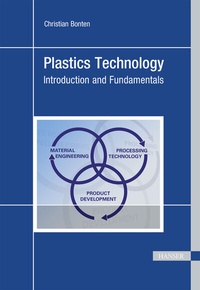
Plastics Technology
Introduction and Fundamentals
1st Edition
Published on 7. October 2019
496 pages
978-1-56990-768-9 (ISBN)
Description

This introductory book covers the entire spectrum of the plastics technology/engineering, from raw material to finished plastic products. It is intended not just for university/college students in plastics technology and other engineering disciplines but also for beginners to the field in general.
The interconnectivity between the different relevant knowledge areas of plastics technology, such as materials engineering, processing technology, and product development, is emphasized. A chapter "Plastics and the Environment" is also included, covering a topic (rightly) often of great concern to students and newcomers to the field.
Also includes numerous videos, conveniently linked via QR codes, to better demonstrate key processes visually.
More details
Other editions
Additional editions
Book
10/2019
1st Edition
Hanser Publications
€109.99
Shipment within 3-4 weeks
Person
Author
Univ.-Prof. Dr.-Ing. Christian Bonten leitet das Institut für Kunststofftechnik (IKT) in Stuttgart, eines der führenden deutschen Forschungsinstitute auf dem Gebiet der Kunststofftechnik. Das Institut arbeitet auf allen Gebieten der Kunststofftechnik: der Werkstofftechnik, der Verarbeitungstechnik und der Produktentwicklung.
ISNI:
ISNI:
Content
- Intro
- Preface
- The Author: Prof. Christian Bonten
- How to Use This Book
- Contents
- 1 Introduction
- 1.1 Plastics - Material of the Modern Age
- 1.2 Applications of Plastics
- 1.3 Plastics and Design
- 1.4 References
- 2 Fundamentals
- 2.1 From Monomer to Polymer - Basics of Polymer Chemistry
- 2.1.1 Origin of Monomers
- 2.1.2 Polymer Synthesis
- 2.1.2.1 Polymerization
- 2.1.2.2 Copolymerization (Special Form of Polymerization)
- 2.1.2.3 Polycondensation
- 2.1.2.4 Polyaddition
- 2.1.3 The Molar Mass of Polymers
- 2.1.4 Binding Forces and Brownian Molecular Movement
- 2.1.4.1 Intermolecular Physical Bonds
- 2.1.4.2 Brownian Molecular Motion - Mobility of Polymer Chains
- 2.1.5 Mechanisms of Solidification and Subdivision of Polymers
- 2.1.6 Primary Structure of Polymers: Constitution and Configuration
- 2.1.7 Secondary and Tertiary Structures of Polymers: Conformation
- 2.1.7.1 Amorphous Structures
- 2.1.7.2 Crystalline Structures
- 2.1.7.3 Influence of the Primary Structure
- 2.1.7.4 Superstructures
- 2.1.8 Polymers - Raw Materials Not Only for Plastics
- 2.2 Fundamentals of Force Transmission
- 2.2.1 Important Terms
- 2.2.1.1 Strength
- 2.2.1.2 Stiffness
- 2.2.1.3 Toughness
- 2.2.1.4 Stress-Strain Diagrams
- 2.2.2 State Ranges of Plastics
- 2.2.2.1 Glass Transition Temperature Tg
- 2.2.2.2 Crystalline Melting Temperature Tm
- 2.2.2.3 State Ranges of Crosslinked Polymers
- 2.2.3 Mechanical Replacement Models
- 2.3 Plastics and Plastics Technology - Definition of Terms
- 2.4 References
- 3 Plastics Materials Engineering
- 3.1 Behavior in the Melt - Flow Properties and Their Measurement
- 3.1.1 Fluid Mechanics Basics
- 3.1.2 Influences on the Flow Behavior
- 3.1.3 The Concept of Representative Viscosity
- 3.1.4 Elongation of Melt
- 3.1.5 Die Swell and Shrinkage
- 3.1.6 Rheometry - the Measurement of Flow Properties
- 3.1.6.1 Measurement of the Melt Flow Rate MFR
- 3.1.6.2 The High-Pressure Capillary Rheometer
- 3.1.6.3 Rotational Rheometer
- 3.1.6.4 Extensional Rheometer
- 3.2 Behavior as a Solid - Solid Properties and Their Measurement
- 3.2.1 Mechanical Properties of Plastics
- 3.2.1.1 The Tensile Test
- 3.2.1.2 The High Speed Tensile Test
- 3.2.1.3 Influence of Time and Temperature on the Mechanical Behavior
- 3.2.1.4 The Creep Test
- 3.2.1.5 The Vibration Test
- 3.2.1.6 The Bending Test
- 3.2.2 Physical Properties
- 3.2.2.1 Electrical Properties
- 3.2.2.2 Magnetic Properties
- 3.2.2.3 Optical Properties
- 3.2.2.4 Acoustic Properties
- 3.2.3 Values for Thermal and Mass Exchange
- 3.2.3.1 Specific Enthalpy h
- 3.2.3.2 Specific Heat Capacity cp
- 3.2.3.3 Density ?
- 3.2.3.4 Thermal Conductivity ?
- 3.2.3.5 Coefficient of Thermal Expansion a
- 3.2.3.6 Thermal Diffusivity a
- 3.2.3.7 Heat Penetration Coefficient b
- 3.2.3.8 Mass Transport
- 3.3 Influence of Additives on Properties
- 3.3.1 Reinforcing Materials - Active Additives
- 3.3.1.1 Fibers and the Principle of Reinforcement
- 3.3.1.2 The Tasks of the Matrix
- 3.3.1.3 Force Transmission of Fiber-Reinforced Plastic Composites
- 3.3.1.4 Defects in Fiber-Reinforced Plastic Composites
- 3.3.1.5 Nanoparticles as Active Additives
- 3.3.2 Functional Additives
- 3.3.2.1 Viscosity-Changing Additives - Flowing Agents
- 3.3.2.2 Plasticizers
- 3.3.2.3 Blending of Polymers
- 3.3.2.4 Impact Modifiers
- 3.3.2.5 Nucleating Agents
- 3.3.2.6 Coupling Agents
- 3.3.2.7 Conductive Additives
- 3.3.3 Fillers - Inactive Additives
- 3.4 From Polymer to Plastic - Introduction to Plastic Compounding
- 3.4.1 The Twin-Screw Extruder
- 3.4.2 Process Technology
- 3.4.3 Characteristic Values
- 3.4.4 Additional Units
- 3.5 Process, Structure, Properties - Influences due to the Converting Process
- 3.5.1 Residual Stresses
- 3.5.2 Orientation of Macromolecules
- 3.5.3 Orientation of Fibers
- 3.5.4 Crystallization
- 3.5.5 Formation of a Macrostructure: Foaming of Plastics
- 3.6 Changes over Time - Overview into the Aging of Plastics
- 3.6.1 Causes of Aging
- 3.6.2 Aging Processes
- 3.6.2.1 Mechanical Aging Mechanisms
- 3.6.2.2 Physical Aging Mechanisms
- 3.6.2.3 Chemical Aging Mechanisms
- 3.6.2.4 Mode of Action of Aging Stabilizers
- 3.6.3 Aging Phenomena
- 3.6.4 Characterization of the Aging Progress
- 3.7 Brief Description of Some Important Plastics
- 3.8 Polyethylene (PE)
- 3.9 Polypropylene (PP)
- 3.10 Ethylene-Propylene-(Diene) Copolymers (EPDM)
- 3.11 Polyvinyl Chloride (PVC)
- 3.12 Polystyrene (PS)
- 3.13 Styrene-Butadiene-Styrene Copolymers (SBS)
- 3.14 Styrene-Acrylonitrile Copolymers (SAN)
- 3.15 Acrylonitrile-Butadiene-Styrene Copolymers (ABS)
- 3.16 Acrylonitrile-Styrene-Acrylate Copolymers (ASA)
- 3.17 Polyamide (PA)
- 3.18 Polybutylene Terephthalate (PBT)
- 3.19 Polyethylene Terephthalate (PET)
- 3.20 Polycarbonate (PC)
- 3.21 Polymethyl Methacrylate (PMMA)
- 3.22 Polyoxymethylene (POM)
- 3.23 Polytetrafluoroethylene (PTFE)
- 3.24 Polyether Ether Ketone (PEEK)
- 3.25 Polyethersulfone (PES) und Polysulfone (PSU)
- 3.26 Polyphenylene Sulfide (PPS)
- 3.27 Cellulose Derivatives
- 3.28 Polyhydroxyalkanoates (PHA)
- 3.29 Polylactide (PLA)
- 3.30 Thermoplastic Polyurethane (TPE-U, also TPU)
- 3.31 Polyurethane (PUR)
- 3.32 Epoxy Resins (EP)
- 3.33 Melamine Formaldehyde Resin (MF)
- 3.34 Phenol-Formaldehyde or Phenol Resin (PF)
- 3.35 Urea-Formaldehyde Resin (UF)
- 3.36 Unsaturated Polyester Resin (UP)
- 3.37 References
- 4 Plastics Processing Technology
- 4.1 Extrusion
- 4.1.1 Extruder Screw and Barrel
- 4.1.2 The Helibar® High-Performance Extruder
- 4.1.3 Pipe and Profile Extrusion
- 4.1.4 Flat Film and Sheet Extrusion
- 4.1.5 Tube and Blown Film Extrusion
- 4.1.6 Extrusion Blow Molding
- 4.1.7 Co-extrusion
- 4.2 Injection Molding
- 4.2.1 The Injection Molding Process
- 4.2.2 The Plasticizing Unit
- 4.2.3 The Clamping Unit with Injection Mold
- 4.2.3.1 Rheological Design
- 4.2.3.2 Thermal Design
- 4.2.4 Influence of the Injection Molding Process on the Properties of the Component
- 4.2.5 Special Processes
- 4.2.5.1 Injection-Compression Molding
- 4.2.5.2 Thermoplastic Foam Injection Molding
- 4.2.5.3 Cascade Injection Molding
- 4.2.5.4 Injection Molding Compounding
- 4.2.5.5 Multi-component Processes
- 4.2.5.6 Sandwich Injection Molding
- 4.2.5.7 Fluid Injection Techniques
- 4.2.5.8 Back Injection Technology
- 4.2.5.9 Injection Stretch Blow Molding
- 4.2.5.10 Variothermal Mold Temperature Control
- 4.3 Processing of Crosslinking Plastics
- 4.3.1 Compression Molding
- 4.3.2 Transfer Molding
- 4.3.3 Injection Molding
- 4.3.4 Polyurethane Processing
- 4.4 Technology of Fiber-Reinforced Plastics
- 4.4.1 Hand Lay-up and Fiber Spraying
- 4.4.2 Pressing of SMC and GMT
- 4.4.3 Pultrusion of Continuous Fibers
- 4.4.4 Working with Prepregs
- 4.4.5 Resin Injection Molding
- 4.4.6 Three-Dimensional Fiber Reinforced Plastic Structures
- 4.5 Further Processing
- 4.5.1 Thermoforming
- 4.5.2 Mechanical Machining of Plastics
- 4.5.3 Welding
- 4.5.3.1 Hot Plate Welding
- 4.5.3.2 Hot Gas Welding
- 4.5.3.3 Extrusion Welding
- 4.5.3.4 Ultrasonic Welding
- 4.5.3.5 Vibration Friction Welding
- 4.5.3.6 Laser Welding
- 4.5.4 Adhesive Bonding
- 4.5.5 Joining by Snap Connections, Screws, and Rivets
- 4.5.6 Coating of Plastics
- 4.5.6.1 Coated Components
- 4.5.6.2 Coating Processes
- 4.6 References
- 5 Product Development with Plastics
- 5.1 Plastics as Construction Materials
- 5.1.1 Plastic-Specific Unique Selling Points
- 5.1.2 Material Preselection
- 5.2 Geometric Subdivision of Products
- 5.2.1 Large-Area Products
- 5.2.2 Housing-Like Products
- 5.2.3 Container-Like Products
- 5.2.4 Complex Products
- 5.2.5 Function-Specific Products
- 5.2.6 Importance for the Choice of the Processing Method
- 5.3 Designing with Plastics
- 5.3.1 Requirements for Products and Functions
- 5.3.2 Benefits of Design Freedom - Integration of Functional Elements
- 5.3.3 Use of Design Freedom - Increasing the Surface Moment of Inertia
- 5.3.4 Material-Specific Design
- 5.3.5 Production-Oriented Design
- 5.3.6 Stress-Oriented Design
- 5.3.6.1 Dimensioning against a Permissible Stress
- 5.3.6.2 Dimensioning against Critical Strain
- 5.3.6.3 Dimensioning against the Influence of Time - Service Life Prediction
- 5.3.7 Brief Summary of Designing with Plastics
- 5.4 Benefits of Prototypes in Product Development
- 5.4.1 Rapid Prototyping
- 5.4.1.1 Stereolithography (SLA)
- 5.4.1.2 Selective Laser Sintering (SLS)
- 5.4.1.3 Laminated Object Manufacturing (LOM)
- 5.4.1.4 3D Printing (3-D-P)
- 5.4.1.5 Fused Deposition Modeling (FDM or FFF)
- 5.4.2 Rapid Tooling
- 5.4.2.1 Casting
- 5.4.2.2 Laser Sintering
- 5.4.3 Selection of a Prototype Method
- 5.4.3.1 Requirements Placed on the Prototype
- 5.4.3.2 Prototypes for Large-Area Products and for Housing-Like Products
- 5.4.3.3 Prototypes for Container-Like Products
- 5.4.3.4 Prototypes for Complex Products
- 5.5 References
- 6 Plastics and the Environment
- 6.1 Plastic Waste
- 6.2 Are Plastics Toxic?
- 6.3 Biopolymers and Bioplastics
- 6.3.1 Biodegradable Plastics
- 6.3.2 Bio-based Plastics
- 6.3.3 From Biopolymer to Bioplastic - Compounding of Biopolymers
- 6.4 Conserving Resources with Plastics
- 6.4.1 Origin of the Term "Sustainability"
- 6.4.2 The Brundtland Report and the Kyoto Protocol
- 6.4.3 Conservation of Resources with Plastics
- 6.4.4 Regenerative Energy Generation with Plastics
- 6.5 Conclusion
- 6.6 References
- A - Recommendations for Writing a Bachelor's/Master's Thesis at the IKT
- A.1 Different Demands of Bachelor's, Master's, and Doctoral Theses
- A.2 Scientific Methods
- A.2.1 Source-Examining Methods
- A.2.2 Theoretical Methods
- A.2.3 Empirical Methods
- A.3 Scientific Work
- A.4 Bachelor's or Master's Thesis
- A.4.1 About the Title of the Thesis
- A.4.2 About the Content of the Thesis
- A.4.2.1 Summary
- A.4.2.2 Introduction
- A.4.2.3 Main Part
- A.4.2.4 Concluding Remarks
- A.4.2.5 Appendix
- A.4.3 About the Scope of the Thesis
- A.4.4 About the Writing Style of the Thesis
- Index
* Introduction to Plastics
* Fundamentals
* Plastic Materials Engineering: melt behavior, solid-state behavior, influence of additives, "from polymer to plastic" through compounding, process-structure properties, influence of aging, overview of important plastics
* Plastic Processing Technology: extrusion, injection molding, processing of crosslinked molding compound, fiber-plastic composites, thermoforming, welding, bonding, coating
* Product Development with Plastics: unique features of plastics, geometrical classification of plastic parts, designing with plastics, usage of prototypes
* Plastics and the Environment
* Recommendations for Writing a Bachelor's/Master's Thesis
