

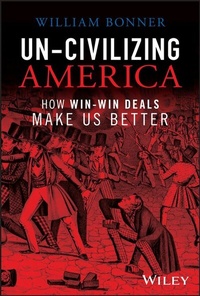
Un-Civilizing America
Description

In Un-Civilizing America - How Win-Win Deals Made Us Rich, bestselling author William Bonner delivers an incisive and engrossing account of the American economy, the four simple steps to earning money the honest way, and why many choose the dishonest way instead. He also discusses the shadow groups that influence America behind the scenes and how their power grew so large they lost the need to remain hidden, and what really drives the government's phony wars--including the War on Drugs and the US-China trade war.
In the book, you'll learn why the best kinds of economies run on "win-win" deals and how companies and individuals use market-set prices to maximize their utility. You'll also discover:
* Why the "Sermon on the Mount" was the best economic and social advice ever given
* How civilization developed and the one thing that sets it apart from barbarity
* How "win-lose" deals inevitably force one side or the other to accept the terms of the "agreement"
* Why allowing only one side to profit in an arrangement is a recipe for disaster in the long run
* Why capitalism favors "win-win" deals while socialism prefers the "win-lose" variety
A can't-miss resource for anyone interested in American or global economics and finance, Un-Civilizing America will also earn a place on the bookshelves of business leaders, entrepreneurs, policy and lawmakers, and regulators.
More details
Other editions
Additional editions
Content
Chapter 1 In the Beginning 17
Chapter 2 On Cooperation and Win- Win 59
Chapter 3 What Civilization Is Not 73
Chapter 4 What Kind of Game Are We Playing? 99
Chapter 5 Win-Win or Lose 127
Chapter 6 Fake News 157
Chapter 7 Win-Lose Money 211
Chapter 8 Government--The Ultimate Win-Loser 247
Chapter 9 The Deep State 271
Chapter 10 De-civilizing America 299
An Afterthought 379
Notes 383
About the Author 397
Index 399
Introduction
"It is forbidden to kill; therefore all murderers are punished unless they kill in large numbers and to the sound of trumpets."
-Voltaire
History doesn't tell us who made the first falafel . or how Cleopatra felt when Marc Antony kissed her on the lips. But it does tell us that the Elamites slew the people of Uruk and the Amorites slew the Sumerians. Then, the people of Uruk slew the people of Kish. Or was it the other way around? In any case, at least the Bible is clear about it: Cain slew Abel.
And take a look at the Kennewick Man, a human skeleton discovered in Washington State in 1996. He lived around 9400 BCE. He died when another human shot him with an arrow.
The royal tomb at Ur, one of the oldest cities in the world, shows the pattern was already well developed in 2600 BCE.
Discovered at that site during the original excavation in 1922 was a wooden box with a frieze carved into it. This "Standard of Ur" depicts an army of soldiers, horses, and war chariots attacking an unidentified enemy. Soldiers are run down by the chariots. Others are led before the king to be sent into slavery, tortured, or executed.
On a stone stele discovered not far away in southern Iraq, it is recorded that Eannatum, king of Lagash, conquered the city of Umma.
On this "Stele of the Vultures," as it is called, we see the victorious phalanx marching over the bodies of the defeated enemies . with buzzards picking at the severed heads underfoot. That was in 2450 BCE. By then, this sort of thing had already been going on for at least a thousand years . and it was just beginning.
Another stele from 200 years later shows the victory of Naram-Sin, an Akkadian monarch and the grandson of King Sargon of Akkad. He fought the Lullubi, a people with an unknown language, thought to be pre-Iranian, who had come down from the Zagros Mountains. He won, of course. Otherwise, the stele would be dedicated to the Lullubi king. There he is, Naram-Sin, larger than life, leading his warriors to victory . with the enemy pleading for mercy.
These are among the first records of civilized warfare. Alert readers will be quick to notice that "civilized warfare" is oxymoronic. That contradiction is at the heart of the present work.
When you set out to write a book, you know where you begin. But you don't know where you will end up. As you think and study, your ideas evolve. As the philosopher Yogi Berra put it: "You've got to be very careful if you don't know where you are going, because you might not get there." Sometimes, you end up somewhere you hadn't intended to go. But often, it is where you ought to be.
My goal was to attack the crooked timber of mankind with a chainsaw. I intended to write a book called The Public Spectacle. In it, I would cut into the lurid and fantastic space where public life takes place.
We all spend a good deal of our lives there . Newspapers and TV shows are devoted to it . It controls many of our thoughts . It takes up our time and money . It kills millions, imprisons millions, and shackles hundreds of millions to the toxic illusions of public life. But few people have done much careful thinking about it.
Not that I was going to approach the subject in a serious or academic way; that was far more work than I was prepared to undertake. But at least I could make the chips fly and have a few laughs.
The resulting book is not the product of diligent scholarship or even careful study. Don't be surprised to find loose ends and contradictions. And don't hold your breath for precision, either. As you get deeper into the book, you will find out why.
Besides, more serious books on similar subjects, with similar conclusions, are available. Steven Pinker has a masterful tome, The Better Angels of our Nature: Why Violence Has Declined, with a much more thorough treatment of the origins and decline of violence in human life. William von Hippel takes up the subject of cooperation in his marvelous book, The Social Leap. Robert Wright's Nonzero does a better job of describing the evolution of a win-win society. And John Gray has thought much more deeply about the philosophical implications in his book The Silence of Animals. All deserve a careful reading.
This book was supposed to be merely a collection of insights, observations, and playful guesses from someone who is trying to connect the dots-sometimes right, sometimes wrong . and always in doubt.
But what has emerged is something that has turned out to be more serious, and less funny, than I expected. The comedy is there. But there is something else, too. The same capacity for mythmaking that makes public life such a hoot is also what makes civilization possible.
As we will see together, the public space-where civilization takes place-is a world that can only exist if people are willing and able to imagine things that don't exist, believe things that aren't provably true, and do things that don't really make sense for them, individually, in any conscious, immediate, or logical way.
Why else, in 1812, would 700,000 Frenchmen and their allies give up their wine and sausages, forego the warm, late-summer sun on the Seine and Rhine . and say goodbye to the coquettish smiles of their filles and fräulein . so they could join Emperor Napoléon's war, tromp 1,000 miles across the barren steppe to freeze their derrières off in a fight to the death with barbarous Cossacks?
Why else would Americans spend $7 trillion to fight a "War on Terror" when there is statistically less chance of coming to grief at the hands of a terrorist than of choking to death on a filet mignon?
Why else would people believe that Pharaoh was a god . that alcohol should be outlawed in twentieth-century America . or that educated Cambodians should be forced to move to rural villages, where they could learn to be subsistence farmers?
These ideas are called "memes" by technologically inclined authors. Richard Dawkins, for example, suggests they are very much like viruses that seek only to replicate themselves in the fertile mush of our minds. Once there, they direct our thoughts and behavior.
Given that I have trouble turning on a television, I prefer to call them "myths"; an older word that fits more elegantly into my more literary approach. As we go on, we will also see that Dawkins's "meme" concept is not really suited to our hypothesis anyway. Our desire to do win-win deals with one another doesn't come from a "meme" that has somehow found a home in our brains. More likely, the success of win-win deals caused the brain to invent a myth . or a meme . to help make sense of it.
This is not meant to diminish the power of the idea, of course. Wherever it comes from, once an idea is anchored in the public space, it tends to shape our other ideas, and our conduct, too.
Many people, for example, think "democracy is the worst form of government, except for all the others." This could be the result of observation. Or a successful meme. Or a myth, invented to protect us from other, less successful forms of government.
But we don't know whether a democracy is better. Its virtues cannot be tested. No one even knows what it means. "Better" can mean almost anything. For the concept to have any meaning at all, you have to know what "democratic government" is, too. And that is another compound abstraction given life by our imaginations.
In other words, government, along with every other thing of "importance" in the public space, is dependent on shared myths. Not necessarily true or false . good or bad, these myths are multilayered, complex, and fluid. They give rise not merely to the form of government you choose, but-at some level-to the existence of government itself.
You can find many proofs of "government"-in elections, police, wars, taxes. You can go to Washington and see government buildings . and meet people who are paid to work for "the government." You can get a check from "the government." You can get very mad at "the government." You can get put in jail by "the government" . or killed by it. But governments would disappear immediately if we stopped believing in them.
And you can't see "the government." You see people. You see uniforms (actually, what you see are colors . and things you interpret as fabrics, worn by moving things you interpret to be people). You see things going on . which you believe-in an elaborate confection of fraud, fantasy, and fact-are connected in some way to "the government."
The government is untouchable, intangible, and abstract. From its parts . its effects . and its works, you can infer that there is something going on, which you can call a "government."
But there could be other explanations for the phenomena you experience. You might just as well believe that all the things you see-thought to be related to "government"-are actually the paraphernalia of a giant film or stage production, like The Truman Show, where "government" employees and...
