

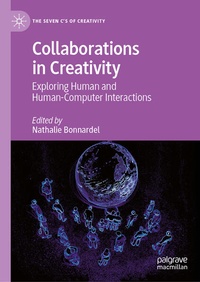
Collaborations in Creativity
Description

This edited book explores the nature of creative activities using the seven C's of creativity framework, with a focus on collaboration. Addressing both Human-Human collaboration and Human-Computer collaboration with different technologies, it explores the relationships and constraints involved in collaborations amongst individuals, teams, and organizations, and offers valuable insights into the role of AI and robots in creative activities. Throughout the chapters, leading scholars in complementary fields (e.g., cognitive, ergonomics, social, industrial & organizational, educational psychology, as well as engineering and media architecture) discuss different types of collaboration in creative situations, including working groups and interactions with AI-enabled technologies (e.g., generative AI and social robots), analyze their barriers and challenges, propose models of these complex activities, and suggest ways to achieve efficient collaborative creative activities that are tailored to the needs of humans and the environments in which they operate.
A useful read for anyone involved in fields requiring collective creativity, such as design, team management, ergonomics, engineering, teaching, creative writing, filmmaking, or the arts, this book also advances research in creativity studies by combining theoretical and applied approaches.
More details
Other editions
Additional editions
Person
Nathalie Bonnardel is Full Professor in Cognitive Psychology and Ergonomics at Aix-Marseille University in France. She is the Founder and Director of the Institute for Creativity and Innovations (InCIAM) and a member of the Board of Directors of the International Society for the Study of Creativity and Innovation (ISSCI). Her research, conducted at the Research center for the Psychology of Cognition, Language and Emotion (PSYCLE), focuses on understanding the processes involved in individual and creative activities, and contributes to the development of new methods, techniques, and digital supports for these activities.
Content
1. Human-Human and Human-Computer Collaborations Towards Creative Activities.- 2. Circumscribing and Appraising Collaboration in Design.- 3. The Psychosocial and Cognitive Underpinnings of Collective and Organizational Creativity.- 4. Social Process Assessment for Recognizing Creativity: A Creative Behaviors and Processes Coding Scheme.- 5. Scientific Collaboration as Multi-level Interaction Processes: Dialectic Knowledge Creation across Teams, Communities, and Society.- 6. The Story Lab: What Can We Learn From Embodied Cognition?.- 7. Using a Large Volume of Local Historical Statistical Tables as a Source of Mutual Inspiration and Collective Creativity.- 8. Human - AI and Social Robots Creative Collaboration.- 9. From Social Encounters to Sociotechnical Creative Collaboration: Perceiving and Engaging with Robots.
