

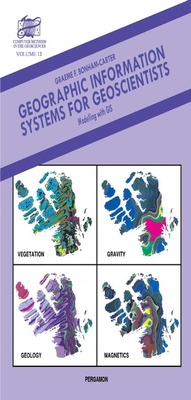
Geographic Information Systems for Geoscientists
Modelling with GIS
Published on 18. May 2014
416 pages
978-1-4831-4494-8 (ISBN)
Description

Geographic Information Systems for Geoscientists: Modelling with GIS provides an introduction to the ideas and practice of GIS to students and professionals from a variety of geoscience backgrounds. The emphasis in the book is to show how spatial data from various sources (principally paper maps, digital images and tabular data from point samples) can be captured in a GIS database, manipulated, and transformed to extract particular features in the data, and combined together to produce new derived maps, that are useful for decision-making and for understanding spatial interrelationship. The book begins by defining the meaning, purpose, and functions of GIS. It then illustrates a typical GIS application. Subsequent chapters discuss methods for organizing spatial data in a GIS; data input and data visualization; transformation of spatial data from one data structure to another; and the combination, analysis, and modeling of maps in both raster and vector formats. This book is intended as both a textbook for a course on GIS, and also for those professional geoscientists who wish to understand something about the subject. Readers with a mathematical bent will get more out of the later chapters, but relatively non-numerate individuals will understand the general purpose and approach, and will be able to apply methods of map modeling to clearly-defined problems.
More details
Other editions
Additional editions

Book
01/1995
Pergamon
€71.79
The article will not be published
Content
ForewordPreface1 Introduction to GIS What is GIS? Purpose of GIS Organization Visualization Spatial Query Combination Analysis Prediction GIS and Related Computer Software Computer Aided Drawing Image Processing Systems 3-D GIS Database Management Systems Desktop Mapping Systems Contouring and Surface Mapping Packages Geostatistics Programs Mathematical Morphology Programs Other Software Custodial Versus Project-Related GIS Geological Application of GIS Mineral Potential Mapping References2 Spatial Data Models Introduction Spatial Objects Sampling-Limited Spatial Objects Definition-Limited Spatial Objects Irregular Imposed Spatial Objects Regular Imposed Spatial Objects Raster and Vector Spatial Data Models Raster Model Vector Model Attribute Data Spatial Attributes Nonspatial Attributes Measurement Scales Attribute Tables The Relational Model References3 Spatial Data Structures Introduction Raster Structures Full Raster Structure Attribute Classification Run-Length Encoding Scan Order for Rasters Region Quadtrees and Octrees Lines and Points in Raster Vector Data Structures Spaghetti Structure Topological Data Structures Vector Structures for Surfaces References4 Spatial Data Input Introduction Data Sources Primary Data Secondary Data Map Projections Geographic Coordinates Plane Coordinates Geometric Distortions Figure of the Earth Developable Surfaces Digitizing Manual Digitizing Raster Scanning Coordinate Conversion Vector Conversion Raster Conversion References5 Visualization and Query of Spatial Data Introduction Display of Cartographic Images Components of a Cartographic Image Resolution, Scale and Metafiles Display Hardware for Digital Images Color Color Lookup Tables Hardcopy Devices Visualization of Surfaces Dynamically-Linked Data Views Spatial Query Query by Spatial Attributes Query by Nonspatial Attributes References6 Spatial Data Transformations Introduction Point-to-Area Conversions Density Mapping Methods for Point Samples Dilation of Spatial Objects Dilating Linear Features Mathematical Morphology Operations Sampling Transformations Areas-to-Points Area-to-Area Raster-to-Vector-to-Raster References7 Tools for Map Analysis: Single Maps Introduction Examples of Applying Analytical Operations to Single Maps Data Analysis and Modeling Map Reclassification Classification Tables Using Breakpoints Operations on Attribute Tables Adding New Fields Spatial, Topological, and Geometrical Modeling Aggregation Operations on Tables Operations on Spatial Neighborhoods Smoothing or Low-Pass Filters High-Pass Filters for Edge Detection Directional Filters Hill Shading Texture Filters Join-Count Statistics References8 Tools for Map Analysis: Map Pairs Introduction Two-Map Overlays and Map Modeling Map Modeling with Attribute Tables Map Overlays and Overlay Tables Correlation between Two Maps Area Cross-Tabulations Nominal Scale Data Binary Maps Interval and Ratio Scale Maps Ordinal Scale Data Other Topics Summary References9 Tools for Map Analysis: Multiple Maps Introduction Types of Models Modeling with GIS Interchange of Map Data Files wi
