

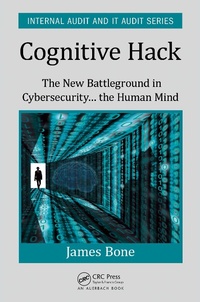
Cognitive Hack
The New Battleground in Cybersecurity ... the Human Mind
1st Edition
Published on 24. February 2017
204 pages
978-1-4987-4982-4 (ISBN)
Description

This book explores a broad cross section of research and actual case studies to draw out new insights that may be used to build a benchmark for IT security professionals. This research takes a deeper dive beneath the surface of the analysis to uncover novel ways to mitigate data security vulnerabilities, connect the dots and identify patterns in the data on breaches. This analysis will assist security professionals not only in benchmarking their risk management programs but also in identifying forward looking security measures to narrow the path of future vulnerabilities.
Reviews / Votes
Review by Raman NarasimhanCoverage & Scope
Cognitive Hack by James Bone offers a fresh perspective on cybersecurity by shifting the focus from technical solutions to the vulnerabilities of the human mind. It argues that the greatest weakness in cybersecurity is not weak passwords or outdated software but rather cognitive biases, decision-making patterns, and human behavior. The book explores how hackers exploit these vulnerabilities through deception, social engineering, and psychological manipulation rather than brute-force attacks on networks. By examining cybersecurity through a multidisciplinary lens that includes psychology, risk management, and information security, The author provides a comprehensive and practical framework for understanding and countering cyber threats. The book is particularly useful for cybersecurity professionals, IT auditors, and business leaders who want to move beyond conventional security measures and incorporate cognitive security into their risk management strategies.
Flow and Structure
The book is well-structured, with six chapters that build logically upon each other. The early sections lay the foundation for understanding the cyber paradox, where increased investments in cybersecurity do not necessarily translate into better protection. Subsequent chapters explore cognitive behaviors and how human perception influences security risks, leading to a discussion on deception and hacking psychology. The later chapters focus on the Cognitive Risk Framework, which provides a structured approach for integrating cognitive security into an organization's defense strategy. The writing is clear and well-paced, with each chapter reinforcing the central thesis that cybersecurity must evolve beyond technical solutions to include behavioral analysis and deception-based security measures.
Practical Use and Applications
One of the book's key strengths is its real-world applicability that provides practical insights into how organizations can defend themselves. The concept of deception-based security, which misleads attackers with false information and traps, making it harder for them to achieve their goals is an interesting thought to look for. It also emphasizes the role of situational awareness training in strengthening human defenses against phishing, fraud, and social engineering attacks. The book is particularly relevant for businesses looking to enhance their security posture, as it highlights best practices for risk management, governance, and cybersecurity intelligence. Case studies, including high-profile cyberattacks like the Ashley Madison breach, provide practical lessons that organizations can apply to improve their security frameworks.
Final Thoughts
Cognitive Hack is a well-researched and thought-provoking book that challenges conventional wisdom in cybersecurity. It successfully argues that human behavior is the weakest link and offers actionable strategies to mitigate cognitive vulnerabilities. By integrating insights from psychology, risk management, and security informatics, Cognitive Hack provides a multidisciplinary approach that is both innovative and practical. Its emphasis on best practices, practical applications, and forward-thinking security strategies makes it a must-read for those looking to stay ahead in the ever-evolving cybersecurity landscape.
More details
Series
Language
English
Place of publication
Philadelphia, PA
United States
Publishing group
Taylor & Francis Inc
Target group
College/higher education
Professional and scholarly
Illustrations
30 s/w Abbildungen
30 Illustrations, black and white
File size
5,00 MB
ISBN-13
978-1-4987-4982-4 (9781498749824)
Copyright in bibliographic data and cover images is held by Nielsen Book Services Limited or by the publishers or by their respective licensors: all rights reserved.
Schweitzer Classification
Other editions
Additional editions
Book
08/2021
1st Edition
CRC Press
€62.80
Shipment within 15-20 days
Book
01/2017
1st Edition
Auerbach Publishers Inc.
€121.00
Shipment within 15-20 days
Person
James Bone, MBA, Risk Advisory Consultant, Editor, TheGRCBlueBook.com, has 25 years of experience in financial services, including public and private industry, managing compliance, risk management, audit engagements and IT security for some of the largest financial services firms in the world. As Chief Risk and Compliance officer, James has worked on the front-lines of risk management establishing sustainable compliance, operational risk and IT security risk programs.
Mr. Bone has created the largest database of Governance, Risk, and Compliance (GRC) solutions on the internet. Recognizing the evolution of GRC systems and the proliferation of electronic platforms available to manage risks, Mr. Bone has systematically organized these tools into classes of solutions through TheGRCBlueBook to expand insight into the marketplace for these tools. Mr. Bone is the author of several papers on risk management, cognitive risk management, and IT security and the editor of TheGRCBlueBook library of risk practice articles.
Mr. Bone founded Global Compliance Associates, LLC to provide risk advisory services to organizations seeking to understand the GRC marketplace as well as the challenges faced by risk professionals in deploying the right tools to manage risk. Mr. has consulted with global public accounting firms, global advisory firms, sovereign nations, government agencies and private business on a variety of custom risk solutions.
Mr. Bone received an honorary PhD in Letters and his BA, Business Administration from Drury University in Springfield, Missouri, Ed.M. from Boston University, and BS in Management from Harvard University. Mr. Bone has served as trustee for Drury University as head of Athletic Committee and is active in other board committee leadership roles. Mr. Bone successfully chaired the Drury University's Presidential Search in 2013 and has served on the Aloha Fountain board as well as the Davies Career Technical High School Board.
Mr. Bone has created the largest database of Governance, Risk, and Compliance (GRC) solutions on the internet. Recognizing the evolution of GRC systems and the proliferation of electronic platforms available to manage risks, Mr. Bone has systematically organized these tools into classes of solutions through TheGRCBlueBook to expand insight into the marketplace for these tools. Mr. Bone is the author of several papers on risk management, cognitive risk management, and IT security and the editor of TheGRCBlueBook library of risk practice articles.
Mr. Bone founded Global Compliance Associates, LLC to provide risk advisory services to organizations seeking to understand the GRC marketplace as well as the challenges faced by risk professionals in deploying the right tools to manage risk. Mr. has consulted with global public accounting firms, global advisory firms, sovereign nations, government agencies and private business on a variety of custom risk solutions.
Mr. Bone received an honorary PhD in Letters and his BA, Business Administration from Drury University in Springfield, Missouri, Ed.M. from Boston University, and BS in Management from Harvard University. Mr. Bone has served as trustee for Drury University as head of Athletic Committee and is active in other board committee leadership roles. Mr. Bone successfully chaired the Drury University's Presidential Search in 2013 and has served on the Aloha Fountain board as well as the Davies Career Technical High School Board.
Content
Introduction: The Analytics of Data Breaches. Cyber-security: Understanding Vulnerabilities. Cognitive Behavior and Cyber-Security. Risk-weighted Exposures of System Applications. The Art and Science of Data Governance. Mapping the Digital Footprint of Data Breaches.
