

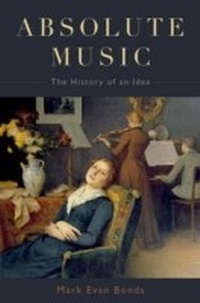
Absolute Music
The History of an Idea
1st Edition
Published in July 2014
401 pages
978-0-19-934365-2 (ISBN)
Description

What is music, and why does it move us? From Pythagoras to the present, writers have struggled to isolate the essence of "pure" or "absolute" music in ways that also account for its profound effect. In Absolute Music: The History of an Idea, Mark Evan Bonds traces the history of these efforts across more than two millennia, paying special attention to the relationship between music's essence and its qualities of form, expression, beauty, autonomy, as well as its perceived capacity
to disclose philosophical truths.
The core of this book focuses on the period between 1850 and 1945. Although the idea of pure music is as old as antiquity, the term "absolute music" is itself relatively recent. It was Richard Wagner who coined the term, in 1846, and he used it as a pejorative in his efforts to expose the limitations of purely instrumental music. For Wagner, music that was "absolute" was isolated, detached from the world, sterile. His contemporary, the Viennese critic Eduard Hanslick, embraced this quality of
isolation as a guarantor of purity. Only pure, absolute music, he argued, could realize the highest potential of the art.
Bonds reveals how and why perceptions of absolute music changed so radically between the 1850s and 1920s. When it first appeared, "absolute music" was a new term applied to old music, but by the early decades of the twentieth century, it had become-paradoxically-an old term associated with the new music of modernists like Schoenberg and Stravinsky. Bonds argues that the key developments in this shift lay not in discourse about music but rather the visual arts. The growing prestige of
abstraction and form in painting at the turn of the twentieth century-line and color, as opposed to object-helped move the idea of purely abstract, absolute music to the cutting edge of musical modernism.
By carefully tracing the evolution of absolute music from Ancient Greece through the Middle Ages to the twentieth-century, Bonds not only provides the first comprehensive history of this pivotal concept but also provokes new thoughts on the essence of music and how essence has been used to explain music's effect. A long awaited book from one of the most respected senior scholars in the field, Absolute Music will be essential reading for anyone interested in the history, theory, and aesthetics
of music.
to disclose philosophical truths.
The core of this book focuses on the period between 1850 and 1945. Although the idea of pure music is as old as antiquity, the term "absolute music" is itself relatively recent. It was Richard Wagner who coined the term, in 1846, and he used it as a pejorative in his efforts to expose the limitations of purely instrumental music. For Wagner, music that was "absolute" was isolated, detached from the world, sterile. His contemporary, the Viennese critic Eduard Hanslick, embraced this quality of
isolation as a guarantor of purity. Only pure, absolute music, he argued, could realize the highest potential of the art.
Bonds reveals how and why perceptions of absolute music changed so radically between the 1850s and 1920s. When it first appeared, "absolute music" was a new term applied to old music, but by the early decades of the twentieth century, it had become-paradoxically-an old term associated with the new music of modernists like Schoenberg and Stravinsky. Bonds argues that the key developments in this shift lay not in discourse about music but rather the visual arts. The growing prestige of
abstraction and form in painting at the turn of the twentieth century-line and color, as opposed to object-helped move the idea of purely abstract, absolute music to the cutting edge of musical modernism.
By carefully tracing the evolution of absolute music from Ancient Greece through the Middle Ages to the twentieth-century, Bonds not only provides the first comprehensive history of this pivotal concept but also provokes new thoughts on the essence of music and how essence has been used to explain music's effect. A long awaited book from one of the most respected senior scholars in the field, Absolute Music will be essential reading for anyone interested in the history, theory, and aesthetics
of music.
More details
Other editions
Additional editions
Book
06/2014
Oxford University Press Inc
€81.10
Shipment within 15-20 days
Person
Content
- Cover
- Absolute Music
- Copyright
- CONTENTS
- LIST OF FIGURES
- LIST OF ABBREVIATIONS
- ACKNOWLEDGMENTS
- Absolute Music
- Introduction
- PART I Essence as Effect: To 1550
- 1 Orpheus and Pythagoras
- 2 Isomorphic Resonance
- Part II Essence and Effect: 1550-1850
- 3 Expression
- The Separation of Powers
- Music and Language
- Music as Language
- Mimesis
- 4 Beauty
- 5 Form
- Form as Number
- Form as Content
- 6 Autonomy
- Material Autonomy
- Ethical Autonomy
- 7 Disclosiveness
- The Composer as Oracle
- Beautiful Insights
- Cosmic Insights
- PART III Essence or Effect: 1850-1945
- 8 Wagner's "Absolute" Music
- 9 Hanslick's "Pure" Music
- Terminology
- Hanslick's Early Aesthetics
- Hanslick the Conventional
- Hanslick the Radical
- Hanslick the Ambivalent
- 10 Liszt's "Program" Music
- 11 Polemics
- 12 Reconciliation
- 13 Qualities Recast
- Expression
- Beauty
- Form
- Autonomy
- Disclosiveness
- Epilogue: Since 1945
- APPENDIX
- WORKS CITED
- INDEX
