

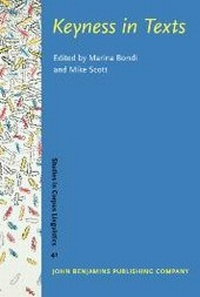
Keyness in Texts
1st Edition
Published on 11. November 2010
VI, 251 pages
978-90-272-8766-3 (ISBN)
Description

This is corpus linguistics with a text linguistic focus. The volume concerns lexical inequality, the fact that some words and phrases share the quality of being key - and thereby reflect or promote important themes - in some textual contexts, while others do not. The patterning of words which differ in their centrality to text meaning is of increasing interest to corpus linguistics. At the same time software resources are yielding increasingly more detailed ways of identifying and studying the linkages between key words and phrases in text databases. This volume brings together work from some of the leading researchers in this field. It presents thirteen studies organized in three sections, the first containing a series of studies exploring the nature of keyness itself, then a set of five studies looking at keyness in specific discourse contexts, and then three studies with an educational focus.
More details
Other editions
Additional editions
Marina Bondi | Mike Scott
Keyness in Texts
Book
11/2010
1st Edition
John Benjamins Publishing Co
€95.40
Shipment within 10-15 days
Persons
Content
- Keyness in Texts
- Editorial page
- Title page
- LCC data
- Table of contents
- Perspectives on keywords and keyness: An introduction
- 1. Keywords and keyness in language studies
- 2. The keyness metaphor in knowledge management:"Aboutness" as subject matter
- 3. The keyness metaphor and text interpretation:Subject matter and organization
- 4. Keyness in text and discourse: A sample analysis
- 5. Overview of the chapters
- References
- I. Exploring keyness
- Three concepts of keywords
- 1. Introduction
- 2. Part 1. Three concepts of keywords
- 2.1 Keywords sense 1 (Williams 1976/1983): Words and culture
- 2.2 Keywords sense 2 (Scott & Tribble 2006): Words and texts
- 2.3 Keywords sense 3 (Francis 1993): Phrases and schemas
- 3. Part 2: The dualism of agency and structure
- 3.1 Texts in society: Some very banal observations
- 3.2 Puzzles of social theory
- 4. Concluding comments
- Acknowledgements
- References
- Problems in investigating keyness, or clearing the undergrowth and marking out trails
- 1. Introduction
- 2. Colonists and prospectors
- 3. Issues
- 3.1 Machine and human KWS
- 4. Text section v. text v. corpus v. sub-corpus
- 5. Statistical issues
- 5.1 The farmer and his crops
- 6. Choosing a reference corpus
- 7. Related forms
- 8. Status of the KW
- 9. Shakespeare's KWs
- 9.1 Hamlet
- 9.2 DO in Othello
- 10. Conclusion
- References
- Closed-class keywords and corpus-driven discourse analysis
- 1. Introduction
- 2. Closed-class keywords as valid objects of analysis
- 3. Closed-class keywords as preferred objects of analysis
- 4. Conclusion
- References
- Appendix 1
- Hyperlinks: Keywords or key words?
- 1. Introduction
- 2. Statistical keywords and discourse topics
- 3. Hyperlinks: Cataphoric references - and key words?
- 4. Hyperlinks and keywords: A contrastive case study
- 5. Conclusions
- References
- Web Semantics vs the Semantic Web?
- 1. The ambitions and credibility of the Semantic Web
- 2. Habits of thought and current limits
- 2.1 Postulates for the representation of knowledge
- 2.2 Current debate
- 2.3 Ontologies and the Semantic Web
- 2.4 Requirements for linguistics
- 2.5 Abolishing text amnesia
- 3. Reconceptions
- 3.1 Dynamic elaboration
- 3.2 Textual knowledge
- 4. Proposals
- 4.1 Typology of keyness
- 4.2 Towards Web Semantics
- 4.3 The complexity of all data
- 4.4 Suspicious metadata
- References
- II. Keyness in specialised discourse
- Identifying aboutgrams in engineering texts
- 1. Introduction
- 2. Concgrams
- 3. From concgrams to aboutness and aboutgrams
- 4. Data
- 5. Analysis of data
- 6. Conclusions
- Acknowledgements
- References
- Keywords and phrases in political speeches
- 1. Introduction
- 2. Data and method
- 3. One million words vs five million words
- 3.1 The main concern of Tony Blair in 2005-2007?
- 4. Uncovering n-grams and concgrams
- 4.1 An issue, a challenge, a threat
- 5. Conclusions
- References
- Key words and key phrases in a corpus of travel writing
- 1. Introduction
- 2. Key words: Implications and other studies
- 3. The corpus
- 4. Method and findings
- 4.1 Key words in the travel corpus
- 4.2 Key-key words and associates
- 4.3 Key words and their contexts - Extended lexical units
- 4.4 Key phrases
- References
- History v. marketing: Keywords as a clue to disciplinary epistemology
- 1. Introduction
- 2. Materials and methods
- 3. Results
- 3.1 Self-representation across disciplines: We v. historians
- 3.2 Objects of the disciplines
- 3.3 Disciplinary procedures
- 4. Conclusions
- References
- Metaphorical keyness in specialised corpora
- 1. Introduction
- 2. Metaphor and textual meaning
- 2.1 Terminology note
- 2.2 Metaphors in text
- 3. Metaphors and corpora
- 3.1 Corpus composition
- 3.2 Locating metaphorical lexis
- 4. Metaphor themes and key metaphor themes
- 5. Conclusions
- References
- Appendix 1
- Appendix 2
- III. Critical and educational perspectives
- A contrastive analysis of keywords in newspaper articles on the "Kyoto Protocol"
- 1. Introduction
- 2. Materials and preliminary methods
- 3. Defining a keyword in news discourse
- 4. Semantic fields
- 5. Keywords
- 6. Conclusions
- References
- Keywords in Korean national consciousness
- 1. Introduction
- 2. Data
- 3. Findings
- 3.1 Frequency
- 3.2 The use of wuli (we, our)
- 3.3 The use of ilbon (Japan)
- 4. Conclusion
- References
- General spoken language and school language
- 1. Definition and purposes of the research project
- 2. Words for studying in a second language
- 3. CoMaS, a corpus of history textbooks
- 4. The Lexicon of Spoken Italian: LIP
- 5. Research questions and methodology
- 6. The key word-list
- 6.1 Framing the discourse: Time and transformation in historical narrative
- 6.2 Causality and interpretation of events
- 6.3 Noun phrases
- 6.4 "Aboutness"
- 7. Limitations of the study
- 8. Conclusions
- References
- Index
- The series Studies in Corpus Linguistics
